

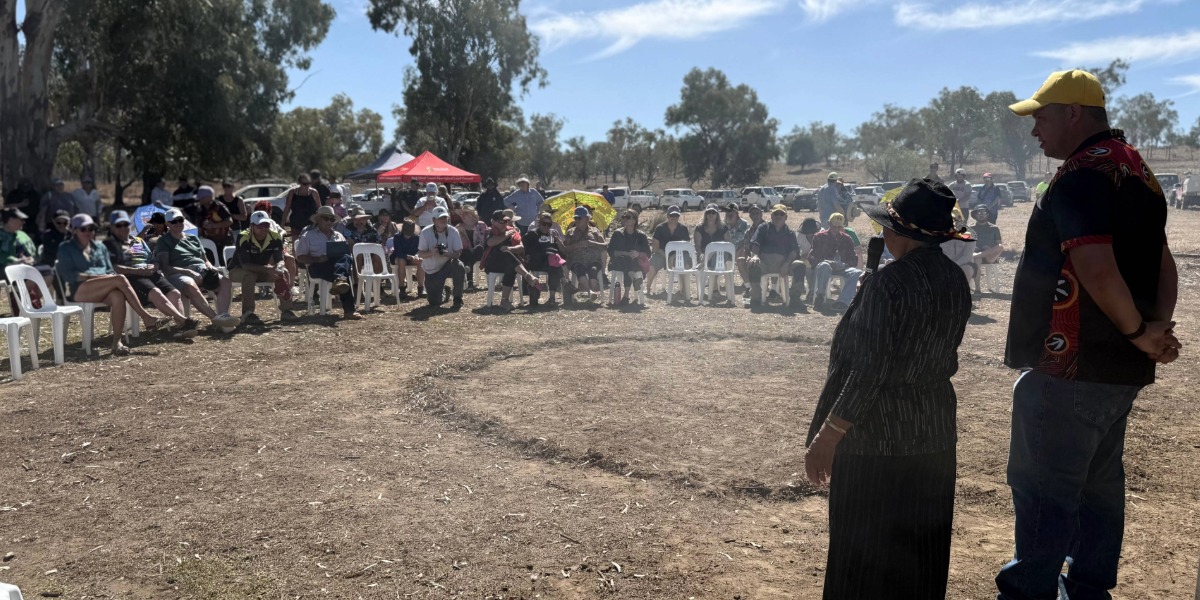
Borah Crossing near Manilla has officially been declared an Aboriginal Place, recognising generations of cultural, spiritual and historical connection for Gamilaroi/Gomeroi people.
The NSW Government announced the declaration this week, formally recognising the significance of the Namoi River site, which includes ceremonial grounds, burial sites, campsites, scarred trees and bora rings linked to continuous Aboriginal use over many generations.
Located along both sides of the Namoi River between Manilla and Gunnedah, Borah Crossing has long served as a gathering place for custodians and family groups, where people lived, shared knowledge, conducted ceremonies and raised families. Many descendants still living in the region today maintain close ties to the site and have ancestors buried there.
The declaration under the National Parks and Wildlife Act 1974 provides legal protection for the site’s cultural heritage while allowing continued public access for activities such as camping, swimming, fishing and birdwatching. Existing grazing and dam operations will also continue.
The NSW Government said it would work with the Yawiriawiri Murri Ganuur Descendants Aboriginal Corporation, the Tamworth Local Aboriginal Land Council, the Red Chief Local Aboriginal Land Council and other Gamilaroi families to develop a management plan protecting the site’s heritage values.
Uncle Greg Griffiths, from the Bulingha Murri Ganuur and Guyinbaraay/Guinberai clan groups, said the declaration carried deep personal meaning for descendants.
“We, the descendants of Yawirawiri Murri Ganuur and other family groups who were recorded at contact with first settlers and explorers, are overwhelmed with excitement and gratitude for the Aboriginal Place registration for Borah Crossing,” Uncle Greg said.
“We have ancestors who were born there, resided there and are buried there. My father always said to me, ‘Son don’t ever forget Borah Crossing’.”
“Now we have it registered which makes me feel that we have fulfilled a legacy and respected our ancestral wishes and memory.”
Uncle Peter White said the recognition would help secure the cultural future of Gamilaroi families connected to the site.
“The listing of Borah Crossing as an Aboriginal Place is profoundly important — not only for my family, but for the wider kinship ties that connect Gamilaroi families to this sacred site,” Uncle Peter said.
“I still remember my father first taking me there, and from that moment the deep, unbroken connection across generations became central to my identity as a Gamilaroi Murri.”
“This recognition means those ties will endure, ensuring our children and grandchildren inherit a strong Country, a strong culture, and strong families for generations to come. For us, it is nothing less than securing our cultural future.”
Heritage NSW Executive Director Sam Kidman said the declaration recognised the enduring connection of Gamilaroi people to Country.
“Borah Crossing is a place of profound cultural significance for Gamilaroi people,” Mr Kidman said.
“Recognising and protecting this landscape honours their enduring connection to Country and ensures these stories, places and histories will continue to be shared with future generations.”
Read all the way through to the end of the story? So did lots of other people. Advertise with New England Times to reach New England locals who are interested and engaged. Find out more here.