

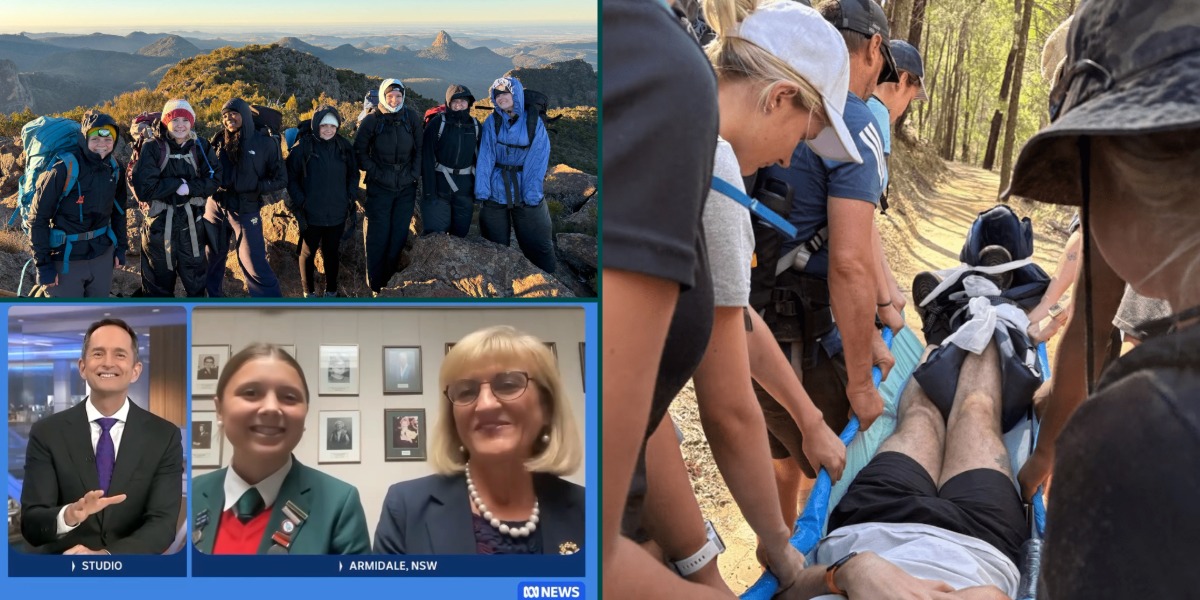
A group of students from Presbyterian Ladies’ College Armidale have been praised after carrying an injured hiker with a broken leg for hours through rugged bushland, after coming to his aid during a Duke of Edinburgh expedition in the Warrumbungle National Park last month.
The Year 11 students were on a four-day hike as part of their Duke of Edinburgh Gold Award when they came across Dubbo man Thomas Wendland, who had broken his leg after slipping on a steep section of track.
After initially passing the injured hiker, the group encountered him again a short distance later and realised he was unable to move safely on his own. Despite earlier help from others on the trail, including basic first aid and pain relief, he had made little progress and was in increasing pain.
Speaking to the ABC on Tuesday, student Stephanie Blake from Walcha said the seriousness of the situation quickly became clear.
“After our lunch he’d only progressed another 200 metres, so he was only able to hop,” she said.
“It became clear he was in a lot of pain and that the injury must have been pretty bad.
“We stepped in and decided to carry him out to a point that he’d be able to get help, which was about 4 kilometres.”
Using only the gear they had with them, the students constructed a makeshift stretcher, drawing on skills developed through their training.
“We decided to make a stretcher out of my hammock that I’d taken to sleep in,” Stephanie said.
An inflatable sleeping mat was used to stabilise the injury, creating a makeshift moon boot to limit movement in the broken leg.
What followed was a gruelling, almost two hour long effort as the group worked together to carry Mr Wendland along the narrow, uneven track, carefully navigating steps, inclines and rocky terrain.
“We would count down three seconds and then lift him up altogether, then walk for a short time, rest, and rotate,” she said.
“We were counting down the kilometres, and our fingers were definitely getting tired towards the end.”
Despite already being several days into their hike, the students carried the injured man for around two hours before reaching a point where National Parks staff could access the track and complete the evacuation.
“You don’t realise how far it is until you’re shuffling along carrying someone,” she said.
“At the start we were like, ‘How are we going to do this?’ and then the reality kicks in that we have to carry him that distance.”
The Duke of Edinburgh’s International Award is a globally recognised youth development program that encourages young people to build skills, undertake physical challenges, complete community service and participate in adventurous journeys. PLC principal Nicola Taylor said the rescue was a powerful demonstration of the value of hands-on outdoor education.
“I am exceptionally proud of the girls, but also of our adventurous journey leaders, Amanda and Marty Burney, who planned the program,” she said.
“They didn’t just step in and tell the girls what to do – they asked them to think, collaborate and work out how they were going to manage it.
“That developed their problem-solving skills and teamwork in a real situation.”
Ms Taylor said the students were given the choice to assist, knowing it would significantly extend their own journey, but all chose to help.
“It did add to the length of their hike, but they were all very willing to step in,” she said.
“It’s a culmination of years of preparation through the Duke of Edinburgh program, and they rose to the challenge.”
Mr Wendland said he knew immediately he had seriously injured himself and was unsure how he would get out.
“I heard it snap, I knew something wasn’t right,” he said.
“I was a little bit worried there for a while. My friend did everything she could, but we didn’t know what the next steps would be.”
He told the ABC the students and their teachers acted quickly and calmly in a situation that could have escalated.
“I felt quite useless while they all got it set up, but they were amazing,” he said.
For the students, the experience was physically demanding but ultimately rewarding, reinforcing the importance of practical, real-world skills.
“This isn’t a skill you can learn off a screen,” Stephanie said.
“You really have to get out there and do it.”
Like what you’re reading? Support New England Times by making a small contribution today and help us keep delivering local news paywall-free. Donate now