

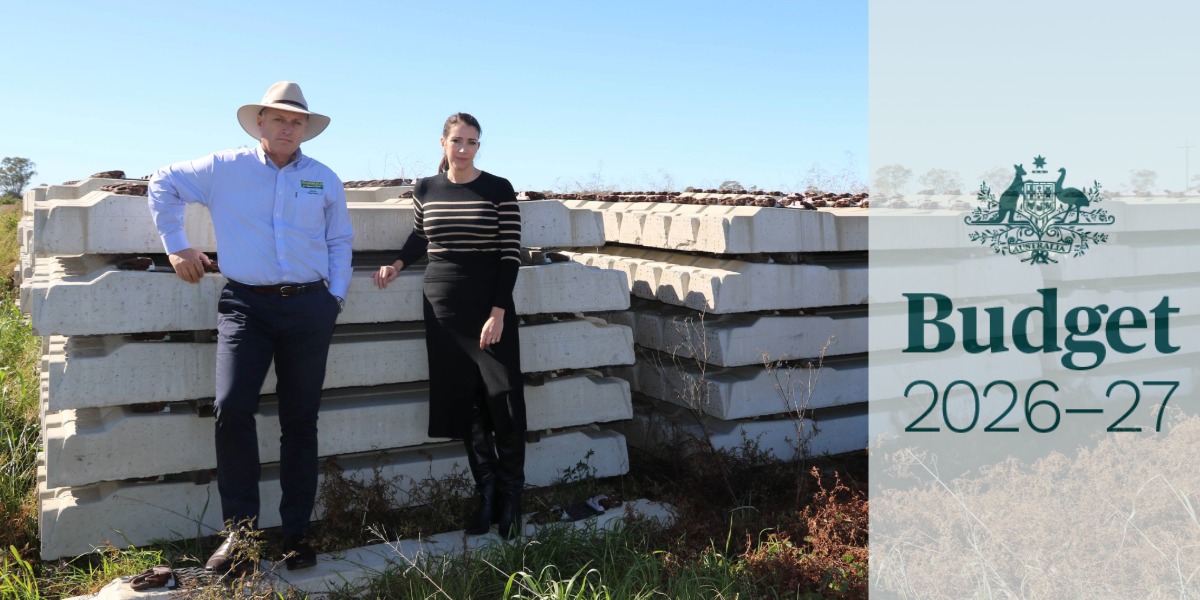
Communities across the New England are demanding clarity from the federal government after the decision to halt Inland Rail at Parkes, with councils, farmers and regional leaders warning the move has placed years of planning, investment and freight development into limbo.
The Albanese Government confirmed this week the multi-billion-dollar freight project would not proceed north of Parkes, despite significant work already completed between Narromine and North Star and years of planning tied to the corridor through Narrabri and Moree.
The decision has sparked growing concern over what happens next for major regional developments including the Moree Special Activation Precinct, the proposed Northern NSW Inland Port near Narrabri, and producers who had expected cheaper and more efficient freight access through the completed rail corridor.
‘An anxious wait’ in Moree
Moree Plains Mayor Susannah Pearse said the community was now waiting nervously to learn whether one final unfinished section through the shire would still proceed.
“This will be concerning for residents and businesses in the Moree Plains, who see the real benefit of moving produce from road to rail and have been huge supporters of the project,” Mayor Pearse said.
Mayor Pearse said only a 23-kilometre section remained incomplete in the Moree Plains.
“We currently have one 23km section awaiting completion,” she said.
“This section connects the two already constructed sections and provides the critical infrastructure to link our grain and fibre handling facilities to port.”
She said council had recently met with Inland Rail executives, who advised the remaining section had received all required approvals and was awaiting federal funding.
“A decision to not proceed with the 23km remaining section in the Moree Plains would not only leave our businesses and people behind, but also our $1bn of agricultural production per year,” Mayor Pearse said.
The mayor said the project was still economically important even without the full Melbourne-to-Brisbane route.
“It makes sense to move freight from road to rail,” she said.
“And when this 23km section is completed, our Shire can move our produce by rail, on higher grade track, to the port of Newcastle. We do not need the full Inland Rail to derive and deliver economic benefit.”
Mayor Pearse said the community would now wait for details in next week’s federal budget.
“It’s an anxious wait until then, but we remain hopeful,” she said.
Narrabri inland port plans clouded
In Narrabri, concerns are also growing about the future of projects tied directly to Inland Rail infrastructure.
Narrabri Shire Mayor Darrell Tiemens said council was deeply disappointed by the decision to withdraw funding for the northern sections of the project.
“Funding for this project was announced nearly 10 years ago right here in Narrabri,” Mayor Tiemens said.
“Billions of dollars have already been committed by businesses that would have played a role in its delivery and long-term operation. To walk away now represents an extraordinary waste of opportunity and investment.”
Narrabri Shire Council has already invested heavily in planning around Inland Rail, including purchasing 240 hectares of land earmarked for the proposed Northern NSW Inland Port.
Mayor Tiemens said Inland Rail had always been about more than simply moving freight.
“This project represented jobs, investment, freight efficiency, road safety and long-term economic growth for inland communities like ours,” he said.
“One of the original drivers behind Inland Rail was reducing heavy vehicle movements on our roads and lowering emissions through greater use of rail freight. Those benefits now appear far less achievable.”
The project had also been expected to create more than 450 local jobs while supporting regional businesses and future industry investment.
Mayor Tiemens said uncertainty around major infrastructure commitments made it difficult for regional communities planning for future growth.
“Regional Australia needs certainty, long-term vision and nation-building infrastructure,” he said.
“Communities like Narrabri are ready for growth, ready for investment and ready to contribute even more to the national economy. We cannot afford to keep shifting the goalposts on projects of this scale and significance.”
Farmers seek clarity
NSW Farmers President Xavier Martin said producers across regional NSW were now seeking answers about what would happen to existing infrastructure, easements and freight plans.
“NSW Farmers policy supported Inland Rail because moving freight more efficiently matters to farm businesses, regional communities, and the prosperity of the nation,” Mr Martin said.
“But governments can’t ask rural and regional communities to carry the burden of disruptive construction, then just change direction without accountability.”
Mr Martin said certainty was critical for producers who had already adjusted operations around the project.
“Certainty matters, and if the funding is stopping at Parkes then the government must be upfront about what happens next, because real people and real businesses have already paid a price,” he said.
“We need the Minister to tell us what this means north of Parkes, for those easements already acquired, and the already-constructed assets that are now stranded.”
Mr Martin questioned how the government intended to improve regional freight capacity without Inland Rail.
“How does the government plan to genuinely invest in the future of rural and regional businesses without this major linkage, and will they work with the states to deliver this funding into improving the existing regional rail freight network, rather than a wasteful redistribution of taxpayers’ money?” he said.
Nationals escalate criticism
Federal Member for Parkes Jamie Chaffey said the decision had effectively stranded already completed rail infrastructure.
“More than 160km of upgraded track between Narrabri and North Star – which has been completed and operational since 2023 – is now a spur to nowhere, disconnected at both ends and generating no commercial value,” Mr Chaffey said.
He said the move would lock “200,000 truck movements each year onto regional roads”.
Mr Chaffey also accused the federal government of abandoning long-promised regional investment.
“In 2011, Albanese called this project ‘central’ to lifting Australia’s productivity. Now, he is abandoning it and abandoning regional Australia,” he said.
Mr Chaffey said the Coalition would continue pushing for the project to be reinstated.
“The Coalition demands a full public accounting of every dollar wasted on this cancellation — including sunk costs, termination payments and stranded asset write-offs,” he said.
Member for Northern Tablelands Brendan Moylan said the decision by Labor to effectively abandon the northern extension of Inland Rail is a devastating blow to Moree and the wider region.
“This is a project that was meant to transform freight efficiency, unlock investment, and support agricultural producers, yet Mr Albanese and his Labor mates have now walked away from delivering it in full,” Mr Moylan said.
“This will add to the growing uncertainty around the Moree Special Activation Precinct, which was also sold to the community on the promise of jobs, connectivity and long-term regional growth,” he said.
NSW Nationals Deputy Leader and Shadow Minister for Western NSW Kevin Anderson said the decision to abandon this project is a disaster for regional and Western NSW.
“Federal Labor are robbing our regions, particularly Western NSW, to pay Victoria, because the Minns Labor Government doesn’t have a long-term plan for infrastructure in NSW,” Mr Anderson said.
Shadow Minister for Regional Transport and Roads Paul Toole did not mince his words, saying Federal and State Labor have a track record of stripping projects that futureproof regional NSW.
“If it’s not jobs or infrastructure for Sydney, Newcastle or Wollongong, Labor don’t care,” Mr
Toole said.
Got something you want to say about this story? Have your say on our opinion and comment hub, New England Times Engage