

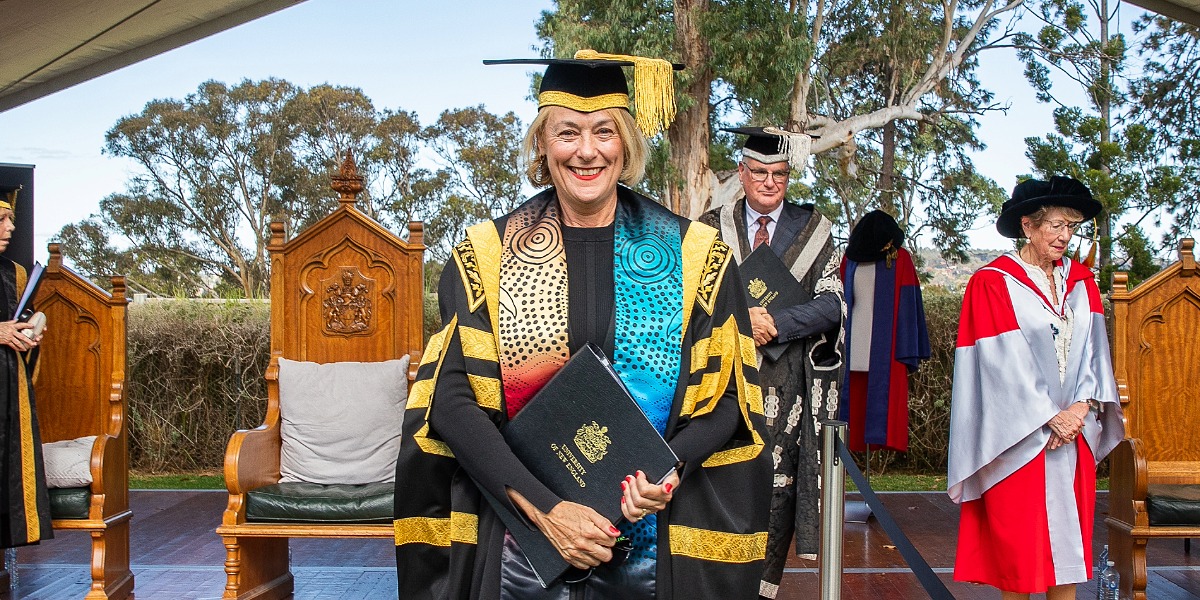
The University of New England has begun the hunt for a new chancellor after Dr Sarah Pearson resigned from the role last month.
The local institution announced the change in a public statement on 3 June, saying Dr Pearson needed to step down for family reasons, and Deputy Chancellor David van Aanholt will serve as Acting Chancellor.
Dr Pearson’s tenure as chancellor was relatively short, but Vice-Chancellor and CEO of UNE, Professor Chris Moran said she had left a mark on the university’s community engagement and connection with students during her time in the role.
“Our Chancellor, Sarah Pearson, had begun to build a really positive momentum, and so we’ll lose some of that leadership momentum,” Professor Moran said.
“Dr Pearson had a strong, positive, bright personality, and so again, we will miss that face of the university.”
Professor Moran said Mr van Aanholt’s long history with the university would provide stability during the transition.
“We have a wonderful acting chancellor who has significant investment in the University for a long period of time. David’s role is giving us full continuity.”
“There’s no gap of continuity of governance, and the process of leadership,” he said.
Under the University of New England Act 1993 (NSW), council-elected chancellors typically serve five-year terms unless they resign earlier. A sitting chancellor must give the council 12 months’ notice before the end of their term, but Dr Pearson’s departure has triggered an earlier process.
The Chancellor Selection Committee, a temporary committee of the UNE Council, is now responsible for finding a suitable candidate. The committee will recommend a candidate to the Council, which has final say on the appointment. Under section 8 of the Act, most Council members, including the chancellor, must be external to UNE’s internal community, and the new chancellor does not need to be a current Council member.
Professor Moran said finding the right person will not be straightforward.
“I think what is extremely important is finding someone with that sense of care. One of the challenges is, where are those leaders today?”
Professor Moran outlined a rough timeline for the process, though the final date will depend on when a chosen candidate is available to start.
“We’ve got an acting chancellor in place for six months from the period of departure of the previous chancellor,” he said.
“Then, you go through a search period, and a setup process of about a month or so, and 6 weeks of active searching and then you get a short list. Then the question is once you’ve chosen someone, when are they available to start?”
For students, the change in leadership carries different weight depending on their course and how closely it intersects with university governance. Medical student Fleur Steen said the resignation raised questions about the university’s direction, even if it was unlikely to disrupt day-to-day study.
“When someone in a position like chancellor leaves unexpectedly, there can be questions about what happens to those plans and who will take the university forward from here,” Ms Steen said.
“While I don’t expect it to have a major effect on students’ day-to-day studies, leadership changes at that level can shape the long-term direction of the university.”
Zoology student Jet Frost said the resignation was unlikely to affect their studies directly, but flagged a broader concern about what might have prompted it.
“While the Chancellor does play an important role in governance of the University, as a Zoology student who does not work for the institute, it will not affect my education very much,” Frost said.
“My only concern is if this is a sign of more serious issues in the leadership of the University.”
Professor Moran said students and staff would have a direct say in shaping the criteria for the next chancellor, as they did during the last selection process.
“We like to have input from the members of our community, so last time around, we asked their statement or preference priority against the selection criteria of the staff,” he said.
“We will be doing that for staff and students this time, so as we begin to interact with people we’re able to articulate to them how the staff and students see the priorities against the criteria.”
This story was written by UNE student and aspiring journalist Baxter Fuge.
Something going on in your part of the New England people should know about? Let us know by emailing newsdesk@netimes.com.au