
A local mother’s warning that she and her 22-year-old daughter could die without access to subsidised prescription medicines, posted to Facebook this week, is the tip of the iceberg for growing community alarm over a One Nation policy that health advocates say threatens the system that keeps medications affordable for millions of Australians.
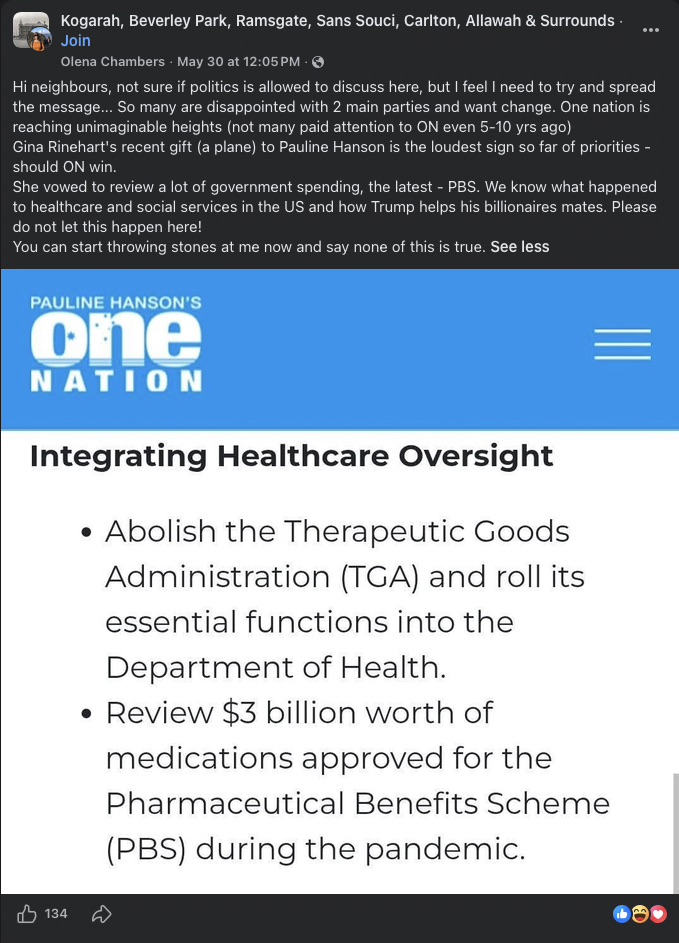
The heightened prominence and polling of One Nation in recent weeks has prompted many to take a closer look at the party’s policy. While most of the policy statements would charitably be called a paragraph, two dot points in a more substantive policy on government waste has prompted a wave of concern from patients and health groups, which has started to increase dramatically since Senator Hanson’s Press Club address on June 17.
Robyn Smith posted a direct appeal to One Nation supporters in a Guyra community Facebook group this week, urging them to examine the party’s position on the Pharmaceutical Benefits Scheme (PBS).
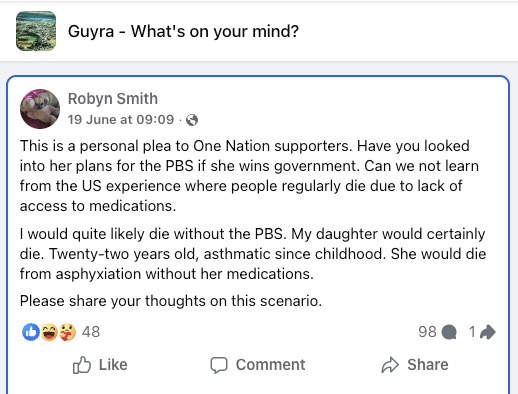
“This is a personal plea to One Nation supporters. Have you looked into her plans for the PBS if she wins government,” Ms Smith wrote.
“Can we not learn from the US experience where people regularly die due to lack of access to medications.”
Buried under the heading “Integrating Healthcare Oversight” in One Nation’s plan to slash $90 billion in government spending are two proposals: abolish the Therapeutic Goods Administration (TGA) and “review $3 billion worth of medications approved for the Pharmaceutical Benefits Scheme (PBS) during the pandemic.”
Senator Hanson gave the measures little attention in her National Press Club address, saying only that 46 per cent of Australians cannot afford prescription medicine and “this is unacceptable to me and my Party.”
Ms Smith said the stakes for her own family were stark.
“I would quite likely die without the PBS. My daughter would certainly die.”
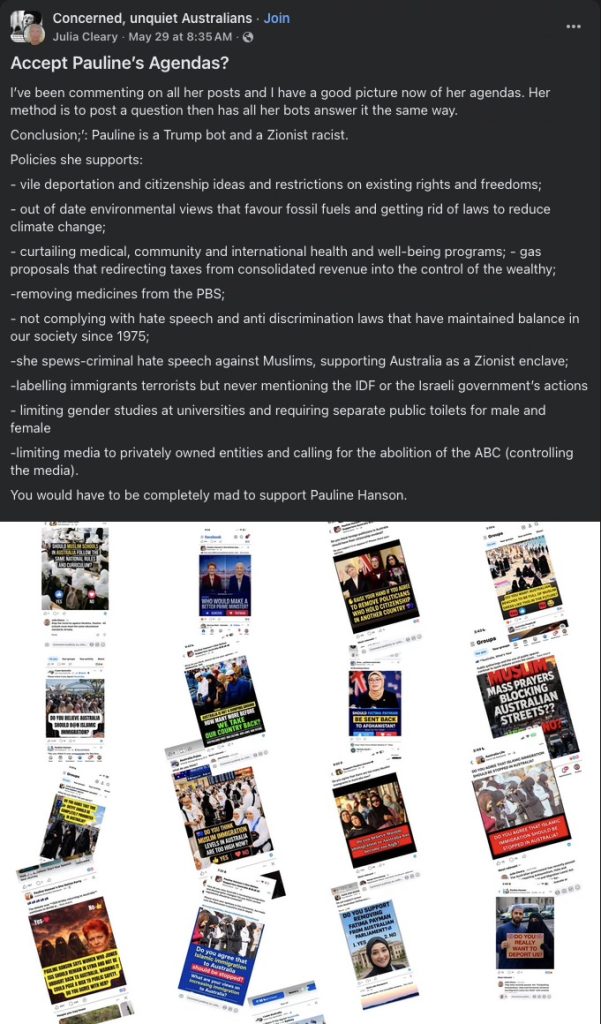
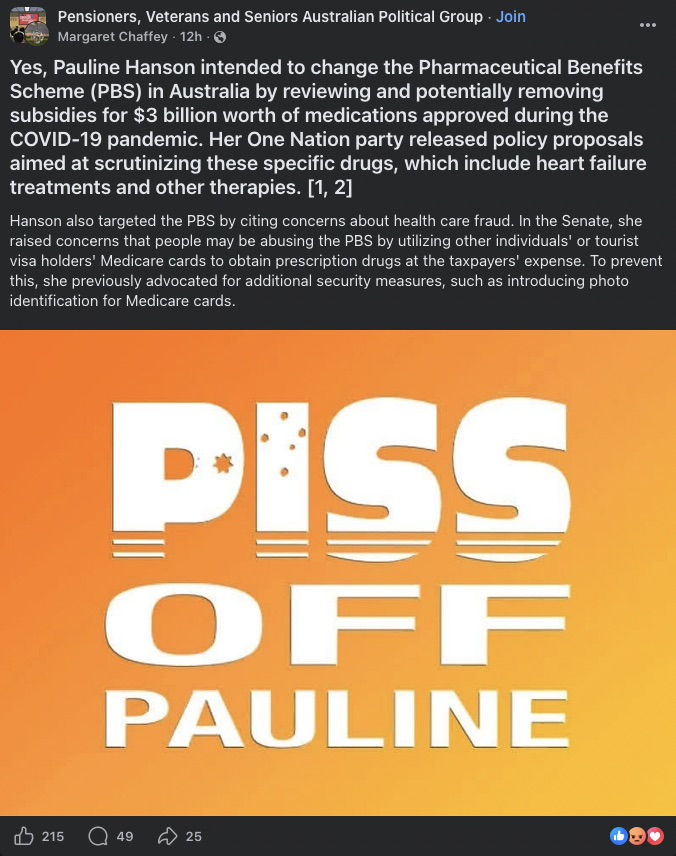
While there was some initial concern about the policy from Labor campaigning before the last election, and some of that content is now being rebroadcast, the fresh wave of concern appears to be authentic and not centrally directed by any group or organisation. The reaction appears in a very genuine grassroots rebellion to the politician and her party, threatening their support base which is largely founded on the same low information, high fear, discussion groups on Facebook where the concern is being most strongly ventilated.
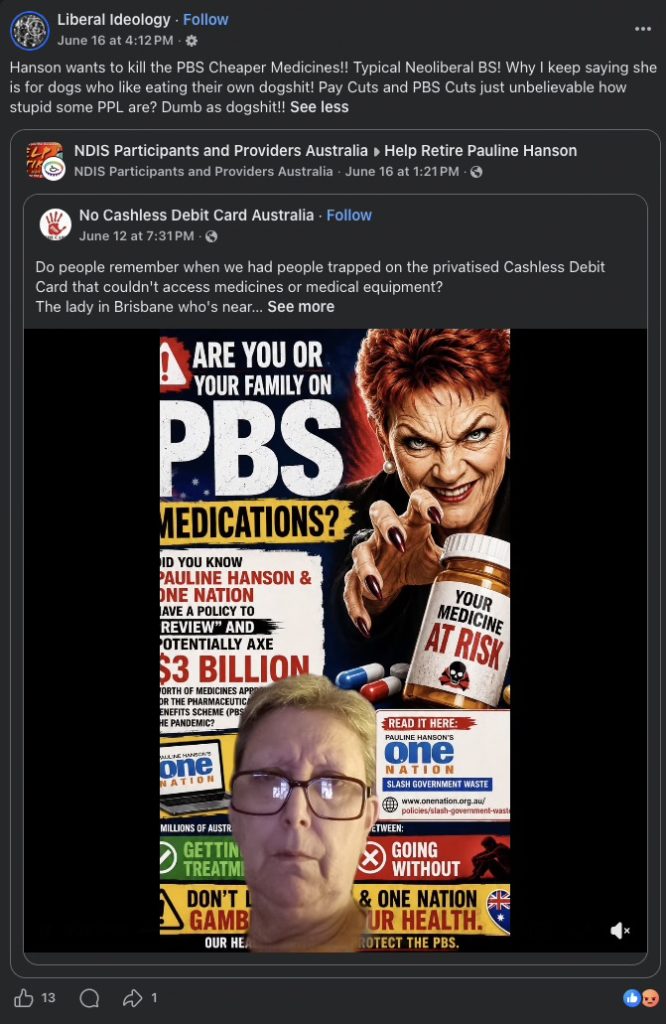
There is also now a petition against the policy, posted this week on Change.org at change.org/p/pauline-hanson-hands-off-our-pbs.
The seemingly organic petition (that lacks a clear call to action indicative of more professional operations) asks for Senator Hanson to identify which medications she intends to target, which illnesses she considers worthy of subsidised medication, and how much more Australians will have to pay for medications after the review.
What are the TGA and PBS?
At the most simplistic level, the Therapeutic Goods Administration or TGA is Australia’s medicines regulator. It determines if a medicine is safe and effective, and allows it to be prescribed by doctors.
The Pharmaceutical Benefits Scheme or PBS is a separate process where the Federal Government decides if they want to pay for the medicine, that they then provide at a set price to you at the local pharmacy.
So the TGA says you can have it, PBS makes it so you can afford it. One is about science. The other is about money.
While the TGA sits within the Department of Health, it exercises independent regulatory powers under the Therapeutic Goods Act 1989, meaning it operates at arm’s length from other departmental functions. The TGA assess all new medications and, after testing that they are safe and do what they claim to do, lists them on the Australian Therapeutic Goods Register or ARTG. Unless there is a special exemption, therapeutic goods not in the ARTG cannot be supplied in Australia.
Megan Brodie, publisher of MedNews, a specialist publication covering the medicines industry, said that the TGA is highly respected, with a history dating back to 1963.
“The TGA is one of the world’s most respected regulators, charged with ensuring therapeutic products for human use that are marketed in Australia are both safe and effective,” Brodie said.
The PBS is the federal program that subsidises the cost of prescription medicines for Australians. Without it, many medications would cost patients hundreds or thousands of dollars per script. Medicines are assessed by the Pharmaceutical Benefits Advisory Committee (PBAC), a body of doctors, health economists and other specialists, before being listed for subsidy by the federal government.
Felicity McNeill, Chair of Better Access Australia, a national advocacy body that campaigns for better and more affordable access to medications, said the separation between the TGA’s independent regulatory role, and the Department of Health managed PBS subsidy function, was critical.
“Maintaining a separate process and decision-making capacity for regulation versus subsidisation is an important governance principle,” Ms McNeill said.
“This delineation gives the community confidence that registration of medicines, vaccines, devices and diagnostics in Australia are independent of any other factors or influence, including whether the Government wants to pay for the technology.”
She also said there are opportunities to simplify the process, particularly to reduce delay – currently it can take two years or longer from the time the TGA registers something on the ARTG, to the time the government lists it on the PBS and makes it affordable for people to use.
“Too many patients are missing out on essential treatments or technology to manage chronic disease or life-threatening illnesses with the time from ARTG registration to subsidy in Australia now over two years for medicines and significantly longer for devices and diagnostics,” she said.
“And those timeframes are growing.”
One Nation, or Malcolm Roberts?
Like most small parties, One Nation policies are generally poorly written, provide little detail, and appear to be the personal thoughts of certain individuals, rather than the result of a well researched and collaborative policy development process common to more substantial political parties.
This item is a good example of that, with these two dot points in a government waste policy which has been on their website since at least February 2025. There is nothing about the PBS or TGA in the three sentence long Health policy, or the vague Covid 19 policy. The position is also arguably contradictory with the two sentence long Medicinal Cannabis policy, given Cannabidiol products for children with epilepsy is one of the medicines listed on the PBS in the frame the party intends to “review”.
The rest of the government waste policy reads like a wish list of the One Nation Senator for Queensland, Malcolm Roberts, who frequently speaks on the need to abolish whole departments or withdraw from international bodies like the UN, and is prone to promoting discredited claims and more extreme ideas. The TGA has been a recurring target for Roberts, particularly since the pandemic, who has asked 83 Questions on Notice in Senate Estimates about Covid vaccines and therapeutics.
Brodie says that despite Senator Hanson’s brief public comments on prescription medicine affordability, the targeting of PBS Covid expenditure and the TGA suggests One Nation’s position aligns closely with Senator Roberts, “who is highly sceptical when it comes both to the pharmaceutical industry and to the benefits innovative medicines provide, especially vaccines.”
“The PBS does not fund Covid vaccines but did fund antivirals for Covid. Listed in early 2022, Pfizer’s PAXLOVID and MSD’s LAGEVRIO raked in a combined $1.2 billion in PBS revenue in their first 18 months on the scheme, although neither is now listed on the PBS,” she said.
“Other medicines listed on the PBS during Covid for non-Covid indications were recommended by the PBAC as per the usual process, and delisting them would deny patients access and likely cause a public outcry.”
McNeill says the One Nation proposal to review $3 billion in PBS medicines listed during the pandemic misrepresents how the scheme works, as the figure largely reflected structural changes to the scheme, not pandemic-era excess spending.
“A large portion of the increase in spending on the PBS since 2020 are price increases negotiated by the generics sector for over 2,500 brands of off-patent medicines that were previously priced at less than $4,” she said.
Subsidy rates had also risen because of changes to the concessional safety net threshold and a reduction in the general co-payment, Ms McNeill said, not because of new medicine listings. She said many new medicines are not listed on the PBS as the Government has cut investment in new treatments.
“As the 2024-25 PBS Expenditure and Review report highlighted, both PBS and private script volumes are growing each year, but the net value of the PBS is diminishing, in particular the Government’s investment in new medicines.”
She also strongly argues that the concern should be with what is not listed on the PBS, rather than those medications which were listed during the pandemic.
“It was not the $3B of listings on the PBS during the pandemic that are of concern to the
community, it was the $3B of listings they could not and perhaps still cannot gain access to on the PBS today,” she said.
“Not just treatments for cancer, but treatments for chronic and acute diseases, like migraine, eczema, diabetes and shingles which without proper treatment impact health, productivity and general quality of life.”
Ms McNeill said she hoped One Nation would redirect its focus.
“That is what Better Access Australia hopes One Nation will focus on: better and faster access to quality healthcare, from cradle to grave, from primary to acute care, from very remote Australia to the city CBD.”
Got something you want to say about this story? Have your say on our opinion and comment hub, New England Times Engage