

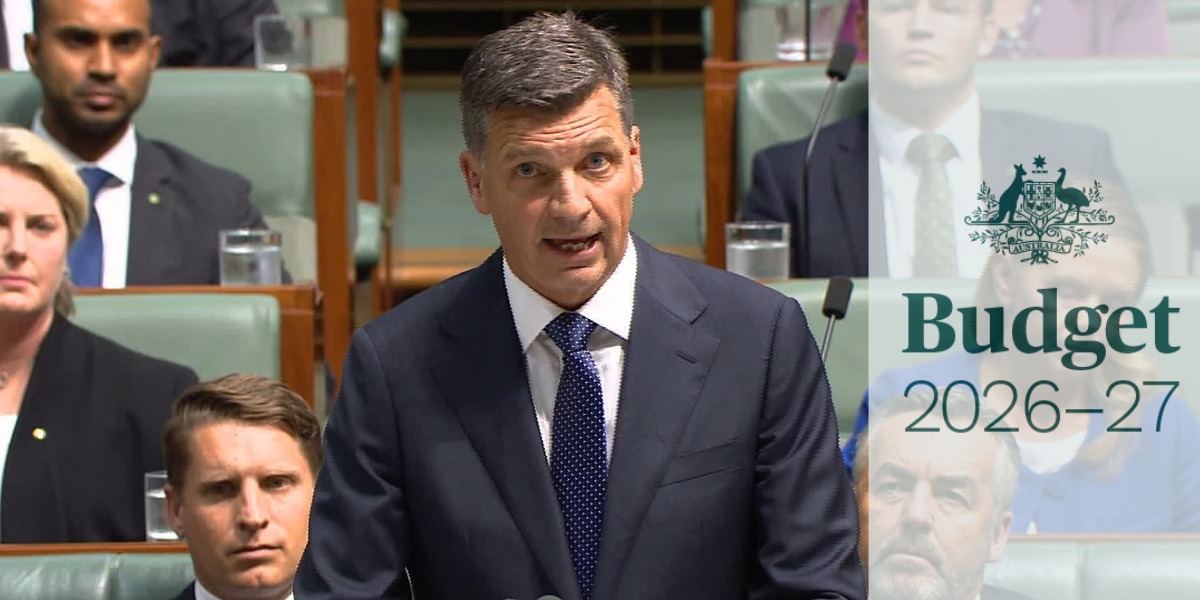
Opposition Leader Angus Taylor has used his first budget reply speech to launch what appears to be the Coalition’s opening pitch for the next federal election campaign, but critics say the address exposed a party that is increasingly out of touch, short on policy detail, and mimicking One Nation rhetoric rather than presenting itself as a credible alternative government.
The speech also appears to confirm that Australia is heading into an unusually long federal election campaign cycle. With the earliest possible date for a normal combined House and Senate election falling on August 7, 2027, and Prime Minister Anthony Albanese widely expected to prefer governing closer to the maximum term, Australia could now face almost two full years of continuous election positioning before the latest possible date of May 20, 2028.
Not ready to govern
The speech raised big questions about whether the Coalition’s ranks have been too severely depleted for them to be able to govern, with gaping holes in the proposals signifying a lack of work.
While tax bracket indexation was pitched as “generational tax reform”, economists and political observers quickly noted the policy would not fully commence until years into the future, with limited immediate relief for households currently struggling under inflation and rising living costs.
Under the proposal, the bottom two tax brackets would be indexed from 2028/29, while higher brackets would not be indexed until 2031/32.
Mr Taylor claimed the policy would eventually leave workers about $1000 better off annually after four years.
“This is generational tax reform. It’s fair, simple and honest,” he said.
However, critics argued the speech failed to engage meaningfully with the structural economic issues facing Australia, particularly regional workforce shortages, productivity concerns, and the growing gap between housing demand and construction capacity.
Housing Minister Clare O’Neil accused the Coalition of presenting “un-costed nonsense”.
“Instead of real answers to these problems, what they got was un-costed nonsense that won’t build a single home or pay a single bill,” she said.
Regions forgotten in a speech that clearly did not consult Nationals
Despite Mr Taylor’s agricultural background and long association with regional Australia, the speech displayed many of the same metropolitan blind spots that were criticised in Treasurer Jim Chalmers’ budget speech earlier in the week.
Inland Rail received just a single mention in the entire budget reply speech, seemingly as an afterthought, despite the federal government’s recent decision to terminate the project north of Parkes triggering widespread anger across regional NSW and Queensland and being the National’s leading issue with the budget.
Mr Taylor offered no substantial argument for reinstating the northern sections of the project, nor any detail on how the Coalition would address the freight, logistics and economic consequences of the cancellation for inland regional communities.
Additionally, the Coalition’s proposed “Future Generations Fund” announced in the speech is also city biased. Under the proposal, 80 cents in every dollar of resource tax revenues above forecast would be funnelled into the fund, with just 25 per cent earmarked for regional Australis – despite 35 per cent of Australia’s population living in regional Australia, and effectively all of the nation’s mining and resource tax revenues being generated in regional Australia.
“Mass Migration” rhetoric over substance
While the traditional Budget Reply speech was framed around cost-of-living pressures, tax reform and housing affordability, much of the political focus quickly shifted to Mr Taylor’s rhetoric on migration.
The Opposition Leader repeatedly used the term “mass migration” throughout the speech, despite the phrase having no formal policy definition or statistical meaning. The term is used in populist right wing political campaigns as a fear-based framing device around migration levels rather than as a recognised economic or demographic measure.
Critics also noted Mr Taylor appeared to repeatedly conflate or confuse migration and immigration despite the terms meaning different things. Immigration refers specifically to people moving permanently to Australia, while migration figures include a far broader range of temporary and permanent movements.
Mr Taylor promised sweeping cuts to immigration, tying future intake levels to housing construction, while also pledging to restrict welfare access for future permanent residents, such as th
“This much I promise: the coalition will deliver one of the biggest cuts to immigration in Australian history,” Mr Taylor told parliament.
However, the Coalition’s own policy framework appeared to reveal significant confusion about the migration figures being discussed.
The proposed cap is, however, on Net Overseas Migration, a figure that cannot be directly controlled by visa approvals or otherwise in the manner proposed because it measures the net movement of people in and out of Australia over a 12 month period, including Australians leaving the country and Australians returning home.
Net Overseas Migration also includes temporary visa holders such as students and workers, making it fundamentally different to the permanent migration program set annually by government.
Taylor also borrowed heavily from the anti-migration rhetoric long championed by Pauline Hanson and One Nation.
One Nation MP Barnaby Joyce openly acknowledged the overlap, saying Mr Taylor was effectively reading from his party’s playbook.
“I’d never seen the coalition pushed further to the right on immigration,” Mr Joyce told the ABC.
The comments have intensified concerns that the Coalition is eroding its own political identity by attempting to outflank One Nation on migration and culture-war issues rather than developing a distinct economic vision.
Migrant advocates also condemned the speech, accusing the Opposition Leader of relying on fear-based political messaging.
Asylum Seeker Resource Centre deputy chief executive Jana Favero described the comments as “inflammatory and desperate”.
“The fact that he feels the need to dog-whistle about mass deportations of so-called ‘overstayers’ … shows they are far more interested in stoking fear than delivering serious policy solutions,” she said.
Ms O’Neil argued the strategy was politically flawed as well as economically simplistic.
“You can’t out One Nation, One Nation… if people like what Pauline Hanson is putting down, they’re going to vote for them, not you,” she said.
Cutting migration also not in the interest of the regions
The Coalition’s migration crackdown rhetoric also landed awkwardly against simultaneous evidence emerging from regional Australia that skilled migrants are increasingly critical to keeping country communities and industries functioning.
Agricultural groups appearing before a parliamentary inquiry this week warned that anti-migration rhetoric risked undermining regional economies already struggling with severe labour shortages.
Submissions from farming and industry organisations highlighted the extent to which regional Australia now depends on overseas workers to sustain industries, schools, businesses and local communities.
The National Farmers’ Federation argued that maintaining a sustainable workforce was more important than where workers originated from.
“Skilled migrants often brought valuable international expertise and perspectives,” the federation said.
“Passing on their culture and values can only be of benefit to communities in regional Australia.”
The dairy industry also warned that migrants were essential to maintaining production, with more than 40 per cent of dairy operations hiring overseas workers in 2024.
Agricultural groups argued migrants were not displacing Australian workers, but filling critical shortages that domestic labour markets have failed to address for years.
The Australian Meat Industry Council said overseas workers were also essential to maintaining food security and fresh produce supply chains.
“Improved understanding would help shift the narrative from a narrow focus on numbers to an appreciation of who migrants are, what skills they bring, and how they keep regional Australia working,” the council said.
Got something you want to say about this story? Have your say on our opinion and comment hub, New England Times Engage