

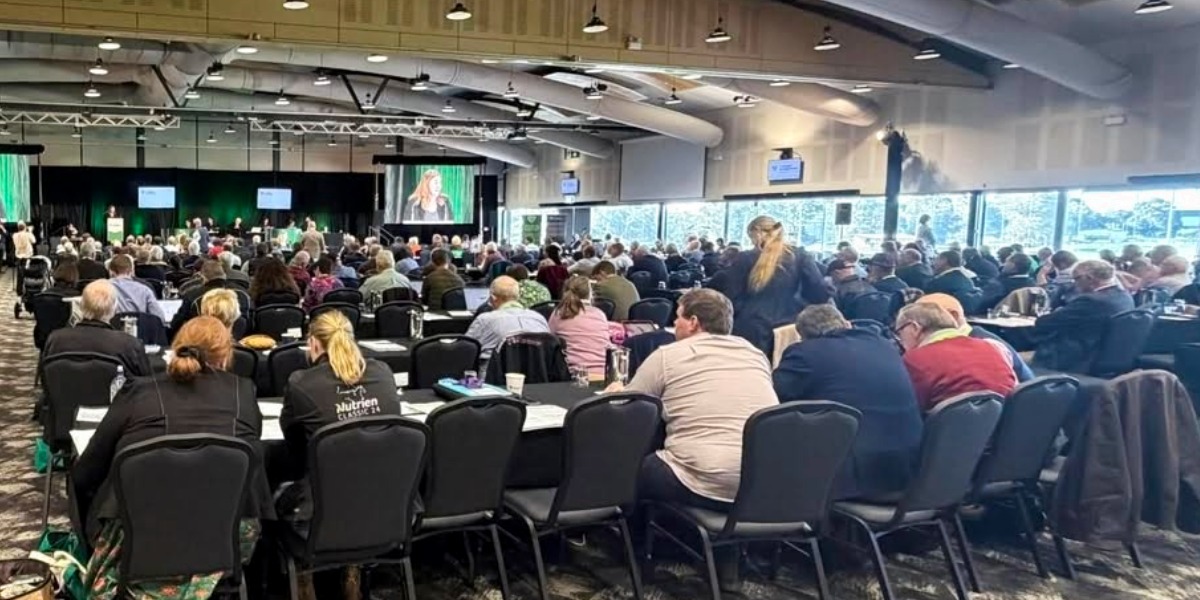
Debate on the land use conflict between farming and renewable energy development has been intense for a number of years at NSW Farmers Annual General Conference. But a noticeable shift in the debate towards more nuance, and an increasing number of voices willing to speak against anti-renewables motions, indicates that a tipping point on the issue is getting closer.
Outgoing president Xavier Martin set a unmistakable anti-renewables tone in his opening address, describing renewable energy developments as a threat and appealing to delegates to stop calling wind and solar projects “farms”.
“Please help me to convert these solar and wind industrial complexes to just that. Not farms. They are never farms.”
“Farms produce healthy plants and healthy animals, and solar complexes and wind complexes do not do that. And I refuse to call them farms,” Mr Martin said.
But he was to be disappointed, with few following his lead on the language. And most of the debating points were not about renewable developments themselves – instead, motion after motion took aim at who pays for the rollout, where the transmission lines go, access to water, and other peripheral matters. Very few tried to argue that wind and solar had no place in our future.
The New England featured heavily in the debate. Armidale branch delegate Tony Menkens, a prominent anti-renewables campaigner, moved a motion calling for the New England Renewable Energy Zone to be cut from eight gigawatts to three, a policy remarkably identical to the Coalition’s election pledge announced last month.
“The crux of this motion is the reduction in the planned New England renewable energy zone from eight gigawatts to three gigawatts of delivered generation electricity into the grid,” Mr Menkens told conference, seemingly making the common error of mixing up the concepts of network transmission capacity (planned for 8GW) and generation capacity (11GW forecast from projects in the development pipeline).
For Mr Menkens, the vote to scale back the New England zone was about more than gigawatts.
“I want to look my grandkids in the eye to say I stood up for agriculture and gave them an opportunity to farm on the New England. That’s why I’m here.”
James Jackson, of the Guyra branch, seconded the motion, saying three gigawatts still represented a serious commitment from the region,
“Three gigawatts is a lot of capacity. It’s a lot of panels. It’s a lot of wind turbines,” Dr Jackson said, also apparently confusing transmission and generation capacity.
Walcha Branch’s Carnie Kermode, one of the Walcha High Country Guardians group, moved a separate motion asking Energy Co to reassess transmission infrastructure requirements, claiming the recently released ISP showed “a sharp fall” in forecast generation capacity for the New England zone.
“Current investor interest is near non-existent,” she claimed, echoing similar discredited claims made by Coalition politicians in recent weeks.
“So effectively, it is a $20 billion investment to nowhere,” Ms Kermode said.
Carnie’s husband Daniel also moved a motion from the Walcha Branch opposing compulsory acquisition of freehold land for transmission lines, after the proposed route through the district was “changed with little warning to landholders”.
“Imagine waking up tomorrow to discover that government has decided to place transmission corridor straight through your property, not around it, through it, your home, your business, your family’s future,” Mr Kermode said.
“If New South Wales farmers cannot stand united on defending freehold land from compulsory acquisition, who will?”
Others had issues with this motion, and the risks of trying to take away compulsory acquisition as a last resort action for Government to ensure major projects can go ahead. Rather than being put straight to a vote, that motion was referred to committee for further legal advice.
A Dubbo branch motion to end taxpayer subsidies for large-scale renewable developments on productive farmland prompted one of the more pointed exchanges of the conference. Moving it, Shane Kilby said public money underwriting renewable projects was distorting land values and squeezing farmers off productive country.
“If the government wants Western New South Wales to power the state, they must guarantee the long-term survival of farming families,” Ms Kilby said.
Speaking in favour, Danica Lees, of the Tambar Springs/Gunnedah branch, was at pains to separate opposition to subsidies from opposition to renewables.
“These motions have come from branches who, over the years, have been willing to work with renewable energy proponents in their area and have been ignored, overrun,” Ms Lees said.
“Their well-founded, evidence-based concerns are being completely ignored. So that is why these motions are coming through, not to make us anti-renewable, but to make people sit up and listen.”
A near-identical Tottenham branch motion, later amended to apply specifically to new large-scale projects, drew the same argument from executive councillor Floyd Legge.
“It’s not opposing renewables at all. It’s ceasing subsidies, underwritten and financial support,” Mr Legge said.
“We’re not against having renewable energy. We’re just against using taxpayers’ money to bankroll everything,” Martin Honner agreed.
Not every delegate agreed subsidies were the problem. Warrumbungle branch’s Angus Atkinson said he could not support a motion he believed trampled on landholders’ right to strike their own deals.
“I’m unsure why this organisation thinks that I don’t have the right to manage my land,” Mr Atkinson said.
Moree branch delegate Oscar Pearse went further, arguing renewable generation could directly benefit farm businesses through agrivoltaics, where livestock graze beneath solar panels.
“There’s a lot of work on this that shows big productivity gains for the landholders, so you’re getting paid for hosting the solar facility, but you’re also getting productive increase,” Mr Pearse said.
Uralla branch’s Justin Hoad questioned where power would come from if every region kept rejecting projects.
“Last year, we pushed it out of Dungowan and out of the hills at Tamworth. This year we want to get it out of Walcha.”
“We just keep telling the government we don’t want it. We need some people in the room to say where’s it going to go,” Mr Hoad said.
Both the Dubbo and Tottenham subsidy motions were carried, along with a further Armidale motion for a broader renewable energy development framework which delegates noted was largely calling for things that were already happening. A Gundagai motion on financial penalties for breaches of landholder agreements also passed.
In the end, despite the nuanced and forthright debate, every renewable energy and transmission motion put to conference was carried, bar the Walcha compulsory acquisition motion, which was referred to committee.
Incoming president Bec Reardon signalled the association would keep up the fight, but wanted to change how it was fought, including making much better use of social media and working with other like-minded organisations.
“Farmers here are being smashed today by increasing prices, by increased regulation, by erosion of our rights to farm,” Ms Reardon said.
“We’re really fighting for our livelihoods against misinformation, against ideologies, and against a lot of politicians and decision makers who really do not understand what it is we actually do.”
And importantly, she wants farmers to come to the debate with solutions.
“We need to get really solutions focused. Policy at the end of the day should be shaped by farmers. It shouldn’t be shaped by bureaucrats and then imposed upon farmers.”
Got something you want to say about this story? Have your say on our opinion and comment hub, New England Times Engage