

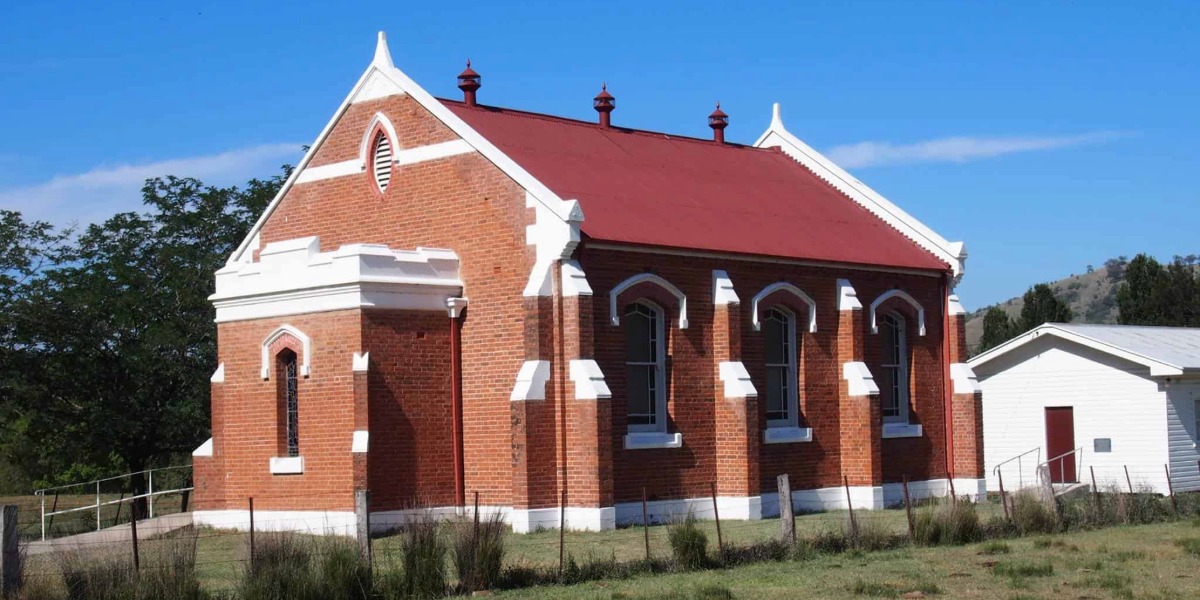
The New England REZ transmission line will obviously affect some views, but the most impacted will be the small community at Rouchel in the Upper Hunter, according to the project’s environmental impact statement (EIS). All four of the highest visual impact ratings are near Rouchel Brook, and the most concern is for the small but well loved Rouchel Uniting Church.
Rouchel is 30 kilometres south-east of Scone and has a population of around 150 people.
The Upper Hunter carries “pretty much the same amount of alignment” as Walcha, EnergyCo Deputy Project Director Julian Watson said.
Across the whole route, the EIS finds the effect on landscape character is generally low to very low. Three of its 10 landscape zones are rated moderate. Of 57 private receivers within the visual study area, 54 had a line of sight to the project. After a detailed assessment with photomontages, nine were rated moderate or high.
“All 4 receivers with a high visual impact rating are located in the vicinity of Rouchel Brook, including the Rouchel Uniting Church,” the EIS stated.
The church is the focus in Rouchel. Residents asked EnergyCo to move the corridor as far west as possible, preferably back to the previous corridor, because of its closeness to homes, the church, and the communities of Rouchel Brook and Upper Rouchel, the EIS states. EnergyCo says they looked at several alternative alignments, but they can’t move the line much further.
“The EIS project area maximises distances to dwellings,” the EIS stated.
The small church still holds services every second Sunday. The towers would be clearly visible from the road outside it. Screen planting will be offered to cut the view from the church itself, and the EIS rates the impact as low once it grows.
The EIS predicts a low noise impact at the church during vegetation clearing and intensive foundation work. It expects those works would not run for long, because the land nearby is mostly cleared farmland.
Noise is also felt around Rouchel. A laydown area on Albano Road at Rouchel Brook would push noise above the construction limit at up to five homes. At Camp 2 on Waverley Road, Waverly, one home would be highly noise affected.
In the New England, the only public viewpoint rated moderate is on Niangala Road, 17 kilometres south-west of Walcha. The road crosses the line twice in a 50km stretch. The EIS states continuous screening is not practical. It proposes keeping roadside trees and planting only where it is safe.
Noise is a bigger issue near Tamworth. The Nemingha maintenance facility has the largest count of construction noise exceedances in the EIS table for camps, ancillary sites, and the facility. In the intensive scenario, 86 homes would exceed the limit by up to 10 decibels, 39 by 11 to 20 decibels, and eight by more than 20. Four would be highly noise affected. Higher limits already apply there because of road traffic noise.
Once the line is running, 48 homes are predicted to exceed the night-time noise limit in light rain or mist. That noise is known as corona noise – a buzzing or hissing sound that comes from electrical discharge around the wires. After feasible mitigation, the EIS rates the remaining impact as significant at 10 homes, moderate at 15, and negligible at 23. It states that options to cut the noise are limited because the wires sit high above the ground.
Other construction effects are smaller. Peak traffic would lift noise by more than 2 decibels on every local road, and at 111 homes it would exceed the road noise criteria. In a worst case, 21 homes would fall within the distance for possible cosmetic damage from vibration. Smaller equipment would cut that to two. Heavy-lift helicopters would work only between Nundle State Forest and Sargeants Gap Road, and between Rouchel Road and Hunter Road.
Near horse studs along Waverley Road and Timor Crawney Road, towers “may appear visually dominant in close proximity”, the EIS stated. It concludes the overall character of the horse industry landscape would not change.
Detail on Camp 3 and on tower changes near Rouchel Brook is due in a Submissions Report or Amendment Report. EnergyCo is exploring moving towers and cutting their height near the church. The EIS says work on the design there is continuing, with limits.
“Continued refinement of the reference design is being undertaken to seek to further reduce visual impacts in this area where practicable, however, design constraints related to topography, watercourse and road crossings and biosecurity considerations are limiting,” the EIS stated.
Like all matters in the EIS, there may still be changes as part of the planning process. Consultations are now underway, and Rouchel is on of the centres to get a local session.
EnergyCo Information Sessions
- Walcha: Tuesday, 27 October, 12pm to 3pm, Walcha Vet Supplies
- Kentucky: Wednesday, 28 October, 3pm to 6pm, Kentucky Memorial Hall
- Gundy: Monday, 2 November, 3pm to 6pm, Gundy Soldiers’ Memorial Hall
- Rouchel: Wednesday, 4 November, 3pm to 6pm, Rouchel School of Arts Hall
- Scone: Thursday, 5 November, 3pm to 6pm, Scone Motor Inn Conference Centre
- Muswellbrook: Friday, 6 November, 11am to 2pm, Muswellbrook Library Seminar Room
- Walcha: Monday, 9 November, 4pm to 6pm, Walcha Central School Hall
- Uralla: Tuesday, 10 November, 3pm to 6pm, Uralla Courthouse
- Armidale: Wednesday, 11 November, 3pm to 6pm, Armidale Town Hall
- Tamworth: Thursday, 12 November, 12pm to 2pm, Tamworth Community Event Centre
Submissions on the EIS close on Thursday, 12 November. The EIS and the Biodiversity Development Assessment Report are on the NSW Planning Portal.
Read our other coverage of the New England REZ Transmission Line EIS
Note: AI was used in the development of this story. Read our AI policy.
Like what you’re reading? Support New England Times by making a small contribution today and help us keep delivering local news paywall-free. Donate now