

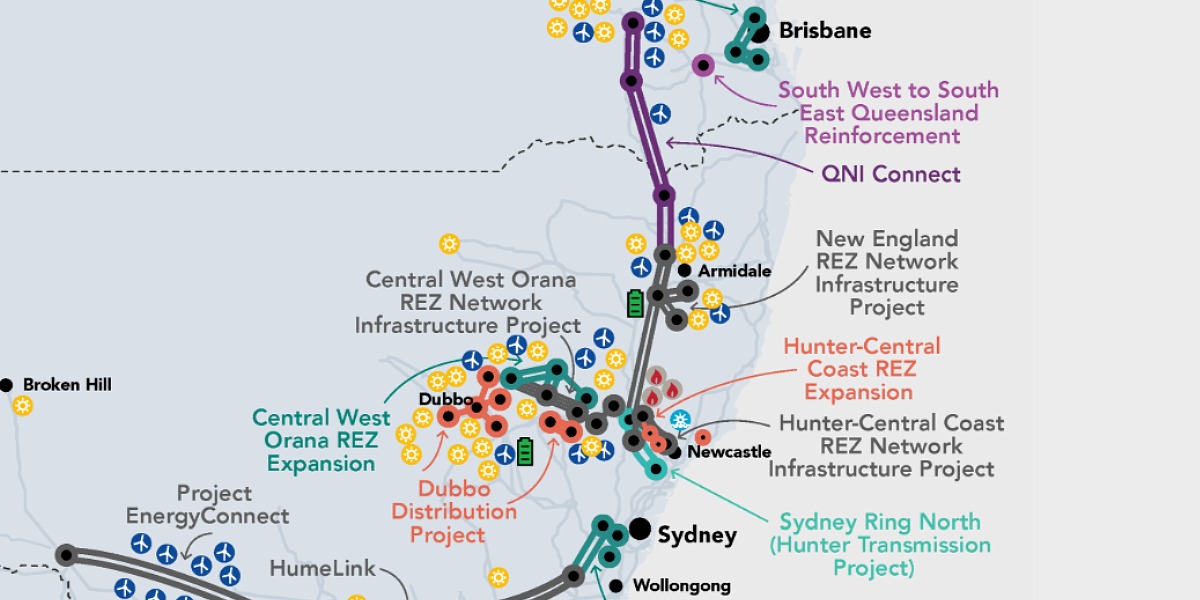
The New England Renewable Energy Zone has been upgraded in Australia’s national energy roadmap from ‘actionable’ to ‘anticipated’, as the country’s electricity market operator released its most comprehensive long-term plan yet for replacing coal with renewables backed by storage and transmission.
The Australian Energy Market Operator released its 2026 Integrated System Plan on Thursday, setting out the least-cost path for the National Electricity Market through to 2050.
New England on track for 2034 delivery with bigger capacity
The New England REZ Network Infrastructure Project is identified in the plan as a key part of Australia’s energy future. The 692km long new transmission line, including two 500 kV double-circuit transmission lines and associated 330 kV circuits connecting Bayswater and the New England REZ, is a key part of the system, essential for the New England REZ to become fully operational.
The ISP now identifies a projected capacity of grid-scale solar and wind energy production (including existing, committed, and anticipated projects) in the New England REZ of 11GW, more than the intended network capacity of 8GW. The expanded Central-West Orana REZ is now forecast to provide a capacity of 14GW, overtaking the New England as the state’s largest REZ.
The Queensland – New South Wales Interconnector (QNI Connect), which will provide for New England generated power to be supplied north to Queensland, has been reduced from ‘actionable’ to ‘future’ due to a reduction in the assumed flexibility of Queensland coal generators and incorporate newly committed and anticipated batteries in the modelling, and is unlikely to significantly progress for the next decade.
The timing for completion of the transmission line and full operation of the New England REZ has not changed from 2034.
Consumers driving better than anticipated energy transition
The ISP was shaped by close to 2,000 stakeholders and more than 300 submissions over two years, and tested around 1,000 different combinations of generation, storage, network and consumer investments across three future scenarios.
“The 2026 ISP brings together extensive stakeholder input and models hundreds of system-wide investment combinations against future scenarios, identifying the least-cost path for the National Electricity Market,” said AEMO CEO Daniel Westerman.
“Over the forecast period, Australia’s ageing coal-fired power stations will close while electricity consumption is forecast to nearly double.”
“At the same time, consumers are continuing to invest in rooftop solar and home batteries, which benefits all consumers by reducing the need for grid-scale investment,” he said.
Renewables are now generating nearly half of Australia’s electricity. In the last financial year, 45% of electricity in the National Electricity Market came from renewable sources. Already, 34 gigawatts of grid-scale renewables and storage are operating nationally, with a further 67 gigawatts in development.
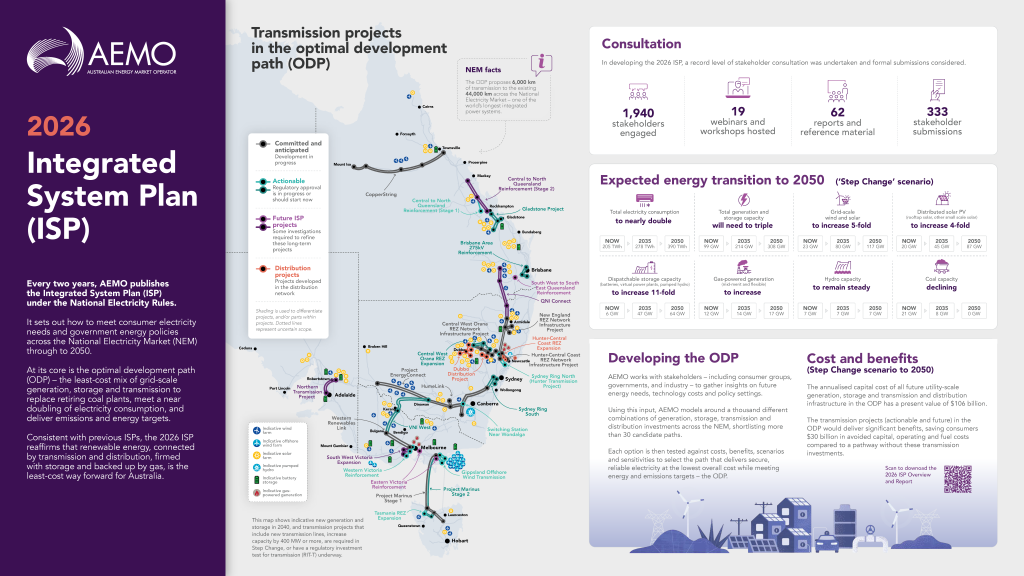
Households are driving a significant part of that shift. Around 36% of detached and semi-detached homes now carry rooftop solar, and approximately 600,000 households have home batteries installed. The ISP projects that rooftop solar will quadruple by 2050, with small-scale solar and batteries forecast to meet almost all residential needs in the decades ahead.
Clean Energy Council Chief Executive Officer Jackie Trad said the scale of demand growth ahead made the task clear.
“AEMO’s 2026 Integrated System Plan shows electricity demand across the National Electricity Market is set to nearly double by 2050 as data centres come online alongside the electrification of mining and manufacturing,” Ms Trad said.
“At the same time, ageing coal plants like Callide C are becoming less reliable and will retire over the next decade. To replace them and meet rising demand, Australia needs to roughly triple its build of large-scale renewable generation and storage. That’s what keeps the system reliable and keeps a lid on costs as coal leaves.
“Households are already part of the solution. Rooftop solar is set to quadruple by 2050 and home batteries are taking off. But that investment only pays off for everyone if the grid can actually use it.”
Transmission network critical for optimal delivery
The ISP’s optimal development path requires expanding the national transmission network by around 14%, or 6,000 kilometres of new lines. Under the Step Change scenario, the plan involves around $106 billion in annualised capital investment to 2050 in today’s dollars. Transmission accounts for around $6 billion of that upfront cost but is projected to save consumers $30 billion in avoided capital, operating and fuel costs compared to a pathway without those investments.
“Transmission is a relatively small share of overall system investment but delivers substantial benefits for consumers by unlocking lower-cost energy across the National Electricity Market,” Mr Westerman said.
“Delivering these transmission projects without delay is critical, as the need and consumer benefits are clear.”
Jackie Trad agreed, saying the improved transmission delivers billions.
“That’s where transmission comes in. Building the 6,000 kilometres of new transmission in the plan would save consumers $30 billion,” she said.
The ISP’s emphasis on transmission as essential infrastructure sits in sharp contrast to a commitment made by the NSW Coalition on Wednesday to scrap the 500-kilovolt transmission line from Walcha to Bayswater — the line the New England REZ depends on to carry power generated in the region to the grid.
The plan’s release also follows the federal government’s announcement on Wednesday of 15 large-scale battery projects funded under the Capacity Investment Scheme, including the Gelston Energy Park near McCully’s Gap, outside Muswellbrook. Developed by Ascera Energy, the Gelston Energy Park will deliver 400 megawatts of storage capacity with a four-hour duration, equivalent to 1,600 megawatt-hours. Collectively, the 15 batteries announced Wednesday will power 3.7 million Australian households.
“Australia’s energy transition requires a whole-of-system approach, one that maximises value from generation, storage and transmission with the growing contribution of homes and businesses through rooftop solar, batteries and more flexible energy use,” Mr Westerman said.
Trad said the plan is clear, the job now is to build it at a pace to replace coal generation in an orderly manner.
“Right now, there’s a gap between projects being financed, getting built, and connecting to the grid. Closing that gap and getting transmission moving is what stands between this plan and lower, more reliable power for Australian homes and businesses,” she said.
The 2026 ISP report is available at aemo.com.au.
Got something you want to say about this story? Have your say on our opinion and comment hub, New England Times Engage