

The New England region has been described as an ideal place to demonstrate the growing importance of One Health, with experts warning that climate change, pollution, disease and environmental pressures are increasingly linking the health of people, animals and the environment.
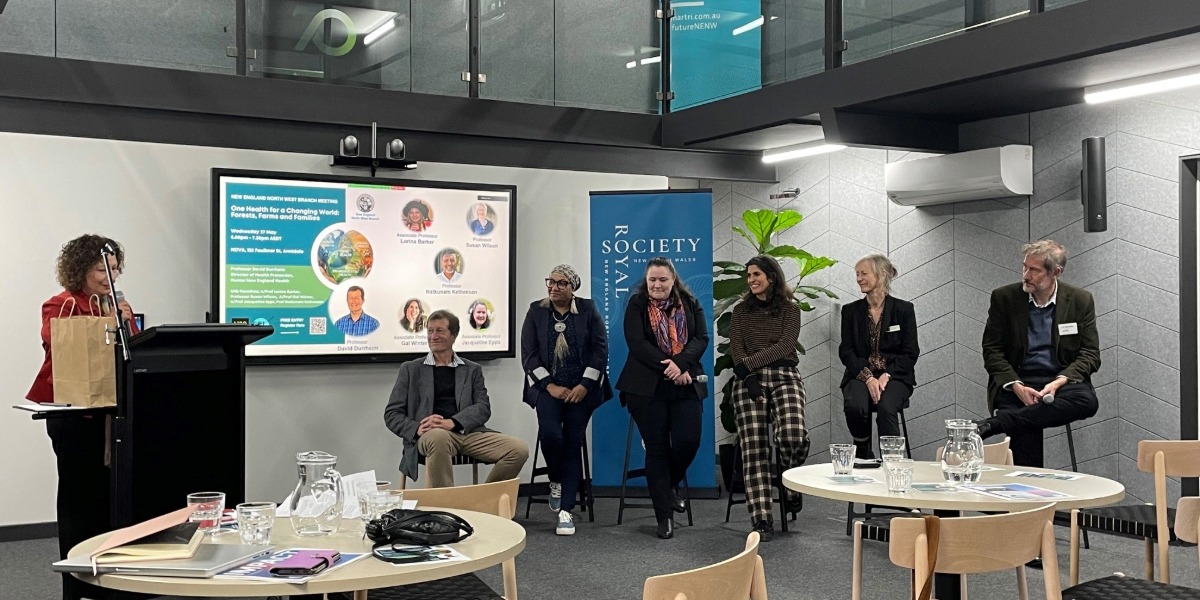
Researchers, health professionals and community leaders gathered in Armidale for the One Health for a Changing World: Forests, Farms and Families forum, hosted by the New England North West Branch of the Royal Society of New South Wales at the UNE Smart Region Incubator.
Keynote speaker Professor David Durrheim, Director of Health Protection with Hunter New England Health, said the Hunter New England region provided a strong example of why collaborative approaches to health were becoming more important.
He said the area’s close interactions between communities, agriculture, wildlife, horses, feral animals and changing environmental conditions made it uniquely suited to demonstrating One Health principles in practice.
“When we bring in the best resources from each other’s fields, then we do these things much better,” Professor Durrheim said.
“We realised that if we were going to have functional relationships to respond to outbreaks, we needed to have ongoing relationships with people.”
Professor Durrheim said the region’s One Health network had already improved outbreak response, surveillance, policy review and cross-disciplinary research.
“One shouldn’t kill a regional One Health network by bureaucracy,” he said.
“There’s something about keeping this organic that actually does work.”
The forum explored how science, public health, environmental management and First Nations knowledge could work together to address emerging challenges.
Associate Professor Lorina Baker said Aboriginal knowledge systems had long recognised the deep relationship between people and Country.
“If you look after Country, Country will look after you,” Associate Professor Baker said.
“Everything we do is relational. To understand the continent that we live in is to understand our songlines.”
She said First Nations communities should be included as part of future solutions.
“If we are invited, and we are part of the discussion, we can also be part of the solutions,” she said.
UNE environmental pollution researcher Professor Sue Wilson warned pollutants such as microplastics and PFAS were now being detected across ecosystems and human populations.
“Plastics are the most wonderful and terrible invention,” Professor Wilson said.
She said scientists were still trying to understand the long-term impacts of microplastics, which are now found in air, water, soils, agricultural systems and human bodies.
“We can’t talk about One Health without talking about pollutants and the cross-disciplinary nature of us all having to talk together,” she said.
Associate Professor Gal Winter said antimicrobial resistance also highlighted the growing overlap between environmental, agricultural and human health issues.
“Imagine a world where you can’t use antibiotics, where a paper cut can be fatal,” Associate Professor Winter said.
Rural GP academic Associate Professor Jackie Epps warned regional communities could face increasing risks from leptospirosis, a bacterial disease spread through infected animals, floodwater and contaminated soil.
“That gap between who is at risk and who actually knows about leptospirosis is what we need to close,” Associate Professor Epps said.
“Leptospirosis is, in every sense, a disease at the intersection between animals, the environment and people. It is the quintessential One Health disease.”
UNE Smart Region Incubator Director Professor Cameron Turner said effective research depended on collaboration with communities.
“Rather than doing things for people, or doing things to people, we need to do things with people,” Professor Turner said.
Got something you want to say about this story? Have your say on our opinion and comment hub, New England Times Engage