

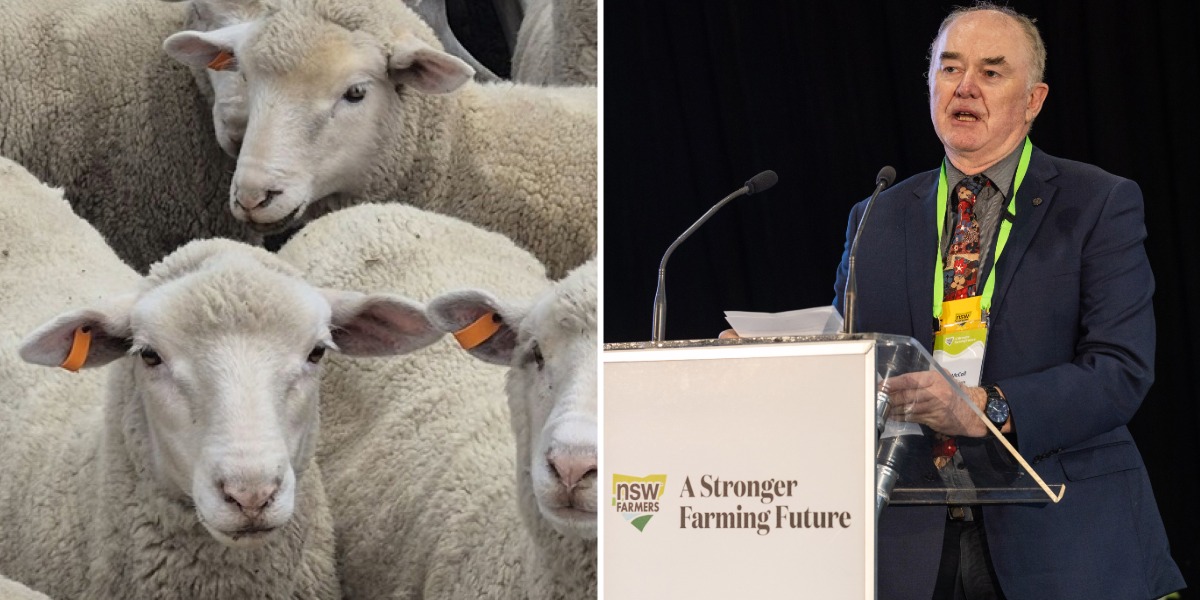
A motion that was not in the conference compendium sparked one of the more intense debates at last week’s NSW Farmers Annual Conference, when producers moved to strip Meat & Livestock Australia (MLA) of responsibility for the industry’s livestock tracability database upgrade, wanting the job to go to an independent contractor instead.
The motion, moved by NSW Farmers Board Director Ian McColl and seconded by Executive Council member Floyd Legge, called for the NSW Government to push back the compulsory date for individual electronic identification (eID) tagging of sheep and farmed goats from 1 January 2027 to 1 January 2029, and for an independent entity, engaged by the federal government, to design, roll out and oversee the database upgrade instead of MLA’s Integrity Systems Company (ISC).
“We are calling on the NSW Government to push the date back to January 2029,” Mr McColl said.
“To date, NSW Farmers has provided in principle support for a individual traceability system, but only if certain conditions were met; that it’s affordable, workable and backed by fit-for-purpose NLIS database.
“However, there have been delays to the critical NLIS Uplift Project, and producers continue to express wide-ranging frustrations with the ISC delivery and transparency.”
Complicating producers’ trust in the system is a significant corporate change that saw the loss of an independent board overseeing the traceability system. MLA managing director Michael Crowley confirmed to Sheep Central in May that ISC, established in 2016 as an MLA subsidiary to run the industry’s traceability, food safety and animal welfare programs including the NLIS, was being folded into MLA as a core business unit under a single operating model, after operating independently for some years.
ISC’s two independent directors, Dr Kat Giles and Belinda Vassallo, appointed in 2023, finished up in March this year. Mr Crowley said there would be no changes to existing ISC programs or committees below board level, and producers would see no difference.
“It’s business as usual,” Mr Crowley said.
“There will be a continued focus on the high-integrity programs, traceability, livestock assurance and engagement that ISC is renowned for, under the ongoing leadership of Jo Quigley,” he said.
The National Livestock Identification System, or NLIS, already tracks Australia’s cattle herd and is being upgraded to handle individual electronic records for the country’s roughly 60 million sheep. Electronic tagging is essential for accessing international markets, and helps producers capture better data on meat quality, from carcass feedback to animal health reporting.
As wool producers often breed and keep their animals on the one property for their entire lives, there has been much stronger resistance in the sheep industry to compulsory electronic tagging than in the cattle sector. On the floor of conference, Mr Legge told delegates the association’s Sheep Meat Committee had been trying to work constructively with ISC for years.
“The reality is, the Sheep Meat Committee has been proactively working with ISC for many years, trying to deliver a product and a database that is fit for producer purpose,” Mr Legge said.
“But they just don’t seem to be listening to our concerns and our constructive feedback.”
“ISC offered stakeholders little more than lip service, failed to deliver competently, and left consequences of a system failure,” Mr Legge said.
“We have tolerated this ineptitude for too long. It’s now time to take control of the future biosecurity product delivery, usability, and accountability of this critical system.”
The Federal Government awarded ISC $22.5 million in September 2023 to upgrade the NLIS database so it could handle the extra workload, followed by a further $3.9 million in February 2025 to help industry and governments transition to the upgraded system. Separately, the Commonwealth committed also $20 million over three years from 2022-23 for eID implementation nationally, $19 million of which went to state and territory governments.
Mr Legge said NSW Farmers had tried engaging ISC at least twice a year to flag problems, without success.
“We’ve had a meeting with the software designers a couple of years ago, and the feeling out of that room was, finally, we’ve got to the people that actually understand the architecture behind a database,” he said.
“The board people just wrote things down, and nothing happened.”
A few months ago, ISC cancelled its contract with a service provider it had worked with for about two years, and said it would seek a new supplier to deliver the database upgrade that was supposed to be finished last month. That development that prompted Mr Legge to push the no-confidence motion through committee over the past year.
“Sheep traceability is simply inventory management,” Mr Legge said.
“Billions of packages a year are traced all around the world. You’ve got 60 million individual units that you’ve got to trace around Australia. It’s not that difficult in my mind for the system to work.”
MLA’s General Manager of Integrity Systems, Jo Quigley, said the project had run into unexpected complexity.
“Integrity Systems’ focus is on delivering a world-leading, reliable and trusted NLIS 2.0 database,” Ms Quigley said. “This involved extensive testing and review, a process that has identified a number of complexities, that needed to be worked through before delivery.”
Ms Quigley said the complexities included transaction volume, regulatory demands and complicated workflows, and confirmed ISC had changed vendors “to ensure we remain on track to deliver value for industry, meet all our requirements and objectives, and implement NLIS 2.0 efficiently.”
She said nothing would functionally change for farmers in the meantime.
“Nothing changes in the current system. It continues to perform well and will remain active until NLIS 2.0 goes live,” Ms Quigley said.
MLA did not provide an indicative date of when NLIS 2.0 would go live.
“We continue to invest in infrastructure, security, and resilience upgrades for the current database. It is comfortably managing more than 50 million sheep and goat devices,” she said.
Back on the conference floor, producers were less than confident. A second motion pushed the fight further, with Wilcannia Whitecliffs Branch delegate Phil Holmden moving a policy motion, AIL05, restating a series of caveats attached to the industry’s in-principle support for eID, and arguing that support should be withdrawn if the caveats were not met. The motion was amended on the floor to align the compulsory start date with the earlier motion, pushing it from January 2028 to January 2029.
Sheep Meat Committee Chair Andrew Mullins, of Narrabri, seconded the motion, telling conference the industry’s patience had run out.
“So what are we talking, half a decade ago? When we, as an association, came to agreement with the government that we would support them to introduce the EID, it came with a whole heap of caveats,” Mr Mullins said.
“They haven’t met the caveats. We’ve basically relisted the caveats and said, now that you haven’t achieved what we needed, we’re going to oppose it until you achieve what we needed, instead of we’re going to support you as long as we’ve done these things.”
“They failed. Now we oppose it until they come to us and fix it.”
Mr Legge argued against the motion, telling conference the sector needed to keep negotiating rather than walk away.
“In politics, you’ve got to be pragmatic. You can’t generally take an all or nothing approach,” Mr Legge said.
Guyra’s James Jackson spoke in favour, pointing to a report he said showed the tag technology chosen for the rollout could cost the industry far more than the alternative.
“There is a lot of problems with this program,” Mr Jackson told conference. “The report essentially said that if they’d taken on the UHF technology, they would have had dollar tags or even cheaper.
“Those low-frequency tags are a very, very expensive option. The cost of these tags over 20 years is going to cost 1.4 billion dollars more than UHF tags.”
Both motions were carried.
As well as reinstating the eID tag discount scheme, Mr McColl said other measures, such as eID tag free pathways for sheep moving from property of birth direct to slaughter, must be delivered if the scheme was to succeed.
Mr Legge said one compromise option gaining support within the Sheep Meat Committee was a cheaper, short-term eID tag for sheep moving straight from their property of birth to slaughter, a pathway he said covered more than half the national flock.
“There’s been work done that a short-term eID tag could be about 40 to 50 cents,” Mr Legge said, significantly cheaper than the full-cost electronic tags which have to be made to last eight years in the paddock.
“It’s not compromising on the traceability system, but it only costs a quarter of the cost that the commercial tags are at the moment.”
Mr McColl said there was also a disproportionate cost burden for farmers, and members had serious concerns about the integrity of key players in the supply chain.
“Unless the NSW Government steps in, eID tags will be mandatory for all sheep and farmed goats in less than six months, and as input costs outstrip inflation, farmers are fighting an uphill battle to front up for the costs of this government mandate,” Mr McColl said.
“Producers have been clear about the challenges that remain.”
Got something you want to say about this story? Have your say on our opinion and comment hub, New England Times Engage