

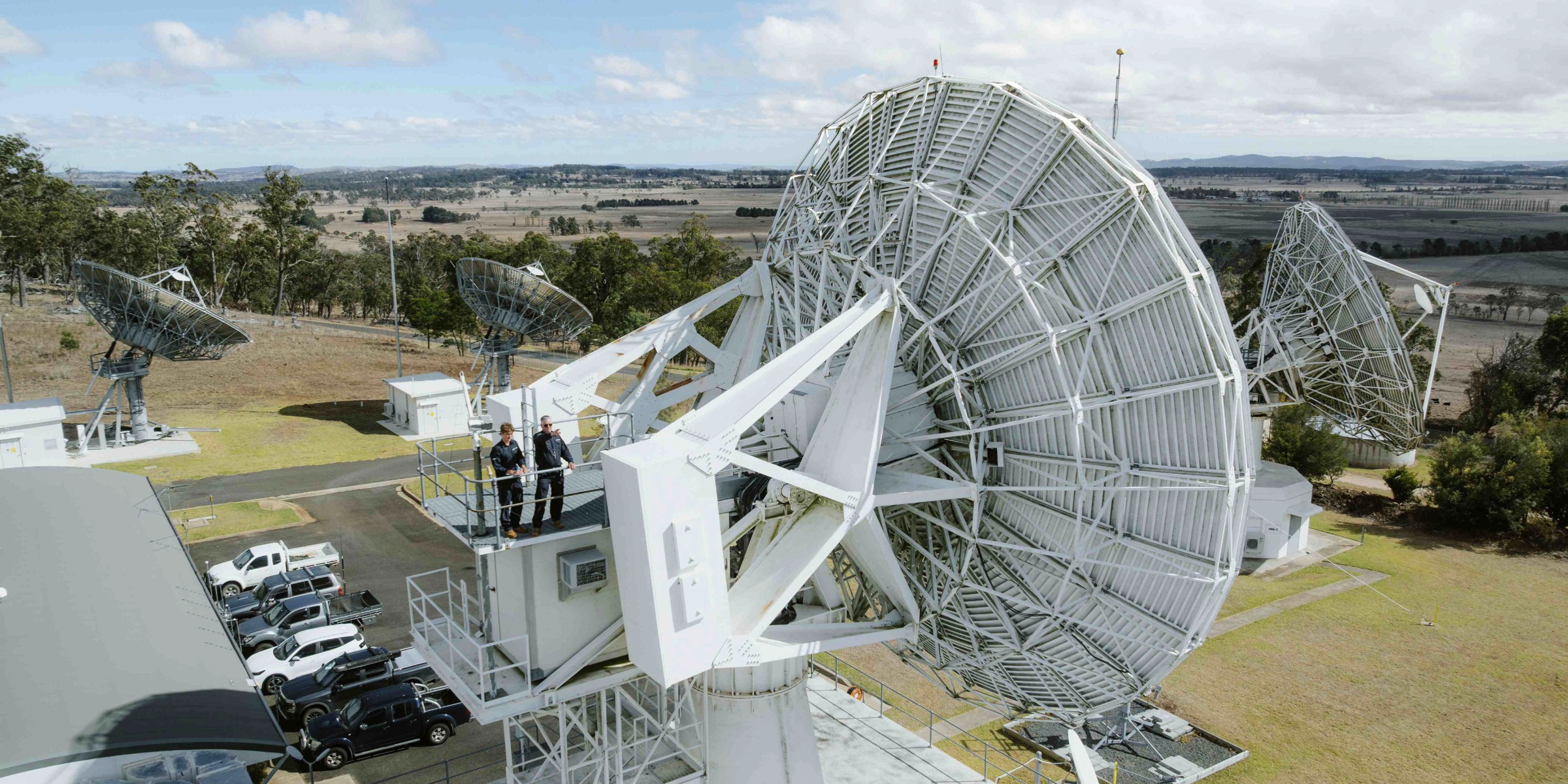
When people think of Uralla, the things that come to mind are usually lovely people, antiquing, solar power, and lots of great little craft businesses. But did you know it’s also got a genuinely significant space facility?
On the edge of town, a satellite tracking station has been quietly going about its business for 25 years. It now sits at the centre of a project that will make GPS ten times more accurate across Australia and New Zealand, and Lockheed Martin is currently looking for an operations manager to help run it.
“There’s a long history with the site, goes back about 25 odd years,” said David Ball, Lockheed Martin Australia and New Zealand’s Regional Director of Space. “It’s a very cool facility to have.”
The big satellite dishes at the site were originally built to track and command satellites as they climbed towards their final orbit, guiding them into position before handing them over to the next station in a global network. The company still uses them to test satellites before they enter commercial service.
“They’re massive antennas, about 14 metres in diameter,” Mr Ball said.
Uralla was picked for the job partly because of what it doesn’t have. At approximately 1,100 metres above sea level, Uralla benefits from clean air, a high number of clear days and nights and exceptionally low levels of radio frequency interference.
“It’s in a quiet radio zone from radio frequency,” he said, “all the restrictions on the use of certain frequencies in capital cities are problematic for spacecraft communication.”
Its location also enables communications with satellites as low as five degrees above the horizon in almost any direction, providing coverage from halfway across the Pacific Ocean to halfway across the Indian Ocean.
“We’ve got great clear skies, so the weather’s good advantage, and we have at this site good horizon to horizon visibility,” Mr Ball said.
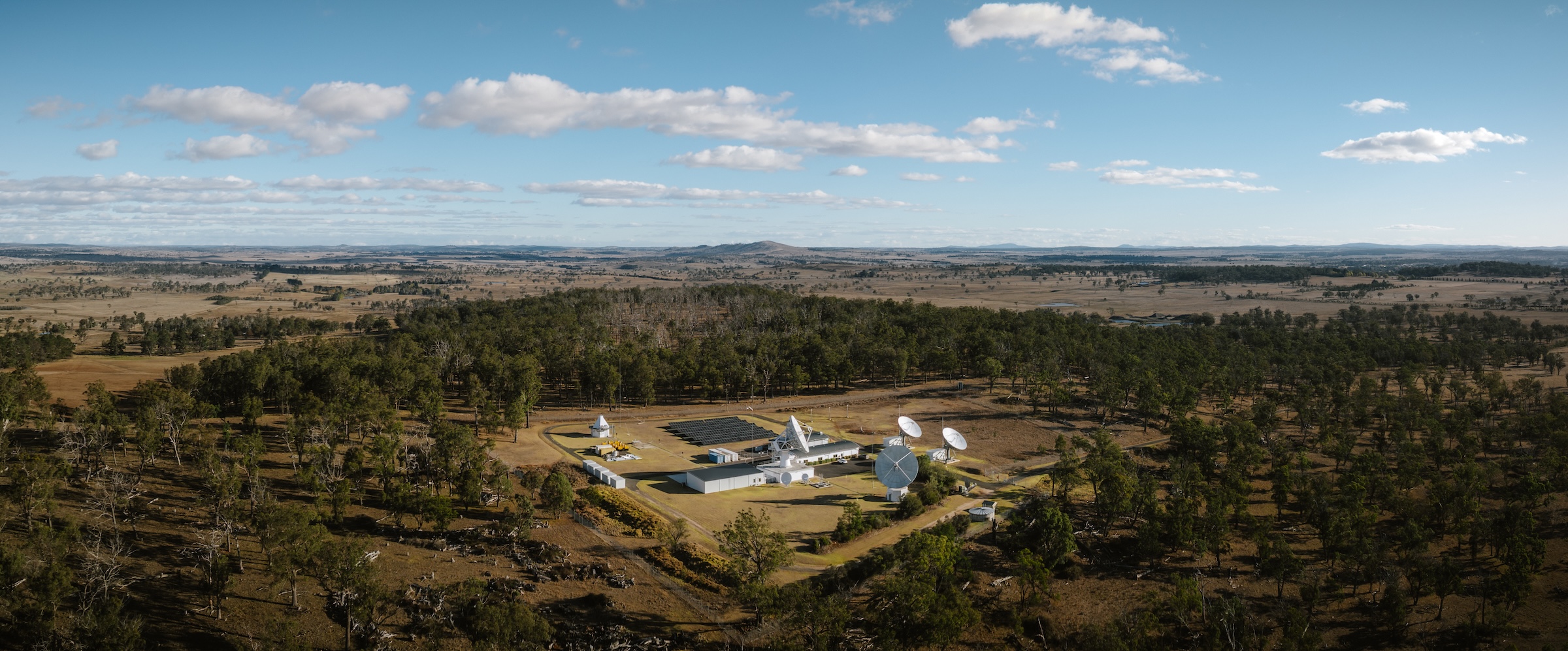
Lockheed Martin has expanded its footprint at Uralla to run SouthPAN, the Southern Positioning Augmentation Network, a joint program between Geoscience Australia and New Zealand’s Land Information New Zealand. Two new 11-metre antennas have gone in for the project, the first one opened in 2023.
“We’ve put our Australian control centre in Uralla. We’ve expanded the head count there, we’ve gone to 24-hour, seven-day operations, and we have put two new antennas in there for this particular program,” Mr Ball said.
So what does SouthPAN actually do? In short, it makes GPS embarrassingly more precise.
“On our Apple iPhone, we have a five to 10 metre accuracy, which is good for finding your way around. That’s why the Uber turns up on the other side of the road to where you’re standing,” Mr Ball said.
“This will bring that accuracy down to about 10 centimetres anywhere in Australia and New Zealand.”
That kind of precision opens up a massive array of uses.
“There’s some really interesting applications that come out of the woodwork.”
He pointed to precision agriculture, driverless cars, and utility companies as examples.
“Precision agriculture, to improve the yield of farms, if you can put down fertiliser more accurately, do the watering more accurately,” Mr Ball said.
The bigger prize, according to Mr Ball, is aviation. SouthPAN adds an integrity check to the signal that will eventually deliver what is known as “safety of life” certification for flying in Australia and New Zealand.
“If you look at Melbourne and Sydney Airport, the pilots have every landing aid you could want to be able to land in any weather condition, regardless of being able to see the actual runway,” Mr Ball said.
“Right now, in regional centres, the air regulations are that you can come down to 1,500 feet, if you can see the runway, you can land,” he said. “If you can’t see the runway, go somewhere else.”
Mr Ball said SouthPAN would eventually let pilots descend to a 200-foot decision height in regional areas instead, using the improved signal rather than relying on clear sightlines.
In real terms, that means the huge number of flights to Armidale that have to turn around and land in Tamworth because of low visability will become a thing of the past. It’s a problem Mr Ball has lived himself.
“I had this very experience into Armidale about a year or two back. We’re my boss up to go to Armidale, and we got to 600 feet and the cloud base was too low, so we ended up in Tamworth.”
For the Royal Flying Doctor Service, the stakes are higher again, with this new system making it possible for them to access any of the 3000 airstrips in the country in any weather.
“They’re trying to get into get treat people, get people out in some pretty rudimentary airstrips across Australia.”
“They’ll be able to use that system to get themselves down and get in in bad weather where they where they otherwise may not have been able to,” Mr Ball said.
Similar systems exist in the United States and Europe, but SouthPAN is the next generation.
“This is world first of the second generation space based augmentation systems,” Mr Ball said. “This in the next level of the technology in reliability and integrity of accuracy.”
Lockheed Martin has held the SouthPAN contract with Geoscience Australia since it was signed in September 2022, and is progressively upgrading the software as new elements of the program roll out. About a dozen people currently work at the Uralla site across rotating shifts to keep the system running every day of the year.
That is the team the new Operations Manager will join. The role calls for a degree in engineering, telecommunications, navigation, physics or computer engineering, along with experience in GNSS and SBAS systems, safety certification and security accreditation, and experience leading teams in high-pressure, ‘no fail systems, 24/7 environments. Applicants must be Australian citizens eligible for an Australian Government Defence security clearance. Oh, if you can also be an experienced pilot, that would be great.
It might be the coolest job in Uralla, but finding the right person is not an easy task.
“It’s a bit of a unicorn,” Mr Ball said.
And you’d better believe the pay packet is equally unique.
“It’s alright,” Mr Ball said with a big smile. “It’s a good role.”
Culture fit is also as important as the very long list of technical skills required.
“We really enjoy the work, and just finding the right people from a technical perspective,” he said. “You’re all working 24/7 together. You’re all in a remote location. Everyone’s got to get along and mesh nicely.”
Think you’re the unicorn they’re looking for? Check out the job here.
Read all the way through to the end of the story? So did lots of other people. Advertise with New England Times to reach New England locals who are interested and engaged. Find out more here.