

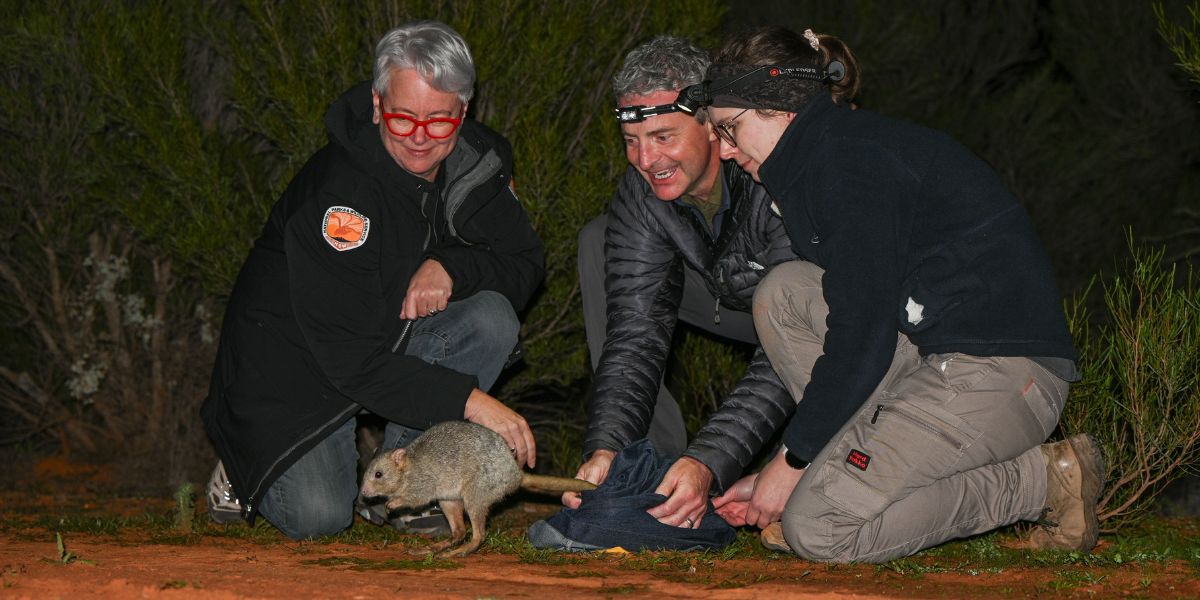
Australian Wildlife Conservancy (AWC), the NSW Government and the NSW National Parks and Wildlife Service (NPWS) will extend their groundbreaking conservation partnership for another decade, strengthening efforts to recover Australia’s threatened wildlife.
NSW Minister for the Environment Penny Sharpe announced the renewed commitment during a visit to Mallee Cliffs National Park in far south-west NSW, one of the partnership’s flagship sites, where large-scale conservation work has been delivered over the past decade. She was joined by AWC Board Chair Nick Butcher and NPWS Threatened Species Unit Manager David Kelly.
“We’re bringing native species back from the brink. bilbies, numbats and Shark Bay bandicoots are back where they had disappeared from and they’re thriving,” said Minister Sharpe.
“The next ten years of this partnership is not just about what happens inside fenced areas, it’s about improving our knowledge of what contributes to successful reintroductions, so we can drive recovery of threatened species and tackle our extinction crisis.”
When AWC and the NSW Government signed their landmark agreement in 2016, it marked the first time a private conservation organisation had partnered with a government agency to manage wildlife and deliver large-scale threatened species recovery. The partnership has since become a model for conservation collaborations across Australia.
Over its first decade, the partnership combined AWC’s science-led conservation model with NSW Government support to establish large feral predator-free fenced areas at Mallee Cliffs National Park and the Pilliga State Conservation Area in north-west NSW. Following construction, all introduced cats and foxes were removed from within the fenced areas, creating safe havens for threatened wildlife.
Since then, 11 native species have been reintroduced across the two sites, many of them nationally threatened and some absent from the landscape for more than 150 years.
The reintroductions have delivered significant conservation gains. At Mallee Cliffs, Greater Bilby numbers are now estimated at 1,840 and the Brush-tailed Bettong population exceeds 600 individuals. At the Pilliga, reintroduced populations of the Bridled Nailtail Wallaby, Brush-tailed Bettong and Shark Bay Bandicoot have all grown into the hundreds.
“By working together, we’ve proven what long-term collaboration can deliver for conservation in Australia,” said Tim Allard, AWC Chief Executive.
“Together with the NSW Government, we’re turning the tide of extinction by restoring threatened species to their former range, rebuilding resilient ecosystems, and reconnecting local communities to nature. With this partnership extending, we’re excited to build on this success and see an even greater impact for Australia’s wildlife over the next decade.”
“AWC, the NSW Government and NPWS are pioneering a new model for conservation in Australia, and its success creates a blueprint for restoring threatened species and rebuilding ecosystems,” said Nick Butcher.
“After a decade of hard work, wildlife absent from this landscape for over a century are back and thriving, and biodiversity is recovering at scale. Extending our partnership will ensure greater gains for nature and expand AWC’s work beyond the fence across the broader landscape, and into the next chapter of conservation in Australia.”
Over the next decade, the partners aim to expand feral cat and fox management beyond the fenced areas, creating opportunities to reintroduce selected species into the broader landscape. The approach will test how targeted predator control can support threatened species recovery outside fenced safe havens.
The work builds on AWC’s wildlife restoration program at Mt Gibson Wildlife Sanctuary in Western Australia, where three species have now been successfully released beyond the protection of a feral predator-free fenced area.
The renewed partnership will also support the reintroduction of additional locally extinct species into the fenced areas, further strengthening conservation outcomes across both sites.
More information about the partnership is available here.
Read all the way through to the end of the story? So did lots of other people. Advertise with New England Times to reach New England locals who are interested and engaged. Find out more here.