

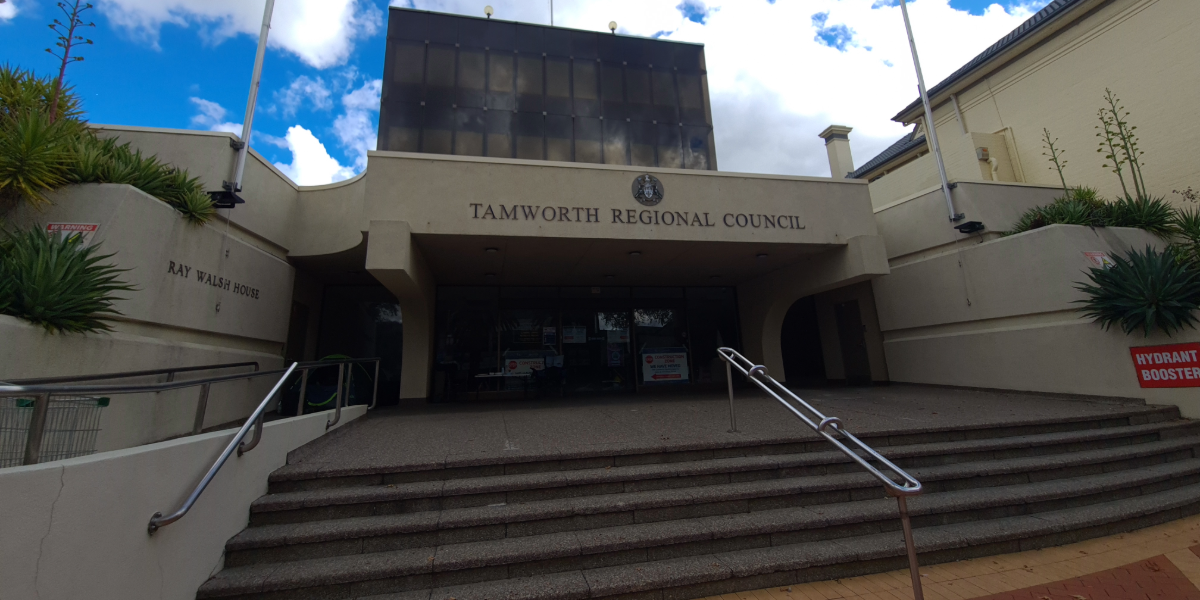
Tamworth Regional Council has voted five to three to sell Ray Walsh House, ending more than four years of uncertainty over the future of the landmark Peel Street building.
The decision, made at Tuesday night’s ordinary council meeting, followed more than an hour of debate, two failed attempts to defer the vote, and a rejected amendment that would have required the building to be heritage listed before any sale could proceed.
Councillors resolved to sell the building and the adjoining car park on the north-western side, with the car park on the south-eastern side to be offered as an option to a future purchaser. An Expression of Interest process will be used to appoint a sale agent, with General Manager Paul Bennett to report back to council on the recommended agent, method of sale, and reserve price before any sale proceeds.
Ray Walsh House, at 435-437 Peel Street, served as Tamworth Regional Council’s administrative headquarters for almost three decades before it was vacated in 2022 after the failure of the air conditioning system servicing three of its five floors. The discovery of friable asbestos in vermiculite fire protection material sprayed on all structural steel floor members meant the air conditioning could not be replaced without first removing the asbestos-containing material. With staff safety foremost, council undertook a staged relocation of workers based on the level of known risk to their health. Council staff are currently based at a leased facility at the Hub in West Tamworth.
Mayor Webb said the financial reality left council with no realistic alternative.
“As much as we might like to think that we could go back into a refurbished Ray Walsh House, we just can’t afford it, and there is no light at the end of the tunnel in terms of finding the funds to do that in the foreseeable future or the long term future,” he said.
“The financial capacity of local government in New South Wales and the nation as a whole has never been looked at in a worse light.”
Cr North, who read Cr Impey’s statement to the chamber, said the vote was about far more than the building itself.
“The decision before councillors tonight on the future of Ray Walsh House is not a simple decision,” Cr Impey’s statement read.
“It is not simply about what may be the best path forward for the building, but is about what is best for the organisation of council, the employees, the community, and the building itself.”
Cr Sutherland said four years of consideration had not been wasted, and that the vote to proceed was not a final commitment to sell.
“The way I’m interpreting the recommendation is that we’re going to move towards the sale,” Cr Sutherland said.
“We’re going to engage an agent to be able to have that conversation with, and all that information is going to be brought back to us as councillors to make a decision on.
“I’m going to support this motion, but knowing that the support of this isn’t the agreeing to sell it right now, it’s the process of moving towards sale.”
Cr Sharpham, who said he had campaigned on wanting to see the building restored, said he had not anticipated the extent of the challenges that would emerge.
“There is significant difference between what we’d like to do and what we can responsibly do,” he said.
“I have no doubt the building could still be standing for another 100 years, if it finds the right pathway forward, and that’s the key.”
Cr Brooke moved an amendment from the floor that would have made any sale conditional on the building first being added to the Tamworth Regional Local Environmental Plan as a heritage item, and required a conservation management plan to be developed before the sale could proceed. The amendment was seconded by Cr Mears but defeated.
Cr Brooke said he was acting on a recommendation in the Tamworth Main Street Heritage Study, a 2017 document commissioned and grant-funded by council, which recommended Ray Walsh House be listed as a local heritage item.
“If this iconic building is going to leave public ownership, the structure itself has protections, both to ensure it remains part of our city streetscape and to give us the ability to guide major redevelopment works into the future,” he said.
Cr Brooke said he could not support the original recommendation without those protections in place.
“I have made promises. I keep my promises, and because I cannot support this recommendation.”
Cr North said while he understood the intent, placing conditions on the sale would reduce the value council could expect to receive.
“You start putting caveats of one sort or another on there, we’re going to halve the value of that asset,” he said.
“Our objective here is we’re going to sell this asset, we want to realise full value as much as possible.”
Deputy Mayor Budd said the amendments would derail the process.
“What these amendments actually do will take, we’ll be here in six months talking again,” Cr Budd said.
“We won’t be attracting any buyers.”
Cr Rodda moved at the outset to defer the decision until all councillors were physically present in the chamber, citing the significance of the matter and concern that Cr Impey was absent. The motion was seconded by Cr Mears and defeated five to three.
Cr Rodda then spoke at length against the recommendation, arguing the council had not exhausted all options and had failed to follow through on resolutions directing further investigation.
“This report is, in my view, premature,” Cr Rodda said.
“Before making an irreversible decision, councillors should be satisfied that our own directions have been carried out.”
He said residents who attended the Town Hall and made submissions had been promised their ideas would be considered before a final decision was made.
“Yet councillors have had no workshop in examining those submissions, and tonight’s report presents only one recommendation: sell.”
Cr Mears also argued the financial case against remediation had been overstated, contesting figures presented at the Town Hall meeting and suggesting the true cost of staged asbestos removal was between 25 and 40 per cent more if undertaken while the building was occupied, not the 100 per cent figure cited at the community meeting.
“Based on all the public available evidence in regards to the remediation of Ray Walsh House, a figure was put up somewhere between 49 and $50 million, and that is an excessive amount of money,” Cr Mears said.
He warned that delaying a decision would not make the financial challenge easier.
“If we can’t save it now, we won’t have it then.”
Mayor Webb closed the debate before the vote, saying he did not want to repeat what had already been said.
“I think the simple fact of the matter is, as much as we might like to think that we could go back into a refurbished Ray Walsh House, we just can’t afford it.”
Voting in favour were Mayor Russell Webb, Deputy Mayor Jeff Budd, Cr Brendon North, Cr Marc Sutherland, and Cr Matt Sharpham. Voting against were Cr Mark Rodda, Cr Steve Mears, and Cr Ryan Brooke. Cr Charles Impey was absent from the meeting; a statement on his behalf was read by Cr North.
General Manager Paul Bennett will report back to council on the recommended agent and method of sale before any further steps are taken.
Got something you want to say about this story? Have your say on our opinion and comment hub, New England Times Engage