

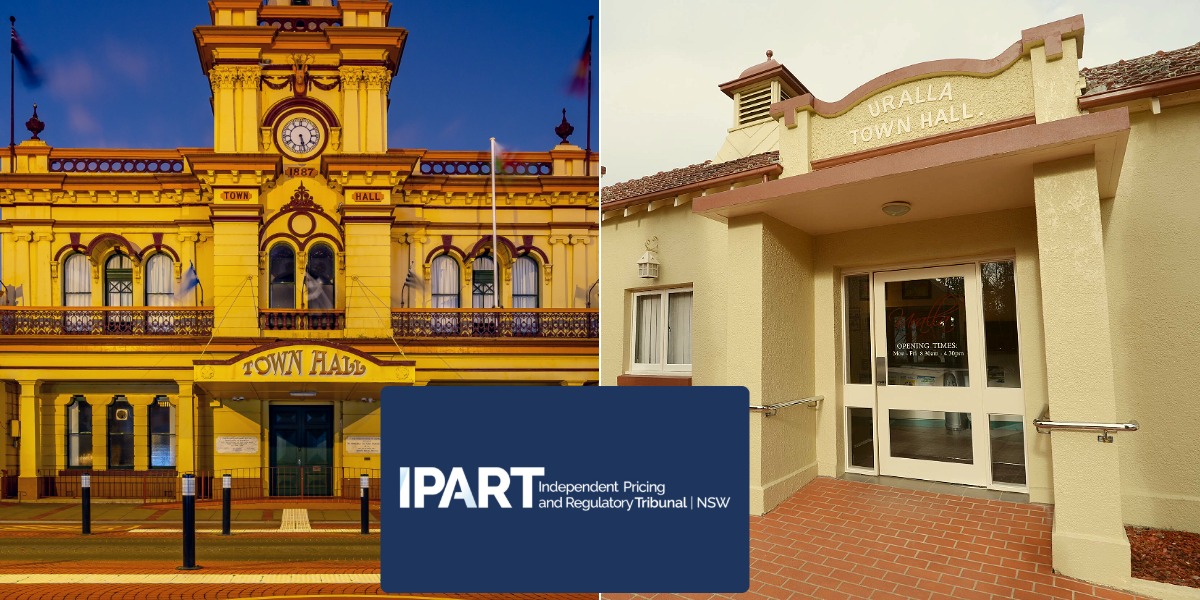
The green light has been given for sharp rate rises in Glen Innes Severn and Uralla Shire after the state’s pricing watchdog approved special rate variations designed to shore up the long-term financial sustainability of both local councils.
The Independent Pricing and Regulatory Tribunal (IPART) on Tuesday approved applications from nine NSW councils to increase their general income above the annual rate peg, including Glen Innes Severn Council and Uralla Shire Council, while rejecting an application from Cessnock City Council.
Under the determinations, Glen Innes Severn Council received approval for a cumulative 48.3 per cent increase over three years, including annual rate peg increases. Uralla Shire Council’s general rates will rise by 28.5 per cent in 2026-27, followed by a further 23 per cent increase in 2027-28.
The decisions come as councils across regional NSW grapple with escalating operating costs, ageing infrastructure, rising compliance burdens and what local government leaders describe as years of chronic underfunding and cost shifting from state and federal governments.
IPART chair Carmel Donnelly said the tribunal had undertaken a detailed review process before making its decisions.
“Our decisions reflect a thorough review against the criteria set by the Office of Local Government, while carefully considering stakeholder feedback received during the submission period,” Ms Donnelly said.
“It is now up to elected councillors to decide the next steps. Councils have significant flexibility in how and when they implement approved rate increases.”
“This includes the possibility of deferring these changes for up to ten years, as well as deciding how rates are set for different categories of ratepayers.”
IPART sets annual rate pegs for NSW councils, limiting the increase in income they can collect from ordinary rates. For 2026-27, the core rate pegs range from 2.5 per cent to 4.2 per cent across the state.
Glen Innes Severn Council General Manager Bernard Smith described the determination as a critical step toward restoring the council’s long-term financial position.
“The approval provides Council with an opportunity to strengthen its long-term financial position and continue delivering essential infrastructure, services and community outcomes that residents rely upon,” Mr Smith said.
“Like many regional councils across New South Wales, Glen Innes Severn Council has experienced sustained increases in operating costs, asset renewal requirements and service delivery pressures, while revenue growth has remained constrained over many years under the rate pegging system.”
Mr Smith said the approved variation would be phased in progressively, not introduced in a single year.
Under the approved structure, Glen Innes Severn Council’s general income will rise by 21.5 per cent in 2026-27, 12 per cent in 2027-28 and 9 per cent in 2028-29.
“The approved SRV does not result in a 48.3 per cent increase in a single year,” Mr Smith said.
“The 48.3 per cent figure represents the cumulative increase including the impact of compounding over the three-year application period and includes annual rate peg increases approved by IPART.”
The additional revenue is expected to support infrastructure renewal, essential services, operational obligations and economic development initiatives across the region.
Glen Innes Severn Mayor Margot Davis said the increase was unavoidable given the financial strain facing regional councils.
“This is not a decision that Council has taken lightly, nor one that our community has asked for but is a necessary and responsible decision as a result of chronic and systemic underfunding of Councils over a very long period of time,” Mayor Davis said.
“We will also continue to advocate strongly for broader reform of local government funding, the return of the Federal Assistance Grants to 1% of Federal tax revenue (currently 0.49%) and the ongoing issue of cost shifting, recognising that many regional councils face similar challenges in a system that is broken and puts inequitable pressure on local government.”
In Uralla, Mayor Robert Bell said the council did not take the rate rise decision lightly, acknowledging the pressure already being felt by households amid the continuing cost-of-living crisis.
“We know that any rates increase can be difficult, and Council does not take this decision lightly,” Mayor Bell said.
“However, this outcome would allow Council to continue delivering the services our community relies on every day — from local roads and bridges to parks, libraries, waste services and community facilities.”
The Uralla council has already exhibited its draft 2026-27 operational plan and budget, which assumed approval of the special rate variation, and will consider public submissions before formally adopting the budget later this month.
Uralla Shire Council Acting General Manager Mick Raby said the council had spent years trying to minimise financial pressure on ratepayers through organisational restructuring, service reviews and efficiency measures, but warned those steps alone had not been enough.
“But these efforts alone have not been enough to offset the impact of Federal and State Government cost shifting and the ongoing increase in operating costs,” Mr Raby said.
“Without additional revenue, Council would be forced to make extremely difficult decisions that directly impact service levels, asset maintenance and future investment.
“This approval allows us to plan responsibly, rather than defer critical maintenance and increase risks to safety and infrastructure condition.”
Got something you want to say about this story? Have your say on our opinion and comment hub, New England Times Engage