

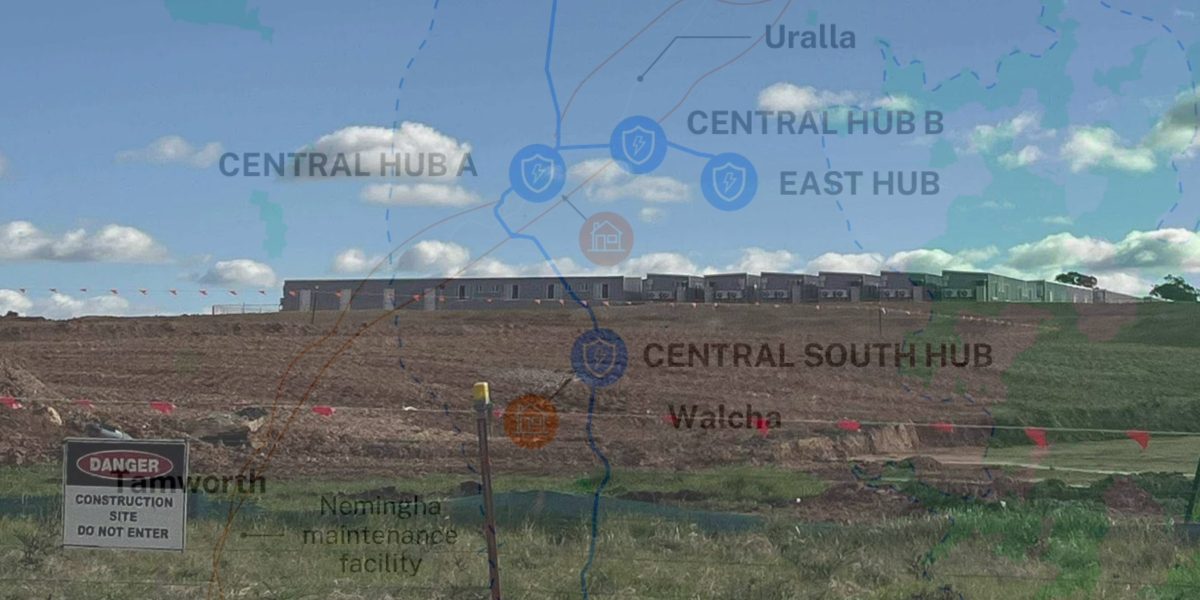
For a decade, New England was told the renewable energy boom would bring improved roads, more housing, and many other social benefits. Housing was a clearly identified pinch point, as crucial as water in ensuring the affected communities could handle the impact of the Renewable Energy Zone (REZ). The New England Renewable Energy Zone Transmission Project EIS now on exhibition offers 2,060 beds in five temporary camps, and none of them are in a town.
On Glenburnie Road at Kentucky, a small village south-west of Uralla, EnergyCo plans to house up to 550 workers.
Another 550 beds are planned for the Central South energy hub, on the Oxley Highway near Walcha Road. Three smaller camps of about 320 beds each would sit further south, at Barry, Waverly, and Muswellbrook.
The camps are temporary. They will be built from demountables on land EnergyCo has bought for its energy hubs. When construction ends, about six years from the start, they will generally be pulled down and the land rehabilitated.
That is the plan set out in the environmental impact statement (EIS), open for submissions until Thursday, 12 November.
It is not what many people in New England thought would be happening.
For years, councils, community groups, and local leaders talked about worker housing in a very different way. They pictured something like an athlete’s village on the edge of town. Workers would live there during the build. Afterwards, the units would be sold, rented, or handed over as affordable housing, aged care units, or key worker homes in towns that badly need them.
The EIS does not rule that out. But it does not deliver it either.
What EnergyCo is proposing
The New England REZ transmission project is a 300-kilometre network of high-voltage lines and energy hubs running from the Upper Hunter to the Northern Tablelands. EnergyCo, the NSW Government agency building it, expects about 1,400 workers on the project at its peak.
According to EnergyCo’s workforce accommodation fact sheet, the Barry camp and an alternative Muswellbrook site on the New England Highway were only recently identified and will be assessed later.
Each camp would be self-contained, with on-site medical staff, catering, laundries, gyms, 24-hour security, shuttle buses, generators, water treatment, and wastewater treatment.
“Workforce accommodation camps would be built within landholdings acquired by EnergyCo for the project,” an EnergyCo spokesperson said.
“Where practical, workforce accommodation will be located within key construction sites like the energy hubs (substations).
“Locating workers close to where construction is taking place helps reduce traffic on local roads, minimises travel requirements and lessens pressure on housing and accommodation in nearby towns.”
There is a logic to that. The energy hubs will be the biggest worksites on the project. Putting workers on site cuts their daily drive, keeps heavy traffic off local roads, and stops 1,400 workers competing with locals for rentals that barely exist.
But it also means the money spent housing those workers will leave with the demountables, and New England communities would not get the housing and economic boost promised.
The promise, and how it changed
In November 2023, Community Power Agency and Orange Compass released a discussion paper, Short-term worker accommodation with long-term community benefits, to start a New England roundtable on the issue. It warned that the region’s housing market was already broken.
In Walcha, the paper found, rental vacancies were “consistently low, often at 0%” and had not been higher than 1% since August 2015.
The paper set out a menu of options. Councils could lease land for camps on sites earmarked for future subdivisions, with proponents paying for water, sewer, and power that would later serve permanent homes. Community housing providers could build units for workers, then turn them into social or affordable housing. Camps could become housing for people escaping domestic violence.
It pointed to Balranald, where a 400-bed village built on the edge of town for one solar farm has since housed workers from several projects and, council staff said, brought steady trade to local businesses.
Armidale’s mayor was saying the same thing. At a regional forum in September 2023, he floated Olympic village-style housing in Armidale that could be sold as ordinary homes once the wind farms were built.
“Armidale is likely to be the dormitory for the New England Renewable Energy Zone,” said Armidale Mayor Sam Coupland.
“I don’t want to see workers’ camps.”
Later that month, he estimated the region would need to house more than 2,000 workers for a decade.
Armidale Regional Council carried that line into the upper house inquiry. Its 2025 submission called for camps located “close to town” and designed “to integrate into the urban landscape of the town,” with designs that could “be put to alternative uses when no longer required.”
“As a lasting benefit to the Region, the NE REZ should deliver legacy housing and associated trunk infrastructure,” the submission states.
In answers to the committee in August 2025, the council listed options including legacy medium-density housing on the Marsh Street car yards, using UNE college facilities, and “dedicated workers’ camps on Council-owned land.”
None of the five camps in the EIS is in Armidale itself, the Boorolong hub being smaller with no planned on site worker accommodation, as per the EIS plan.
EnergyCo itself talked up legacy outcomes in the past, and is not ruling them out. Its 2023 workforce accommodation fact sheet for the Central-West Orana REZ, the state’s first, said it was “investigating a number of legacy housing initiatives in the REZ, such as accommodation for key workers and opportunities to provide affordable community housing once construction in the REZ is complete.”
What was actually built in Central-West Orana was a 1,200-bed camp at Merotherie, 15km from Dunedoo, on the energy hub site. That camp, and the stories that come out of it, now shape how New England sees its own future. Fear-riddled warnings laced with racism from anti-renewables campaigners are far from reality, but may have a nugget of truth from the tales of Merotherie.
The rules have shifted too. The NSW Government’s construction workers accommodation policy, which applies automatically in Walcha, Uralla, and Armidale, now makes it easier to approve worker housing. But it is blunt about what that housing is for.
“Construction workers accommodation is not suitable for long-term housing needs,” the policy states.
Under those rules, moveable dwellings must be removed when the project ends.
What the social impact assessment found
Chapter 10 of the EIS, based on the social impact assessment prepared by consultants Umwelt, rates each impact twice: before and after EnergyCo’s proposed fixes.
Housing scores well on paper. The assessment rates reduced access to rentals and short-term accommodation as a medium impact, falling to low once camps and a workforce management plan are in place.
“The workforce accommodation camps are expected to largely reduce the pressure on local housing markets however impacts may be experienced during the establishment of each accommodation camp and will vary spatially depending on proximity to service centres and available accommodation stock,” the assessment states.
In other words, the camps solve EnergyCo’s housing problem. They do not add to the community’s housing stocks, but they also don’t add pressure to anyone else’s housing.
The assessment heard that message from the community. Among the concerns it recorded was a “preference for workforce accommodation solutions that minimise impact on local services and communities and deliver longer-term community benefits.”
The response to that is one line in the workforce management plan. It promises “ongoing exploration of opportunities for legacy outcomes following construction, such as repurposing workforce accommodation camp facilities for community use.”
The fact sheet goes no further. It says EnergyCo is open to repurposing camps for housing or community use, working with councils and the network operator.
Health is the other sore point. The assessment rates reduced access to health services as a high impact before mitigation. It singles out places near the camps “where baseline service provision is limited or absent.”
EnergyCo’s answer is that the camps will look after their own.
“The sites will be self-contained with on-site amenities and services including 24/7 medical support,” the EnergyCo spokesperson said.
Again, the warning from the Central West Orana REZ is that isn’t quite right. Dunedoo’s hospital has a part time GP as it’s only on site doctor, and resources there are claimed to have been stretched from things like cardiac arrests that simply cannot be managed by a medic with a first aid kit.
The EIS sets the bar a little lower. The workforce management plan requires “at a minimum camp-based first aid and medic personnel, and facilitated access to General Practitioners via Telehealth services, to ensure that the project workforce has no reliance on local health services.”
Once that is in place, the assessment rates the health impact as low. It rates the strain on ambulance, police, and Rural Fire Service crews as medium, also falling to low with an emergency plan.
For people living near Kentucky or Walcha Road, where police and ambulances have to come from a long way away, that rating will be tested in the submissions.
The social assessment also rates the risk of anti-social behaviour around the camps as high for the local community before mitigation, falling to medium. The main safeguard is a workforce code of conduct with “zero tolerance for anti‑social, discriminatory or unsafe behaviour toward other workers or members of the community.”
Uralla clear in asking for something else
No council in the REZ has planned harder for worker housing than Uralla Shire.
Its Local Housing Strategy, adopted in August 2025, expects up to about 1,100 renewable energy workers to look for accommodation in the shire at the peak, around 2029 and 2030, as the transmission line is commissioned. It notes that rents spiked when the New England Solar Farm was built, and that purchase affordability had not recovered since.
The strategy’s second goal is “Ensuring a positive legacy from REZ investments.”
It wants to “facilitate construction workers accommodation associated with REZ projects in a way that manages short-term demand and allows for seamless repurposing of assets that support long-term community needs.”
The strategy records that talks with EnergyCo and private developers had pointed to “a coordinated, semi-permanent accommodation solution.” It mapped land south of Uralla township as the best fit. Those areas, the strategy states, “may also represent logical areas for future township expansion over the longer term.”
Instead, the biggest camp in the shire will be at Kentucky, inside the fence of an energy hub.
Uralla Shire Council has not formally considered the Kentucky camp, and a council spokesperson was frank about why.
“The REZ project has Critical State Significant Infrastructure designation,” the spokesperson said.
Council can advocate to state agencies and developers, but the decision on where and how big the camps will be is not its to make.
“Council has consistently advocated for workforce accommodation that can deliver win-win outcomes,” the spokesperson said.
Uralla’s draft Growth Management Strategy puts the preference plainly.
“Council’s preferred approach is for workforce accommodation to deliver lasting benefits to the community wherever possible,” it states.
“The Network Operator’s workforce is anticipated to be the largest across all the projects proposed for the REZ,” the spokesperson said.
“Council understands that temporary workforce camps will have a place.”
Uralla is still chasing other options, the spokesperson said. These include worker accommodation on council land that becomes permanent housing for essential workers, helping hotels and motels expand, and clear guidance for developers.
“Uralla is looking for legacy outcomes.”
“We encourage our community to make a submission to the proposal for TWA at Kentucky,” the spokesperson said.
Walcha says no, even to housing in town
If Uralla shows what a council can do when it leans in, Walcha shows the opposite, with anti-renewable forces on Council going so far as to propose illegal motions in their desperation to oppose anything linked to the REZ.
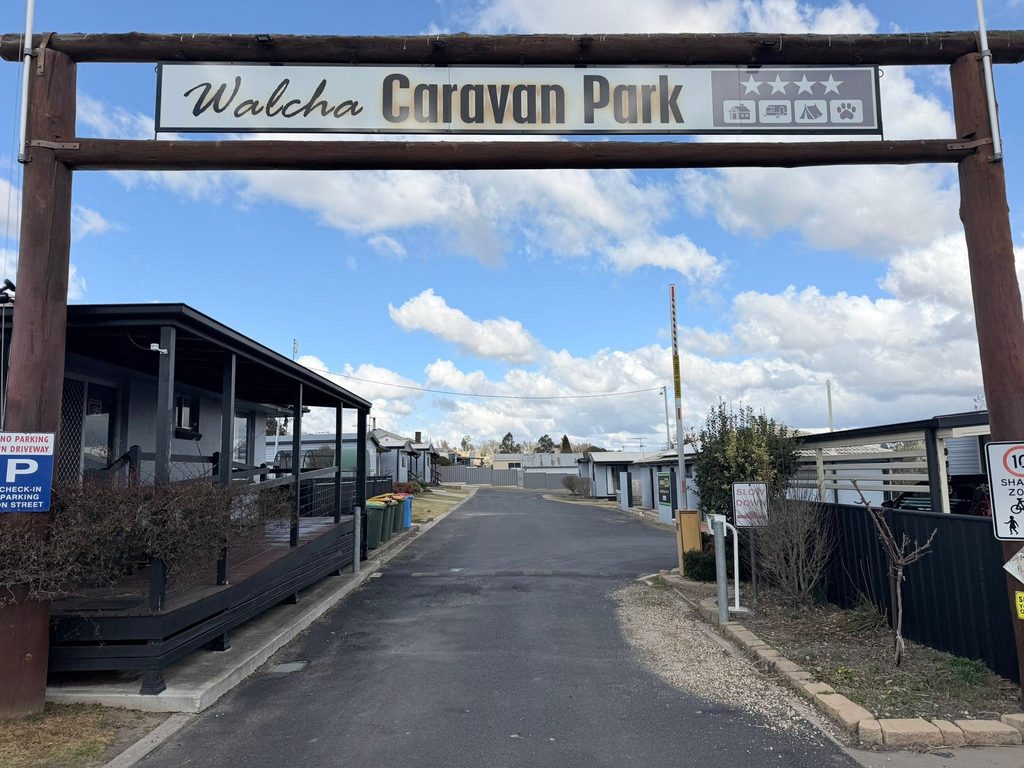
On Wednesday, 28 October, Walcha Council voted four to three to refuse development application 10.2026.6, the redevelopment of the Walcha Caravan Park on Middle and Jamieson streets. The applicant was Winterbourne Wind Pty Ltd, the company behind the Winterbourne wind farm which purchased the caravan park as part of its worker housing plans and community investment.
It is exactly the kind of in-town accommodation the region has asked for, in a town where there is a desperate shortage of housing generally, particularly low income and short term housing.
The $7.44 million plan would replace nine old moveable dwellings with 36 new ones, providing 37 long-term and six short-term sites, along with new amenities, sewer and stormwater upgrades, and safer footpaths near the school.
Council staff recommended approval of the DA.
“The proposal is also considered to be in the public interest, subject to appropriate safeguards,” the assessment report to council states.
The application drew 52 objections, including over “the potential use of the site for worker accommodation.” The assessment found none of the issues raised was big enough to justify refusal.
Councillors refused it anyway, on the single ground that it was not in the public interest.
The refusal was moved by Deputy Mayor – and well known anti-renewables campaigner with Voice for Walcha – Rachel Greig. Her case was that the caravan park was really a worker camp by another name.
“I think we know that the dominant purpose is for workers’ accommodation,” said Deputy Mayor Rachel Greig.
Vestas has said publicly that the park would house some of its peak construction workforce, but their plan is for the units to remain as ongoing tourist or local accommodation, that is, it will stay as a caravan park.
“It’s just a bit ironic that if we approve this as a caravan park, we actually lose all the controls that we’re trying to keep,” Deputy Mayor Greig said.
“I think the developer had the opportunity to put this through as workers’ accommodation, and that would have solved all our problems.”
It is a striking argument from a councillor who has already moved previously, again against the advice of council staff, to turn down REZ related worker accommodation on council land. In March 2025, Cr Greig declared a non-pecuniary, non-significant interest because her husband was president of Voice for Walcha, which had written to councillors opposing it, and stayed for the vote. She declared no such interest at this week’s meeting.
“I think the issue with all of the councillors here is we don’t know what we’re approving,” said Cr Glen O’Brien, who is connected to Walcha High Country Guardians.
Cr O’Brien had earlier tried to have the privately owned property rezoned for as public recreation land before any further development was approved. He also tried to move that the regulatory compliance certification be delivered prior to approval, and that more information be given. Staff advised those moves would not be lawful, and the development application provided more information than required.
O’Brien withdrew his motion and then seconded the refusal on the grounds it was not in the public interest. The draft minutes also record no declaration of interest from him on the item; but on the worker camp item at the March 2025 meeting, Cr O’Brien declared pecuniary and significant non-pecuniary conflicts of interest and left the chamber. Cr O’Brien has been asked why he did not declare interest on the item as the owner of a tourism business in town, but has not yet replied to that query.
Former mayor Cr Eric Noakes spoke against the refusal.
“Over my time in council, I’ve seen other councils turn down DAs that fit the local, the state planning, and it costs them dearly,” said Cr Eric Noakes.
“There are things that come to you that you don’t agree with, but quite often state planning laws overrule what you think and what you want and what is necessarily good for the community,” Cr Noakes said.
Staff also cautioned against refusal, warning it would likely be taken to court.
Mayor Hyde Thomson, Deputy Mayor Greig, Cr O’Brien, and Cr Gary Olrich voted for the refusal. Cr Noakes, Cr Stephen McCoy, and Cr Anne-Marie Pointing voted against. Council sat one short after Cr Adam Iuston resigned on Friday, 23 October.
New England Times understands a rescission motion to reverse the decision is being considered on the basis that a fight in the Land and Environment Court would be expensive and futile to defend.
Walcha Council is yet to take a formal position on the EnergyCo owned camp planned for its shire, which it will not be given the opportunity to refuse.
“It will be addressed in our EIS submission,” a Walcha Council spokesperson said.
EnergyCo has agreed to fund up to $75,000 for a traffic consultant to help council review the EIS, and council has asked it for up to $25,000 more for a planning specialist.
So the council that has now twice refused to let a REZ workers live in town will, with EnergyCo’s money, write a submission about the camps outside town.
A housing crisis with no spare beds
The REZ worker camps debate is landing in the middle of a national housing shortage.
Under the National Housing Accord, Australia aims to build 1.2 million homes in five years. The National Housing Supply and Affordability Council reported in August that about 308,000 had been completed, roughly a quarter of the target. NSW had built 21 per cent of its share and is not expected to reach it until 2032.
The NSW Government says its planning reforms are starting to bite, with 49,545 homes completed last financial year, the most since 2020-21.
“This isn’t just data, it is new homes for families, key workers and young people, through the completion of almost 50,000 new homes,” said Minister for Planning and Public Spaces Paul Scully.
Most of the big wins are in Sydney. In New England, the latest is East Tamworth, where a rezoning of vacant government land this month cleared the way for more than 200 homes, at least 30 per cent of them social and affordable.
“With more than 600 people on the social housing waitlist in Tamworth, this rezoning will help provide more people in need with a safe and secure place to call home,” said Minister for Housing Rose Jackson.
The upper house inquiry into renewable energy zones, chaired by Mark Banasiak, reported in July that EnergyCo had failed in its central job of coordinating cumulative impacts and services. It found REZ development would create “challenges” for housing, roads, and water, and that councils had been left to manage the fallout without enough resources.
Reporting on the inquiry put the number of non-local construction workers needing a bed in New England at the peak at about 4,800, across all projects.
The NSW Government has now responded. RE-Alliance, which supports renewable energy in the regions, said it was not enough.
“The government’s response largely points to existing arrangements and work underway,” said RE-Alliance National Director Andrew Bray.
“If those arrangements are delivering, it needs to explain how: what’s happening locally, who is responsible and what communities can expect next.”
Mr Bray said worker accommodation was one of the key gaps the inquiry had identified.
“Communities need reassurance that these needs are being addressed so that renewable energy development brings more opportunities than challenges,” he said.
EnergyCo says that work is underway, through a regional steering committee of councils set up in June.
“EnergyCo is engaging with local councils and developers of generation and storage projects to deliver a coordinated workforce accommodation and housing strategy for the New England REZ,” the EnergyCo spokesperson said.
“Local councils are key partners in this work.”
But no such strategy is on exhibition as part of the EIS. Just the camps a long way from town.
What happens next
The legacy housing that New England was told about is still on the table, in a working group and a line in a management plan. Whether it ever gets built may depend on how loudly towns ask for it before submissions close.
Walcha Council has asked for the exhibition period to be extended.
“While we wait to hear about that, we’re working to the deadline, and want to hear from you,” the council wrote on social media.
It is running a short, anonymous survey, open until Monday, 2 November, to inform its submission and ongoing advocacy. An information session will follow on Wednesday, 4 November, from 4pm to 7pm, at a Walcha venue to be confirmed with those who register. Residents who want to speak at the session, or want help with their own submission, can leave their details at the end of the survey.
“Council’s survey isn’t a formal EIS submission,” the council wrote.
“Your own submission is the most important.”
The EIS closes for submissions on Thursday, 12 November. Anyone can make one through the NSW Planning Portal, under application SSI74175972.
Read our other coverage of the New England REZ Transmission Line EIS
Like what you’re reading? Support New England Times by making a small contribution today and help us keep delivering local news paywall-free. Donate now