

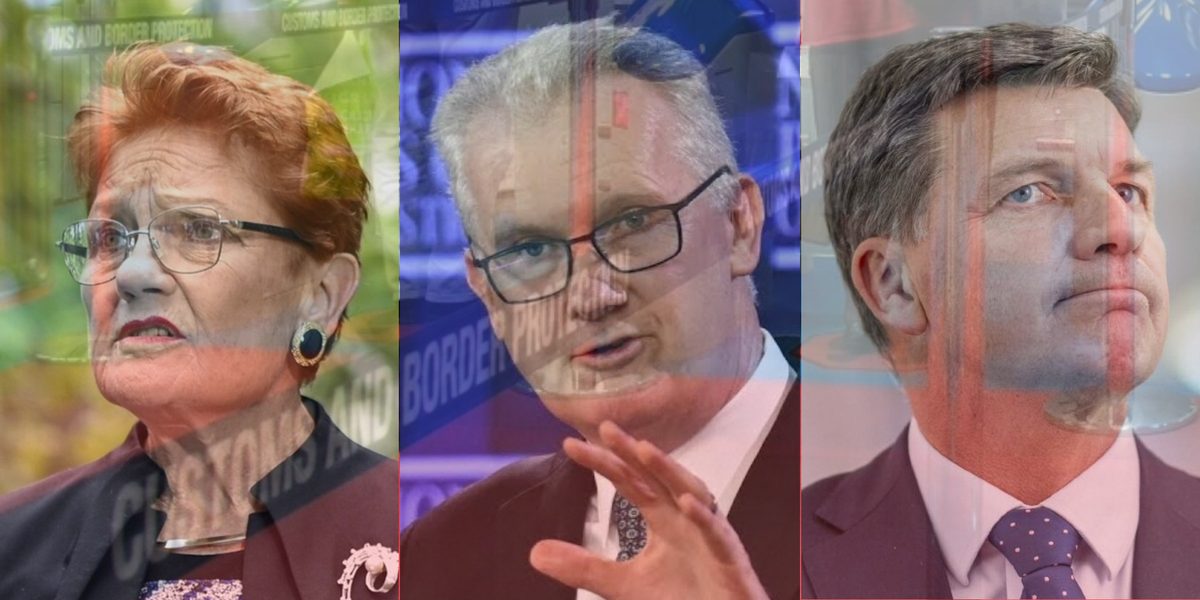
One Nation and Labor have unveiled new migration policies this week, with the Coalition’s own plan close behind, each one promising fewer people while depending on more of them.
Australia has not produced enough babies to replace its own population since the mid-1970s; migrants have made up the shortfall every year since, and in almost every downturn, someone in Canberra has decided they are the problem.
Academics have a term for the anxiety underneath all of it: demographic bulimia. The phrase belongs to the German writer Hans Magnus Enzensberger, who wrote in his essay “The Great Migration” that “the idea that too many and too few people could simultaneously exist in the same territory causes panic – an affliction for which I would like to suggest the term demographic bulimia.” Dr Luke Mansillo, a political scientist at the University of Sydney who specialises in Australian elections and racial politics, says the same contradiction sits underneath Australia’s own migration debate.
“It’s simultaneously too many and too few, as opposed to demographic anorexia, which is what Japan has,” Dr Mansillo said.
Enzensberger argued the panic cannot be reasoned away, because both fears live in the same mind at once. It produces, he wrote, “policies of stop-and-go, alternating between timid repair measures and obstacles to thought and action,” rather than a settled answer to either fear.
Dr Mansillo said the condition is particularly heightened in nations like Australia where we have both extremes at once.
“We both have the German and French experience of people from other places coming for betterment, we needed that,” he said.
“But we also, at the same time, have the Bulgaria in us, where the future is disappearing.”
Germany and France have spent decades absorbing large numbers of migrants and refugees, looking “too full” to some of their own citizens, while Bulgaria’s population has fallen by more than a quarter since the end of communism in 1989, from just under nine million people to under 6.7 million.
That is roughly where Australia sits: dependent on immigration to keep the economy running and furious about it, but at the same time, knowing that the only alternative is population – and economic – collapse.
The nation that can’t grow itself
Australia’s fertility rate dropped below replacement level in the mid-1970s and has not recovered. Dr Mansillo traces the shift to the oil crisis of that era, the same kind of economic shock that cut births during the Great Depression, before recovery came after the Second World War.
“It’s an economic decision to have a child,” he said.
Australia is not alone. Global fertility has more than halved since 1950, and the OECD average has fallen to 1.46 births per woman, well below the replacement rate of 2.1. China, Japan and Germany are all already shrinking, and Dr Liz Allen, a demographer at the Australian National University, says Australia is “about a generation away from the same fate” without migration to cover the gap. As Dr Allen puts it, “rather than an exploding bomb of overpopulation, the world faces an economic and social implosion due to lacking substantive supports necessary to help raise much-wanted children.”
Since then, population growth has leaned on immigration. Net overseas migration (NOM) peaked in the years after the pandemic reopening, as Australia made up for two years of closed borders, but has fallen sharply since. Minister Burke said at the National Press Club on Thursday, 17 September, that the figure is now “47 per cent below what that peak was.”
NOM currently sits at about 301,000 a year. The government wants that down to 245,000 this financial year and 225,000 a year after that, from a starting point of 292,100. The Coalition wants it closer to 170,000, tied to how much housing the country is actually building. One Nation wants a hard cap of 130,000.
NOM is also something no political party can fully control, so all of these commitments and targets are meaningless. NOM counts Australians and New Zealanders travelling in and out of the country as well as migrants, movements no visa policy can stop or set a number on. That makes a political promise to hit a precise NOM figure about as reliable as a government telling you it can reduce your electricity bill.
Dr Mansillo’s own explanation for the anxiety is less about immigration than about what immigration has come to stand in for.
“It’s a discursive problem,” he said. “We’re beating around the bush, and we talk about immigration because we don’t know how to talk about what this is to us.”
He points to rural Australia’s own hollowing-out: decades of factory and farm closures that pushed people off the land and into cities.
“So there’s racial resentment born of it. It’s often put into the guise of housing or jobs or what have you, because it’s an easy phrase for people to latch onto,” he said. “And people don’t like being called racist.”
Dr Mansillo also connects the anxiety to trust: small, wealthy, homogeneous countries tend to have generous welfare states, he argues, because people believe the next generation will pay in as the last one did, and when that belief erodes, whether through migration, inequality or simple demographic change, support for collective institutions erodes with it.
“Societies that cannot replace themselves have something afoot that is problematic,” Dr Mansillo said.
“We require migrants to replace the taxpayers that were never born.”
Migration and reproduction are different debates, but they run on the same fuel: a fear of who is, and is not, going to make up the country’s future, and a wish to control it. Migration is a genuinely hard thing for a government to control, since so much of net overseas migration is simply Australians and New Zealanders living their lives. A woman’s body has historically been a far easier thing for a state to legislate than a border, particularly for the male politicians who don’t face the consequences of reproductive policy.
In August, Coalition MP Llew O’Brien and Nationals leader Matt Canavan pushed to revive restrictions on abortion access, and Barnaby Joyce was among those who turned out to back them at a Parliament House rally organised by the Australian Christian Lobby.
“You have a responsibility to care for a person. Let’s call it what it is – a person,” Mr Joyce said.
It was not a one-off: Mr Joyce had already spoken at a separate anti-abortion rally outside NSW Parliament earlier in the year. Flinders University researcher Dr Prudence Flowers has described the emerging broader pattern as “a quite noxious brew of anti-feminism, anti-abortion and anti-immigration all tied together.”
One Nation sets the terms
One Nation moved first in the latest rounds of immigration policy announcements, and went hardest. Its immigration policy, published Tuesday, 15 September, opens with a blunt line: “Our immigration system needs a radical reset.”
The plan would cut 750,000 temporary visas over three years and run net negative migration for that period. Experts have warned that Australia has only seen negative migration in times of severe economic stress, and during the Second World War. After that, the party wants net overseas migration capped at 130,000 a year, about 100,000 fewer than Labor’s long-term target. A separate policy would stop overseas students bringing family members to Australia at all, with a single exception for postgraduates on a new “high-value study visa.”
One Nation leader Pauline Hanson dismissed calls for the policy to be independently modelled.
“Do you trust these economists, what they come out and say? Because I don’t,” she said on News24 on Tuesday.
One Nation MP Barnaby Joyce backed her in on the ABC’s National Forum. He dismissed the Parliamentary Budget Office as unelected.
“They’re not elected. I am,” he said.
“I’ve never seen forward estimates in any budgetary paper being even close to the mark of what it’s supposed to do, and so the will of the Australian people is so pronounced. This has to be dealt with.”
Senator Canavan was not much kinder about the policy itself.
“There’s a reason One Nation have had four policies in four weeks, is they’ve gone off half-cocked a number of times, they haven’t quite understood the complexities,” he said on ABC TV.
Angus Taylor went after Mr Joyce directly, pressing him on the impact on our region rather than principle.
“Barnaby Joyce needs to explain what One Nation’s migration policy would actually mean for families, farmers and small businesses across New England,” Mr Taylor said.
“One Nation says net overseas migration will be negative for three years, but has not said what the number will be in year one, year two or year three.”
“If it is negative, how negative?” Mr Taylor said.
“There is also no published dollar cost to the federal budget and no PBO costing attached to the announcement.”
“What does it mean for a publican in Tamworth who cannot find staff?” he said.
Business groups were blunter still, with Australian Chamber of Commerce and Industry chief executive Andrew McKellar warning of the economic cost.
“Major cuts that reduce skilled migration would damage our economy, hit the budget and weaken our capacity to provide services for, and lift, living standards,” he said.
Labor’s careful arithmetic
Labor’s own reforms are narrower than either of its rivals’. International students and graduate visa holders will no longer be able to bring family members to Australia, other than PhD students and some exceptions for Pacific and ASEAN nations. It is nearly identical to One Nation’s own position on student family visas. Neither party has published modelling or evidence to justify the specific restriction. Working holiday-makers will face a ballot for second and third-year visas, with second-year places cut from 57,000 to 45,000 and third-year places cut from 31,000 to just 5,000. The points test will be reworked so construction qualifications count alongside university degrees. About 77,000 people who have overstayed their visas will face detention for a matter of weeks before removal.
Speaking at the National Press Club this week, Minister Burke described the system he wants as a simple one.
“If you want to come on a temporary basis to Australia, apply for a temporary visa. If you want to come to Australia permanently, apply for a permanent visa. And if you no longer have a valid visa, you should leave Australia,” he said.
Speaking on ABC News Breakfast that same morning, Tanya Plibersek defended the government’s record.
“We’ve been methodically bringing down net overseas migration since we were elected. It’s about 45 per cent lower now than when we came to government,” she said.
“We want to continue to meet the targets that we’ve set for net overseas migration, 245,000 this year, 225,000 the next couple of years. We know that this country needs skilled migration. Our health system, our aged care system, our agricultural sector wouldn’t work without overseas migration.”
The Coalition was not persuaded the reforms went far enough. Senator Duniam said the measures had merit but fell short.
“There are some measures that have been announced that have merit and that may go some way to dealing with this problem but there is so much more to do,” he said on ABC TV.
“The visa hopping, which they’ve attempted to make some remedies to, is a massive concern, we don’t think they’ve gone far enough on that.”
The Coalition’s other half
The Coalition’s policy has arrived in instalments, but the party will likely struggle to find a balance between wanting to please the populist right by cutting immigration, and protecting its rural base, which desperately needs more people. The first wave, an “Australian values” migration plan, was announced back in April. A fuller policy is expected within weeks.
Federal Member for Parkes Jamie Chaffey framed the existing system as broken.
“Since Labor came to power, Australia’s migration program has been in chaos. Numbers have been too high and standards have been too low,” Mr Chaffey said.
“The Coalition’s plan will restore integrity, rebuild confidence, and ensure our migration system serves the national interest.”
Shadow Minister for Home Affairs and Immigration Jonathon Duniam put it more starkly.
“Living in Australia is a privilege not a right,” Senator Duniam said.
The April announcement would make the Australian Values Statement a binding condition of every visa, with breaches able to trigger a failed character test. It would also restore Temporary Protection Visas, fast-track the refusal of protection claims from a new “safe country list,” and expand social media screening for prospective migrants.
On one point, the Coalition has been unusually specific. Nationals MP David Littleproud offered what he called an “ironclad” pledge that the party’s policy will not touch the working holiday visa program, aimed squarely at regional electorates worried about seasonal labour.
Senator Canavan went further, accusing the government of blaming regional industries for its own missed targets.
“The government is now resorting to using our farmers, service industry, other regional industries as whipping boys for their failure to bring down migration. The targeting in Tony Burke’s speech of the farm sector is an outrage,” he said.
Tasmanian Premier Jeremy Rockliff put the stakes in blunter terms, warning of the effect on his state’s farms.
“We will have fruit rotting on the vines,” Premier Rockliff said.
“If you don’t pick the fruit, there are no jobs in packing, no jobs in transport, no jobs in marketing, it must be reversed otherwise it will destroy the … job opportunities of young people.”
The Greens and the human rights argument
The Greens have opposed the cuts from a different direction: not that migration should be lower, but that treating it as a numbers problem obscures the human cost. The party’s own immigration policy goes well beyond opposing this week’s announcements, calling for the humanitarian intake to be expanded to 50,000 places a year, indefinite detention to end with a seven-day cap, and the Department of Home Affairs and Australian Border Force to be abolished altogether.
Greens leader Larissa Waters said the government was chasing One Nation’s voters rather than confronting the cost of living pressures behind the anxiety.
“There is no out-Paulining Pauline. If you fight on her territory, you lose, and put countless people into the harm of being abused for their background, culture, and the colour of their skin,” she said.
Deputy Greens leader Mehreen Faruqi, the party’s spokesperson for tertiary education, focused on what it would mean for international students.
“Labor is effectively telling international students: give us your money, prop up our universities, and subsidise our system, but don’t expect to bring your families with you,” Senator Faruqi said.
“Labor’s move to force people to choose between their family and a chance to study in Australia is soulless mimicry of One Nation tactics.”
The detention plan drew the sharpest criticism of all. Greens immigration spokesman David Shoebridge drew a direct line to the United States.
“If the Minister doesn’t want these policies to be compared to ICE, he should not behave like ICE,” he said.
Former Australian Human Rights Commission president Dr Gillian Triggs said the pre-2015 detention system Labor’s plan partly resembles had put children in what she called a “horrific pipeline,” a finding from her own commission’s 2014 report, “The Forgotten Children”.
“There were 1100 children held in detention without education, for more than a year and longer for some, but detained indefinitely,” Dr Triggs said.
“Most of those children were severely mentally and physically ill … the damage that was done to children and families is well documented, and probably unique globally.”
Sanctuary: the town that didn’t get the memo
Armidale was named a Commonwealth refugee resettlement site in 2017, and the first arrivals landed in February 2018. Mr Joyce welcomed the decision at the time.
“Settling humanitarian entrants in regional areas reduces skill shortages, promotes diversity in the workplace and the community, and builds capacity in the region,” he said in a statement.
Since then, over 650 Ezidi refugees have settled in Armidale, a rise of close to three per cent in the town’s population, along with a smaller and more recent wave of Congolese families. Lucinda Wright, of the Armidale refugee support organisation Sanctuary, has watched both groups arrive.
“The groups, particularly initially the Ezidis, have settled here, have mostly settled very well, and have begun working … and they’ve bought houses, and some of them have started businesses,” Ms Wright said.
“Like any migrant group that comes to a town, they’ve enriched it in a multicultural way, and I think broadened Armidale communities’ outlook on the world considerably.”
Ms Wright does not think the current political mood, in her own electorate’s own backyard, will change much for the people already living there.
Mr Joyce’s own position has not moved much since 2018, even as his new party runs on the opposite premise. Asked by Guardian Australia whether Armidale is a multicultural success, given One Nation’s position that multiculturalism has failed in Australia, he did not disown the town he represents.
“Armidale is made of people who’ve come from a whole range of cultures, and a whole range of ethnicities, and a whole range of religions. But I stick to it that you’ve got to, once you’re in Australia, you’ve got to work within guardrails,” he told Guardian Australia.
Out of the way, for now
Despite the intensity of recent debate, and the grief it creates for many migrants who are subjected to personal attacks and fearful of changes that may affect their right to stay in Australia, this issue is likely to fade out as the election nears, just as it did in the last election. The reason is simple: while ‘fear of the other’ is great for whipping up cheap polling numbers, no one actually wants to change the immigration settings.
As seen this week by the furious reactions to Labor’s policy announcements, particularly around student visas, or the Coalition’s promise not to touch the agricultural and working holiday visas, no one is prepared to take the cuts in their patch. The need for people in each sector is much more intense than an overall desire to ‘do something’.
Tony Bourke made it clear this week that he wants the debate to return to normalcy.
“There are some pretty absurd claims out there,” Minister Burke said. “We are capable of having a mature debate about this.”
Dr Mansillo has seen this pattern before an election, and does not expect this round of announcements to change much either.
“They’re trying to neutralise the issue early. So in the six months before the election, we’re not talking about this,” he said.
“I think it’s all talk.”
Like what you’re reading? Support New England Times by making a small contribution today and help us keep delivering local news paywall-free. Donate now