

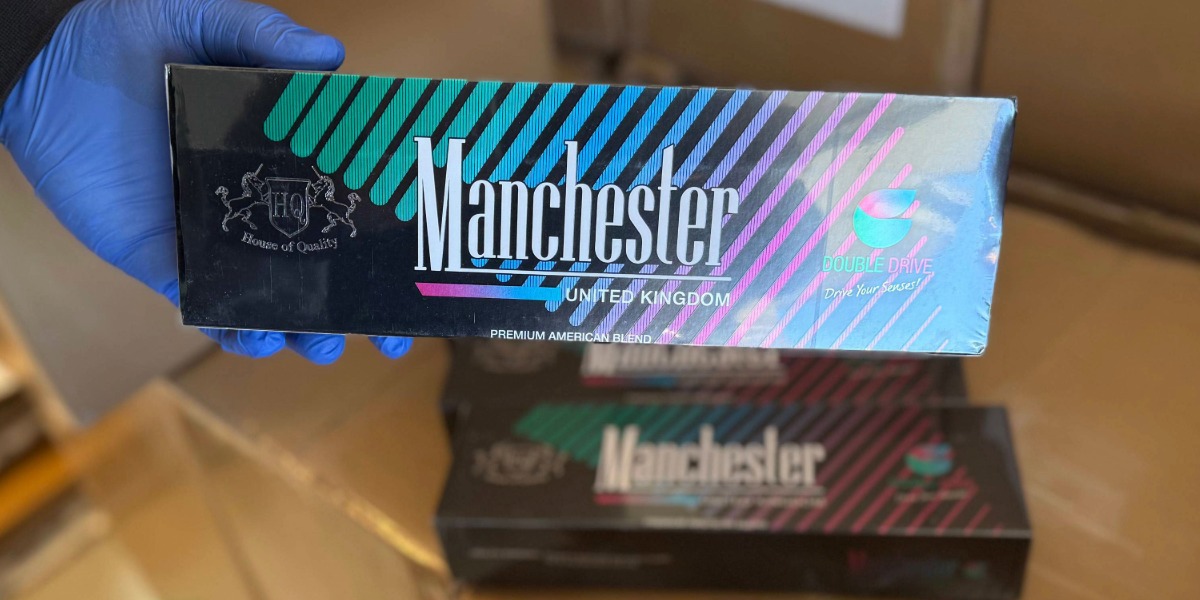
Two parliamentary inquiries have spent months hearing the same evidence. A decade of rising federal tobacco excise created a black market now worth billions. It is communities such as ours that are left counting the cost, in gutted retail strips, crippling insurance bills and, increasingly, organised crime.
Glen Innes Severn Council has been one of the loudest voices demanding action, led by the committed position of Mayor Margot Davis. Just over a year ago, GISC passed a resolution to make it known what impact the illicit trade was having on local communities.
“Illegal tobacco undermines local businesses, evades tax and funds organised crime,” she said.
“Council is committed to speaking up for our community and highlighting the very real impact this illicit trade is having on our town and more broadly the region.”
Glen Innes Severn was joined by a number of other council areas across the New England. All of them told the same inquiry the same story. Unlicensed tobacco outlets are opening on their main streets. No planning rule was built to stop them. Crime followed, and legitimate retailers are paying the price.
What the NSW inquiry found
On Thursday, 20 August, the NSW Legislative Council’s Portfolio Committee No. 5 tabled its report into the illegal tobacco trade. It runs to 16 findings and 11 recommendations.
In Canberra, the Senate’s Legal and Constitutional Affairs References Committee has spent months examining the same crisis. Its own inquiry is due to report next week, and expected to have similar findings and recommendations.
“The committee is alarmed by the expansion of the illegal tobacco trade and its connection to organised crime, placing local communities and business at an increased risk of harm,” Committee Chair Robert Borsak said.
The NSW report is unambiguous about where responsibility sits. It found that increasing federal excise “has played a decisive role in the dramatic expansion of an illicit market in tobacco in Australia.” It found that current excise levels are “not acting as a deterrent to smoking, but rather a deterrent to smoking legal tobacco.”
The black market, it found, is “helping fuel the trade in illicit drugs and other organised crime activities, including arson, murder and other criminal syndicate related violence.” It is also “seriously adversely affecting legal tobacco retailers, including though reducing their business revenue and increasing their insurance premiums.”
The committee was unequivocal in where the blame should be laid.
“The federal government needs to take clear and direct responsibility and accountability for reducing this illicit trade.”
It found that state and territory governments are “shouldering a significant financial burden” from the black market’s growth, and need direct federal financial help to fight it. And it found there is “no clear evidence that enforcement and regulation alone will meaningfully reduce the black market in tobacco.”
Its central recommendation follows directly. The federal government should, “as a first step, immediately reduce the excise rate to the rate in effect in January 2019.” Any cut should be paired with research into the right long-term rate, sustained enforcement, retail density controls and cessation funding.
Other recommendations call for public consultation on capping tobacco retail licences. They call for development approval to be required for stores near schools. They call for a public awareness campaign on illegal tobacco’s links to organised crime, and more compliance officers with a focus on regional areas. And they call for a formal mechanism for the Commonwealth to fund states for the enforcement burden created by its own excise settings.
Its final findings also state that the persistently high excise rate “has a disproportionate negative effect on smokers from poor socio-economic communities who are more likely to access illicit tobacco than wealthy smokers”. In other words, the burden falls disproportionately on communities like ours.
How a decade of tax rises created the trade that is now impossible to police
The excise increases at the centre of the NSW committee’s findings did not arrive all at once. From December 2013, the federal government legislated four consecutive annual increases of 12.5 per cent, on top of ordinary indexation. The last took effect in 2016.
The Centre for Independent Studies has since identified that run of rises, in research into the trade, as the point from which a black market began to take hold at scale.
By 2021-22, tobacco excise was raising $12.7 billion a year. But the Tax Office had already identified an excise gap of at least $2.3 billion, attributed to the illicit market. That figure comes from a federal parliamentary Bills Digest, prepared ahead of the next round of increases.
That round added a further 5 per cent a year on top of indexation, from September 2023 through September 2025. It was the tipping point that sent the illicit market into overdrive.
Researchers Dr James Martin and Dr David Bright, of Deakin University, gave evidence cited in the digest. Australian smokers were already “taxed at one of the highest rates among comparable nations,” they stated, and the increases were “only likely to increase” demand for illegal alternatives.
The May 2025 federal budget confirmed how far the government’s own revenue base had already collapsed. Tobacco excise was once one of the most reliable levers in the federal budget. It is expected to raise around $7 billion this financial year, down from more than $16 billion at its peak, the ABC reported. Treasury is forecasting a further plunge of nearly the same amount over the following four years.
Treasurer Jim Chalmers put more than $150 million toward tackling the trade in that budget. His argument was that enforcement, not price, was the answer.
“There’s two ways that we get tobacco excise down. One’s a good way and one’s a bad way,” he said.
Rohan Pike is a former Australian Border Force officer who ran its tobacco strike team. He was blunter about what a decade of policy had produced.
“It’s a low-risk, high-reward crime pot that is attracting more and more criminal groups,” he said. “The golden goose is now well and truly cooked.”
By February this year, NSW itself was formally asking Canberra for money. It argues the Commonwealth created the mess it must now clean up. Announcing extra federal funding for state enforcement, Health Minister Ryan Park said the assistance was “an acknowledgement that the federal tobacco excise is out of step with the community and it is driving consumers towards cheaper illegal tobacco products.”
“But so long as the federal excise is where it is, we can continue to see illegal tobacco permeate throughout our high streets,” he said, “and so I will continue to work constructively with our Commonwealth colleagues in establishing a more sustainable, long term and permanent funding stream for tobacco enforcement personnel.”
The political for and against
Coalition MPs have been calling for an excise cut since at least 2024, when Queensland MPs Llew Obrien (LNP, Wide Bay) and now former MP Warren Entsch (LNP, Leichardt), spoke out on the issue.
O’Brien, a former police officer, said the trade was “totally out of control.”
“We need to at least look at reducing excise and consider whether that will help get this under control,” he said.
Entsch said at the time he had watched illegal tobacco shops trade openly in his own electorate with long queues.
“If you think you’re going to tax yourself out of this problem, you’ve got to be kidding,” he said.
Days after the Labor NSW Health Minister pointed to federal excise as the problem in 2025, Oxford Economics published research recommending the excise be reset to 2019 levels, alongside stronger enforcement. It modelled the price gap between legal and illegal cigarettes, and found it had widened from $11 to $47 over the past decade.
It put the illicit market’s current share at 50 to 60 per cent. Without a change of course, it forecast that could reach 89 per cent by 2028-29. But a combined reset and enforcement push, it estimated, could cut that share to 37 per cent, while adding $3.1 billion back to excise revenue.
That research fed more political pressure that broke into the open in April, when the Coalition proposed cutting the excise by 50%, followed by a similar claim by One Nation in June.
Pauline Hanson went further in mid-August, calling for a 75 per cent cut that would strip nearly $30 off the price of a pack of cigarettes.
“People are sick of the firebombing, shootings, extortion and killings. They are sick of watching tobacco shops burn, while organised crime takes control of the market,” she said.
To which the Coalition responded with assertions they were working on a policy proposing an 80% cut.
“We have said for some time the excise rate needs to be cut to kill organised crime and kill the black market,” Nationals Leader Matt Canavan said.
Member for New England Barnaby Joyce argued that constantly raising the price of cigarettes and expecting more tax revenue was “absurd economics.”
“You’re going to get more mafia … and that’s precisely what’s happening,” he said. “And the only way we can deal with the criminality … is to bring back the price of legal cigarettes into the same realm as where the illegal ones are.”
Labor dismissed the calls as a “thought bubble”.
“The government’s focus is on the compliance side,” Treasurer Jim Chalmers said. “[An excise cut] is not something we are proposing.”
Health Minister Mark Butler was more dismissive still of Senator Hanson’s specific plan. He described it as a cheap headline rather than considered policy.
“We’re not going to be particularly interested in sort of thought bubbles like One Nation’s this week,” he said. “There is a Senate inquiry looking at this right now. We’ll look at that report very, very closely.”
There is evidence to the Senate Inquiry that an excise cut may not work.
Australian Medical Association president Danielle McMullen argued the international evidence does not support the theory that a cut would kill the black market.
“The illegal trade persists even in countries with much cheaper cigarettes, including in countries like Vietnam, the Philippines and Senegal where tobacco is very cheap,” she said.
“There’s absolutely no evidence to support the idea that reducing excise will impact illegal tobacco.”
ITEC Commissioner Amber Shuhyta also claims to have seen no solid evidence that closing the price gap would bring smokers back to the legal market. “There’s no evidence in front of me that, even if we made regulated products $30 or $20, people wouldn’t still opt for a $10 packet,” she said.
The NSW committee heard all of this and was not swayed. It found the ITEC Commissioner’s evidence “focused on protecting tobacco excise as a public health tool.” Harm minimisation, it concluded, not an unbending commitment to high prices, should now govern policy.
Organised crime, arson and billions of dollars
Under NSW and federal law, tobacco is illicit if it is imported, manufactured, supplied or sold without the correct excise paid. That covers everything from smuggled, branded cigarettes to “chop-chop,” loose-leaf tobacco grown domestically outside any regulatory system. No licence to grow or process tobacco in Australia is issued.
The scale of that trade is contested. But every measure points the same way: up, sharply. The NSW committee cited the ITEC Commissioner’s estimate that the illicit market now makes up 50 to 60 per cent of all tobacco sold in Australia. That is up from around 15 to 20 per cent as recently as 2016.
Imperial Brands stated in its submission that “current industry estimates indicate illicit tobacco consumption has now exceeded 60 per cent.” Others claim it is higher still.
Even the Tax Office’s own submission conceded its official tax-gap model “understates the size of the illicit tobacco market.” That model put the net gap at 19.6 per cent in 2023-24.
A legal pack of 25 cigarettes that cost $13 in 2010 costs $40 to $50 today. Illegal packs, which pay no excise, sell for as little as $7 to $15.
Deputy Commissioner David Hudson, of NSW Police, said the gap has done the damage.
“You have ostensibly law-abiding citizens who are faced with an option of spending $65 for a product or as low as $7 for a product, and there’s no penalty in buying it,” he said.
Government forecasts obtained by the NSW committee show excise receipts falling from $16.27 billion in 2019-20 to $7.77 billion in 2024-25, and just $4.13 billion this financial year. The Australian Border Force reported seizing 2.53 billion illicit cigarettes and 435.46 tonnes of loose tobacco in 2024-25 alone. That is a 320 per cent jump on four years earlier.
The illicit trade has become entangled with serious organised crime. Dr Martin said competition for the market “has fuelled an ever-expanding nationwide crime wave.” He pointed to “over 270 firebombings, multiple homicides, a growing number of thefts and robberies and instances of extortion targeting the legal retail sector, and at least one terror attack, now linked to an infamous tobacco crime boss.”
Prohibition Does Not Work is a network of think tanks. Citing Australian Criminal Intelligence Commission data, it put the national figure at more than 200 firebombings and at least three homicides since the “tobacco wars” began, with associated costs estimated at $4 billion a year. It named outlaw motorcycle gangs, including the Mongols, Finks and Rebels, alongside Iraqi crime syndicates.
It cited reporting that described the pattern behind the arson attacks in three words: “earn or burn.”
Enforcement active but ineffective
On Tuesday, 11 August, federal, state and territory agencies ran Operation Shorthand. It was a coordinated raid on more than 100 service stations across New South Wales, Victoria, Queensland, South Australia, Western Australia and the ACT.
“My message to anyone involved in the illegal tobacco trade is clear: we’re coming after you,” said Assistant Minister for Customs Julian Hill.
It was just the latest in a series of chest-beating statements from law enforcement that seems disconnected from the reality of a complete failure to curb the activity.
The ATO’s casework shows the scale of the task. In August 2025, Operation Bear on the Gold Coast seized 7.5 million cigarettes and more than 26,000 vaping devices.
Between July 2018 and June 2025, the ATO’s Illicit Tobacco Team completed 97 operations. That resulted in 180 seizures, almost 498 tonnes of product and roughly $782 million in excise duty foregone. It referred 48 briefs of evidence to prosecutors, for 31 convictions. Courts, the ATO stated, were “hesitant to impose the stronger penalties introduced in 2018.”
Reforms passed since November 2025 give NSW some of the toughest penalties in the country. Selling illicit tobacco, or possessing a commercial quantity of it, now carries up to seven years’ jail and fines above $1.5 million. In the most recent reforms announced this week, landlords in NSW who knowingly let tenants sell it face up to a year in prison and fines up to $165,000.
“Landlords who intentionally allow tenants to sell illicit tobacco and illegal vapes are not only undermining legitimate business operations, but they are exposing their community to associated criminal activities,” Mr Park said.
Yet Prohibition Does Not Work argued that even record funding has not been enough. Some $345 million has been committed to enforcement agencies since January 2024. It cited former Australian Border Force Commissioner Michael Outram’s observation that “prohibition of goods at the border, in itself, is unlikely to solve a problem.”
It estimated as much as half of illicit imports still enter the country unabated. The system inspects only a fraction of the roughly 9.38 million shipping containers arriving in Australia each year.
Mr Foukkare said that without a change in policy, crackdowns just produce a “game of whack-a-mole,” with shut-down stores reopening under new names.
Happening right here and now
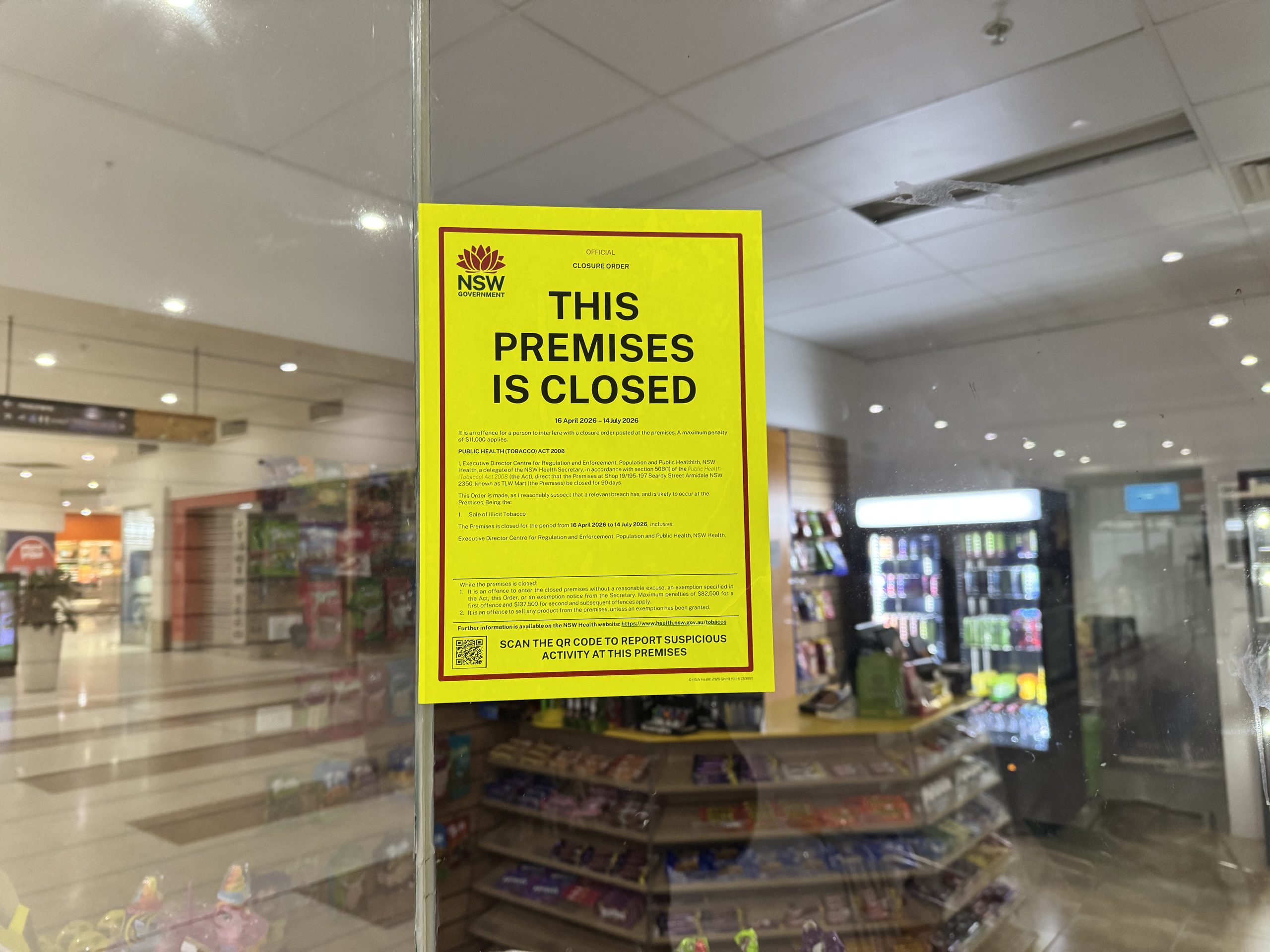
That pattern has already played out on our own doorstep. In April, a multi-agency operation involving New England Police District and NSW Health targeted the region. Multiple premises across Glen Innes and Armidale were issued three-month closure notices, and about $84,000 in illicit tobacco and vaping products was seized.
The following month, New England Police District officers stopped a car on the Newell Highway near Moree. Inside, they found 434,600 illicit cigarettes and about 60 kilograms of dried tobacco leaf, worth more than $1 million, along with cash suspected to be the proceeds of crime. An 18-year-old and a 19-year-old were charged. Both were refused bail.
None of it has put a dint in the local trade. Most of the stores closed in April’s operation are trading again like nothing happened.
Council’s General Manager Bernard Smith gave evidence to the NSW Parliament’s illegal tobacco inquiry that compliant local retailers are being punished, and their only offence is being located near a suspected illicit tobacco outlet.
“It’s impacting on their revenue. It’s impacting, particularly, on their insurance premiums, six-figure excesses and tripling of insurance costs,” he said.
“Businesses which have vacated because of their proximity to illegal premises, their insurance costs have gone through the roof.”
In their submission to the NSW Parliamentary inquiry, Narrabri Shire Council sought a standalone planning category for tobacconists to give councils a mechanism to deal with the issues.
“Our community, like many in regional areas, is directly affected by the health risks, potential criminal connections, and economic disruption caused by unregulated tobacco sales,” it stated.
“Council stands ready to work with State and Federal agencies to support reform and protect the health, safety, and vibrancy of our local communities.”
Inverell Shire Council stated it supported “tougher regulation of the sale of illegal tobacco.” But it insisted “the significant impost of attempting to regulate the illegal tobacco trade is not forced down to Council.”
The message is clear that our local communities are paying the price for Labor’s desire to be seen to be tough on smoking, and taking it too far.
NSW wants the excise cut immediately. It argues that is the only fix that reaches every servo and tobacconist at once.
All eyes will be on Canberra this week to see if the Senate Committee does deliver its report, pushed back twice already, and whether the Federal Government acts to clean up the problem it made.
Like what you’re reading? Support New England Times by making a small contribution today and help us keep delivering local news paywall-free. Donate now