

In a flurry of announcements and changes in the renewable space announced this week are a number of big wins for mid-scale solar projects, including an expanded solar rebate scheme to cover systems up to 1MW, and $100m in concessional funding for up to 16 hybrid projects up to 5MW capacity.
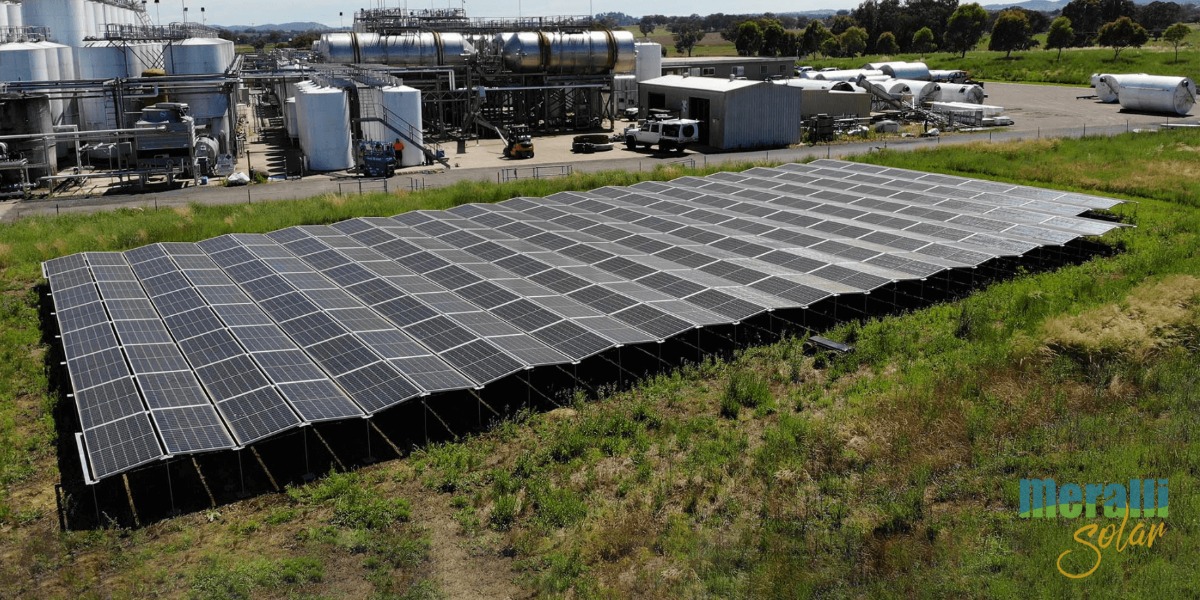
Meralli Solar is a leading provider of peg frame solar solutions specialising in small and utility-sized systems, many of which would qualify for the expanded rebate. Methuen Morgan, Director of Meralli Solar, said the expansion of the Small-scale Renewable Energy Scheme (SRES) from 100 kilowatts to 1 megawatt would make larger solar systems more financially viable for farms, manufacturers, schools, community facilities and other regional enterprises with big daytime energy needs.
“This is a welcome and practical change for regional Australia,” Dr Morgan said.
“Eligible projects are expected to receive an upfront discount of approximately 20 per cent, helping organisations reduce and stabilise their energy costs.”
Dr Morgan said the change could also open the door to community solar projects, allowing regional communities to generate more of their own energy and share in the economic and energy security benefits.
“Fast, high-quality solar builds designed for regional conditions can support local employment, strengthen energy resilience, and keep more investment within regional communities,” he said.
“We have seen this potential through our work at the Wathagar Cotton Gin near Moree. While Wathagar is a much larger project, it demonstrates how solar and storage can support agricultural productivity and wider regional development.”
“The proposed improvements to network-connection processes are also welcome,” he said.
The SRES expansion was announced by the Albanese Government on Wednesday, 5 August, and is expected to commence from 1 October, subject to regulations being finalised, cutting the upfront cost of installation by around 20 per cent on systems up to ten times larger than currently supported.
According to the Institute for Energy Economics and Financial Analysis, Australia’s residential solar capacity sits at 22 gigawatts, while businesses have installed only around 5.6 gigawatts, most of it in systems below 100 kW, the “missing middle” the government says the change is designed to unlock. The discount is estimated at $68,000 off a 250 kilowatt system or $136,000 off a 500 kilowatt system.
Minister for Climate Change and Energy Chris Bowen said the change would let more businesses and communities realise the benefits from solar that households already have.
“We’re putting more rooftops to work and helping businesses, farms and community organisations cut energy costs by slashing the cost of installing medium-sized solar systems by around 20 per cent,” Minister Bowen said.
“One in three Australian homes have rooftop solar, but larger energy users have been locked out because the existing solar rebate only supports systems up to 100 kW.
“We’re fixing that by expanding support to systems up to 1 MW, unlocking the potential of commercial rooftops and helping businesses cut power bills, invest in growth and create jobs.”
The expansion is expected to be budget neutral, funded through the existing SRES model administered by the Clean Energy Regulator since 2011. The government also plans to improve network connection processes for mid-scale solar projects through targeted rule changes.
The CEFC has also committed $100 million to unlock the ‘missing middle’ of Australia’s clean energy transition, working with Infradebt to accelerate delivery of mid-scale renewable energy assets, financing the development of up to 16 hybrid solar, battery and battery retrofit projects.
Community Power Agency welcomed the announcements, with Community Power Agency Director Claudia Hodge saying the funding could be transformative, but only if community groups get a genuine look in.
“These projects deliver more than electricity: they build local ownership, retain value in regional communities and strengthen trust in the energy transition,” Ms Hodge said.
Rewiring Australia also welcomed the expansion. Chief executive Francis Vierboom said it would let communities generate and use more affordable electricity close to home.
“Every community has enormous roofs sitting above warehouses and shopping centres that could be producing cheap electricity,” Mr Vierboom said.
“That power can be used locally to run machinery and refrigeration, electric vehicle chargers or other equipment and help slash costs for businesses and prop up local economies.”
Dr Morgan would like to see the rebate extended to batteries too.
“Battery storage enables businesses and communities to make fuller use of locally generated energy and improve reliability and resilience.
“Support for appropriately scaled commercial and community batteries needs to be the next step.”
Got something you want to say about this story? Have your say on our opinion and comment hub, New England Times Engage