

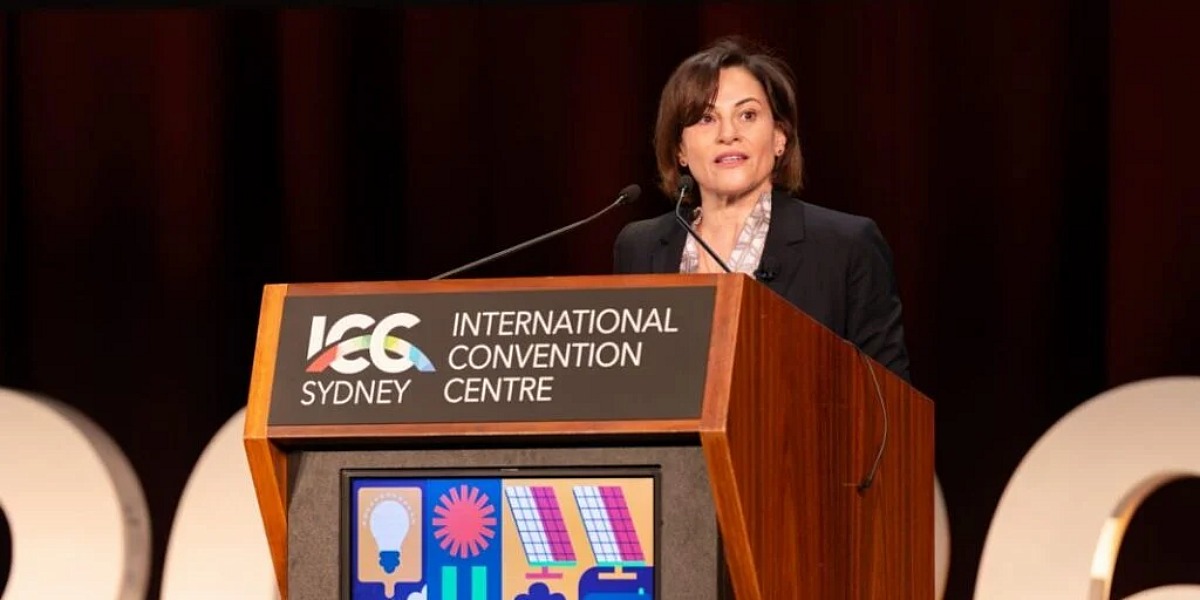
The peak body for Australia’s renewable energy industry admits it does not have the trust of the regional communities hosting its wind and solar farms, including those across the New England, and has proposed a national royalty scheme paid to councils in response.
A royalties scheme to replace the ‘patchwork’ of community agreements
Speaking at the Australian Clean Energy Summit in Sydney on Tuesday, 28 July, Clean Energy Council Chief Executive Jackie Trad said the industry no longer needed to make the case for renewable energy. Its real problem, she said, was winning over the towns where it builds.
“The fundamental problem this industry has is trust. We do not have enough of it in the places where we build: regional and rural Australia,” Ms Trad said.
Ms Trad proposed a national Renewable Resources Payment scheme. Under the plan, every megawatt-hour of renewable electricity generated would attract a legislated payment, paid directly to the local council hosting the infrastructure for the life of the project. It would replace the current mix of access fees, community benefit funds, grants rounds, and negotiated payments.
“Scrap the patchwork. Replace it with something simple, permanent and public, the same way coal and gas pay royalties,” Ms Trad said.
“Regional Australia is being asked to host the machinery of our energy security. The least we can do is make sure the towns that host it share squarely in the wealth it creates.”
Ms Trad said councils, not the industry, should decide how the money is spent, arguing local government is the most trusted level of government in the country.
Local Government NSW President Darcy Byrne welcomed the proposal.
“Councils want renewable energy to succeed, but host communities must see real, lasting benefits from the infrastructure in their backyards,” Mayor Byrne said.
Who knows best?
Community Power Agency, a not-for-profit that works directly with communities navigating the energy transition including many in the New England, said building genuine trust requires more than payments made entirely to councils.
Community Power Agency Director Kim Mallee said trust could not simply be paid for.
“Trust is earned through building genuine relationships, behaving as a good corporate citizen and as a reliable long-term neighbour,” Ms Mallee said.
Despite the comparison made by Ms Trad, royalties paid by coal and gas companies are not the same as community benefit funds. Royalties are a tax levied by state governments on resources extracted, while community benefit funds are a bespoke response to the needs of an individual community. Mining companies generally pay both.
“This idea was inspired by companies in Central Queensland, whose rocky relationship with the Isaac Regional Council has done a complete reversal,” Ms Trad said in her speech.
“Payments made to the council, for its own purposes and priorities, have shown that community that our industry cares about their future, and invests in it.”
Community benefits payments going to council revenue would, in the New England context, deprive communities of both the say and the benefit they currently enjoy. Existing structures of community benefit largely support community life well outside of council’s purposes and priorities, while other agreements contribute to more direct costs related to roads and other infrastructure related to the development. Uralla’s annual grants from the New England Solar Farm, or the similar program in Inverell from the long established Sapphire Wind Farm operated by Squadron, deliver much needed funds direct to community groups, sporting clubs, and local events that would otherwise not be available.
“A mayor knows whether the town needs a pool, a childcare centre, doctor’s rooms or a decent road,” the former Local Government Minister in Queensland said in her speech. “And if the money is spent badly, there is a reckoning every four years at the ballot box.”
However, a key component of many community benefit funds already operating or in advanced development in the region is that community members, not elected officials, know best.
Armidale Regional Council has done significant work on its program, which sets a minimum payment of $850 per megawatt a year for solar and storage projects and $1,050 per megawatt a year for wind projects. The mechanics of the fund management is still being finalised, but is built around the idea that that a central fund with a ‘board of guardians’ invests and grows the money, while a community committee decides how funds are spent. In recent consultation on the Board of Guardians, residents made clear they do not want elected councillors or council staff controlling disbursements, as would seemingly be the case under Ms Trad’s proposal.
Last week, Armidale Regional Council unanimously voted to reject a proposal from Edify Energy’s Kooyong Battery project, precisely because it saught to take control away from the community. The proposal offered the required minimum of $850 per megawatt a year, or $170,000 a year, but sought to direct 85 per cent of that to the central fund while keeping 15 per cent to manage itself. In the brief debate rejecting the proposal, all agreed that the community knows best.
“It’s the first time that a planning agreement for a renewable energy project is being put before this council that is not consistent with our adopted community benefit sharing framework,” said Armidale Regional Council Mayor Sam Coupland.
“In this instance, we have a developer who is effectively saying they know what is best for our community, and in the process is seeking to shortchange us.”
Community Power Agency said any nationally consistent payment rate must be kept separate from money councils already receive for infrastructure contributions or payments in lieu of rates, which it described as a cost of doing business. Its Guide to Regional Benefit Sharing argues communities need at least two levels of investment: one for the immediate neighbourhoods hosting turbines and panels, and a second, wider regional fund for longer-term legacy projects.
The Clean Energy Council did not answer questions about whether it had consulted regional stakeholders before announcing the plan.
In June, regional mayors said they were not consulted before the NSW Coalition opposition announced plans to scrap the transmission line underpinning the New England Renewable Energy Zone, and lack of consultation was clearly identified in the parliamentary inquiry report this week as the core problem that caused ‘avoidable harm’ in the renewables rollout.
More work required
A Clean Energy Council spokesperson said the proposal was intended as a starting point.
“This proposal is about giving regional communities a stronger, more enduring stake in Australia’s clean energy future,” the spokesperson said.
“The Clean Energy Council has deliberately put forward this idea as the start of a conversation because we know the current patchwork of community benefit funds, grants and negotiated payments can be confusing and is not consistently building trust in regional Australia.”
“This is not a finished policy,” the spokesperson said. “It is the beginning of a discussion about whether there is a simpler, more transparent and more accountable way to ensure the communities hosting Australia’s energy infrastructure share directly in the prosperity it creates.”
Mayor Byrne said the proposal did not have to come at the expense of community involvement.
“This is not an either-or proposition. LGNSW has never argued that benefits should be taken away from local communities,” Mayor Byrne said.
“Ensuring that Councils are appropriately compensated for the impacts of renewable energy projects does not exclude communities from the process,” he said. “Rather it ensures that the community remains at the centre of the discussion.”
Kim Mallee said that while a centrally set arrangement may work for some areas, it won’t for others.
“Regional councils are an integral part of the solution, but also have varying capacities to respond strategically to the energy shift, and deliver coordinated benefit sharing that builds trust directly with host communities and creates legacy outcomes for their LGA at large. “
“Crucial to developing trust is considering how other community stakeholders will participate in the local governance of any national approach to benefit sharing funds,” she said.
Got something you want to say about this story? Have your say on our opinion and comment hub, New England Times Engage