

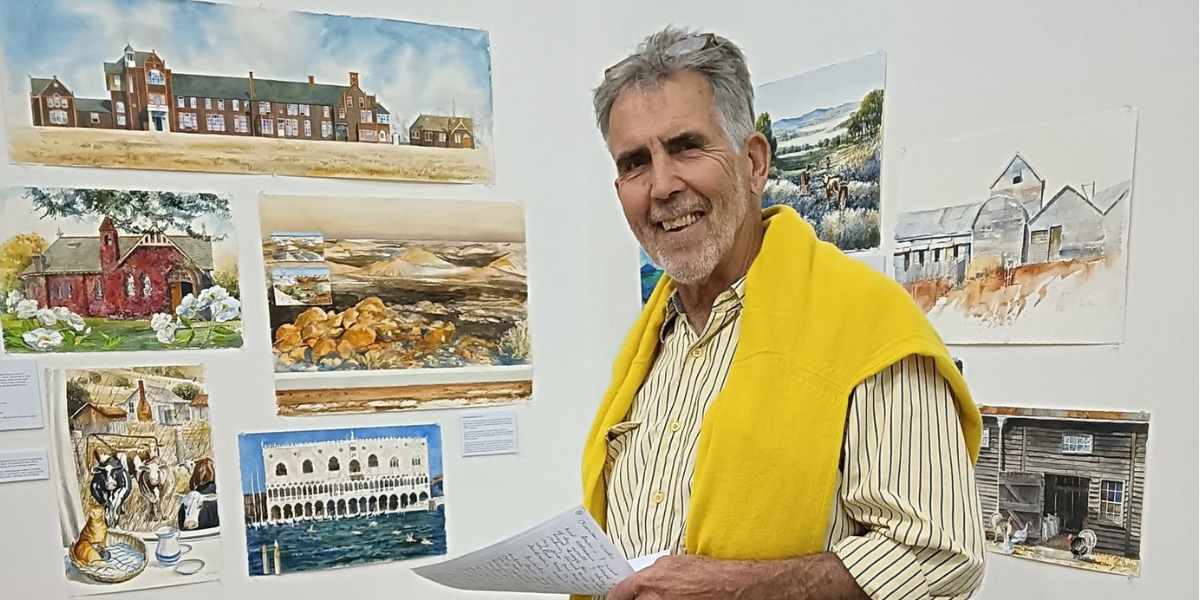
A painting career that began with a flowering almond tree on a Boggabri farm eight decades ago is now filling the walls of Weswal Gallery on Brisbane Street, Tamworth, in a retrospective spanning the entire working life of veteran regional artist James White.
The exhibition, titled “8 to 80”, opened at 2 pm on Saturday, 25 July, with Ruth Blakely OAM, the gallery’s former manager and owner, cutting the ribbon. It runs until Saturday, 5 September.
The show takes its name from the fact that it features a painting Mr White completed at the age of eight, alongside new work made this year, now that he has turned 80.
“I’ve got hundreds of paintings in drawers and things, and when I went through them, I thought, this is like looking at my life,” Mr White said.
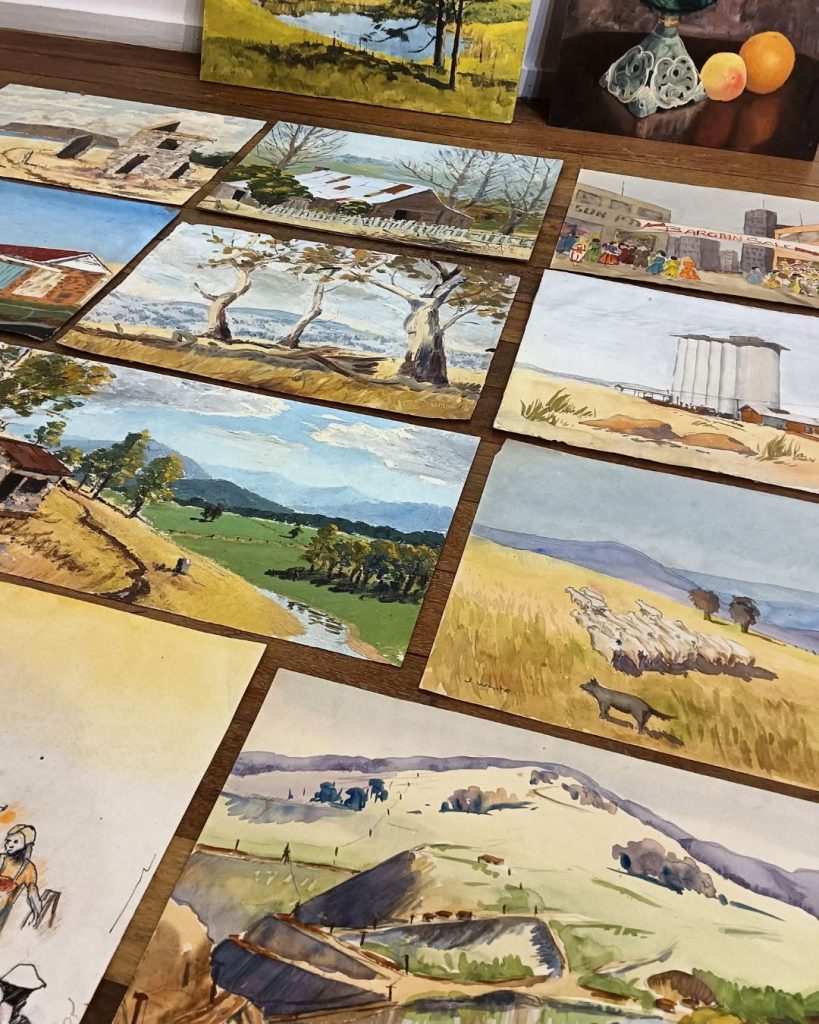
The idea for the retrospective came from Robin King at Weswal Gallery, who has curated the show alongside her sister Jean. New work by Mr White fills the gallery’s main space, while archival pieces, including his visual diaries dating back to childhood, are on display in a second room, loose in folders for visitors to flip through.
“People who go there now, because there’s so much loose art to look at, not framed up, she’s got it all in folders,” Mr White said. “They can see what the progress I’ve had during my life as an art maker.”
Mr White’s earliest surviving work is a painting of a shearing shed on the family farm at Boggabri, made when he was eight years old, after he saw a flowering almond tree beside an old shearing shed on the way to a tennis day.
“So when I went back home, I painted this scene in my head,” he said.
It was his mother who first noticed his ability and encouraged it, giving him coloured pencils, paints and paper as a boy.
“She was far more intelligent than life gave her. She became a housewife. She should have been a doctor or something,” Mr White said. “Mum was certainly the one who facilitated that all the time.”
His art education continued at The Armidale School, where he attended afternoon classes run by Fred Roberts, an English lecturer at the Teachers College. Later, well-known Barraba artist Rupert Richardson encouraged him to take up watercolours, a medium he still works in today.
After leaving school, Mr White spent three years working in shearing sheds around Australia before travelling overseas for two years in the late 1960s, a trip that broadened his subject matter well beyond the New England region.
“I can remember travelling to Greece and being absolutely amazed at how clear the water was,” he said.
Over the decades, Mr White’s subject matter has shifted many times, from early studies of machinery and shearing sheds, to distorted views seen through windows, to the landscapes and buildings of the New England region, and more recently to flowers and still life. He said a new body of work rarely follows a plan.
“Sometimes you can’t paint at all,” Mr White said. “I didn’t paint for two years. And then all of a sudden I saw something.”
His wife, Anne, gave him the support to keep painting throughout their marriage, including during the years he entered work in regional charity art shows across the New England North West, among them events at Barraba, Moree and Walcha. Mr White has exhibited at the Red Cross Currabubula Art Show since the 1960s, missing only the years he was overseas.
“I’ve exhibited there virtually ever since,” he said.
Mr White said charity art shows such as Currabubula gave him the chance to develop his style early on, and he has watched other towns in the region follow suit in more recent years, including Bendemeer and Nundle.
“They’re a great community venture, because it means Joe Average can stick some stuff up there. People come along and are entertained,” he said. “You have to take your hat off. These are run by volunteers who work their backside off to make it happen.”
Despite a career spanning eight decades and hundreds of works, Mr White remains modest about his standing in the art world.
“I don’t have any illusions about my position in the art world. I’m just a regional artist,” he said.
In 1993, Mr White and his family moved to Armidale after he was offered a term as artist in residence at The Armidale School, sketching the school’s historic Sulman-designed buildings. The residency turned into a permanent teaching position, and he went on to teach art at the school for 20 years, working with students from kindergarten through to Year 12.
Mr White said teaching pushed him to understand art history in a way he had not needed to before, as students regularly asked him to explain why famous paintings mattered.
“I worked out that often famous art is art which is done for the first time,” he said. “When the Impressionists came along, they said, this painting’s not complete. And I said, no, it’s an impression of the scene that’s happened in the past.”
Mr White has exhibited at Weswal Gallery since 1982, when he was invited to show alongside Rupert Richardson and Jean Isherwood. He credits Ms Blakely, who ran the gallery for many years, with encouraging him to keep returning.
“Ruth was such a good operator. She’s a lovely, lovely person. And she was just gentle and good at her job,” Mr White said.
Now 80, Mr White said his output has slowed, but his approach has sharpened.
“I’m painting less, but I’m painting better. I’m thinking a lot more about what my content is,” he said.
He is expected to give another floor talk at the gallery in mid-August, giving visitors a chance to hear him explain how his work is made, though people are encouraged to confirm the date and time with Weswal Gallery directly.
Mr White said he does not see his work as complicated, and that is exactly the point.
“My paintings are really just paintings for pleasure. People look at them and enjoy them. They’re not, they’re not emotive, they’re not hard to understand, they’re just nice paintings.”
Weswal Gallery, at 192 Brisbane Street, Tamworth, is open from 9.30 am to 2 pm Monday, Wednesday, Friday, Saturday and Sunday, closed Tuesdays and Thursdays. More information on “8 to 80” is available at weswalgallery.com.au.
Read all the way through to the end of the story? So did lots of other people. Advertise with New England Times to reach New England locals who are interested and engaged. Find out more here.