

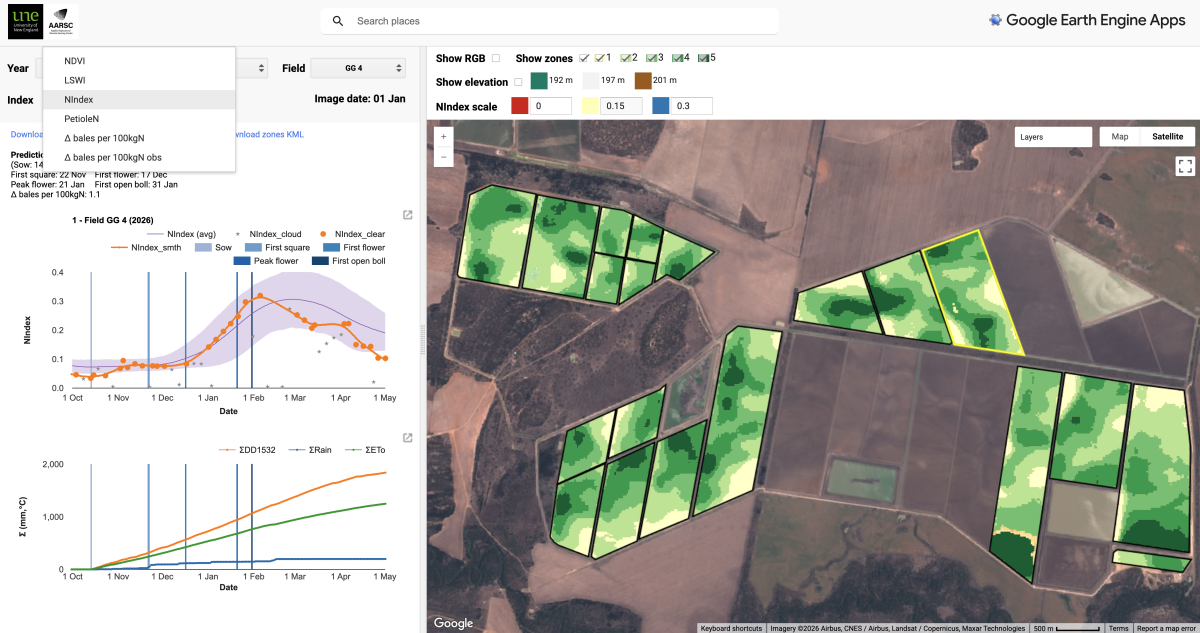
Armidale researchers are turning satellite images into real-time fertiliser advice for cotton growers; in a project the University of New England hopes will change how the industry manages one of its biggest costs.
The university is one of 11 teams sharing almost $550,000 in funding through the Cotton Research and Development Corporation’s (CRDC) Innovation Call, a national search for bold ideas to tackle three of the industry’s biggest future challenges: preparing for a low-pesticide future, optimising nitrogen use and improving weed management.
UNE’s project, Real-time dashboards turning data into decisions, will be presented at the Australian Cotton Conference at the Gold Coast Convention and Exhibition Centre from Tuesday, 4 August to Thursday, 6 August.
The 11 projects were selected in March from a national open call, with CRDC offering up to $50,000 to support each individual feasibility study.
They range from lightning-powered seed technology and AI-driven drones to biofertilisers made from farm waste and nature-based pest control, all delivering on CRDC’s Clever Cotton strategy. All 11 successful applicants will present their completed feasibility studies at Innovation Alley during the conference.
CRDC’s Acting General Manager, Innovation, Susan Maas, said the calibre of applications reflected the ambition now driving the industry.
“From AI to nature-based solutions, these ideas show just how bold and innovative the cotton industry has become,” Ms Maas said.
“Investing early in feasibility studies like these gives innovators the runway they need to test big ideas with real impact.
“We’re excited to see these ideas move from breakthrough to reality, and to hear what the innovators have found as they present their findings to the industry.”
Growers were involved in prioritising the projects through the CRDC and Cotton Australia research panels, and the feasibility studies will inform a second funding round, where up to $500,000 will be available to help successful innovators deliver proof-of-concept projects within the Australian cotton farming system.
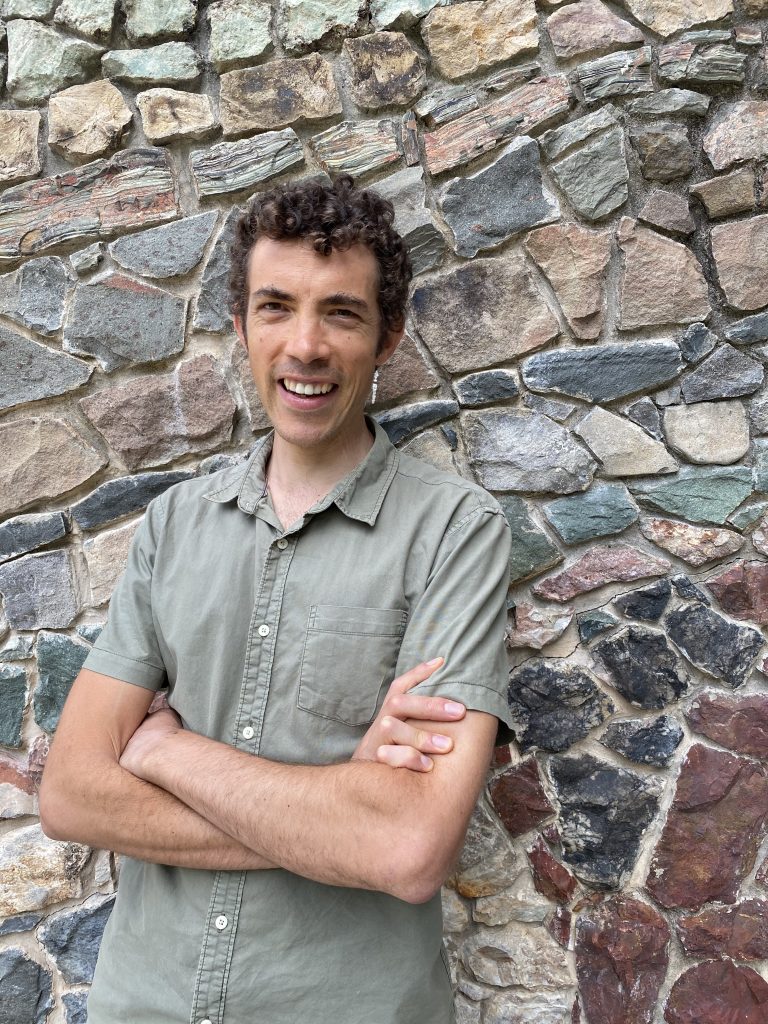
Associate Professor James Brinkhoff, from UNE’s Applied Agricultural Remote Sensing Centre, said the UNE project was aimed squarely at nitrogen use efficiency.
“The main problem is nitrogen use efficiency. We know nitrogen costs have gone up recently with the instability in the Middle East and things like that.”
“There’s an opportunity just to improve productivity and profitability for growers by providing information that helps them to really optimise how much nitrogen to put on to fields and where to put it,” Associate Professor Brinkhoff said.
The idea builds on dashboards UNE has already commercialised for the rice industry, which are now widely used across Australia. But translating that success to cotton has not been straightforward.
“It is quite different. Many of our discussions with consultants sort of really picked up on that cotton is like a shrub. So it’s a very vertical structure. Whereas rice, you know, because we’re using satellite imagery, what you see on the rice canopy is pretty much contains the information about nitrogen and vegetation vigour and things like that.”
“But because cotton is so vertical, there’s a lot of information in the lower levels of the cotton plant, which makes it more challenging, from the satellite remote sensing perspective,” Associate Professor Brinkhoff said.
Where the technology has an edge over traditional methods, he said, is in the sheer scale and detail of what it can see.
“A paddock walk or a soil test, typically you’ll just go to a few locations or you get a very limited perspective of what’s going on across the fields. It doesn’t give you a representative idea of a whole field that can have a lot of variability. Whereas the satellite, of course, sees the whole field and sees all the variability across the field,” Associate Professor Brinkhoff said.
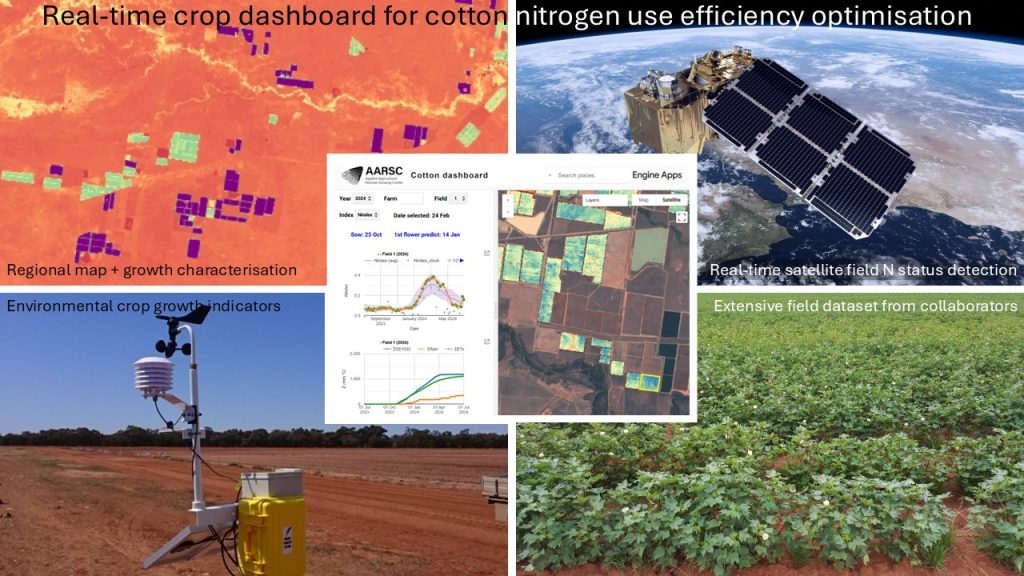
“But then the satellite information also includes things that we don’t see with our eyes. We see red, green, blue, those kind of colours, but the satellite also sees near infrared, shortwave infrared, red edge, all these bands that our eyes don’t see and that are much more sensitive to things like nitrogen status and water status.”
The system uses Sentinel 2 satellites, which pass overhead every five days, with information typically available to growers within 24 hours.
Getting nitrogen application right is a genuine balancing act for growers, with too little costing yield and too much costing money and the environment. Associate Professor Brinkhoff said one of the more promising outcomes of the six-month feasibility study was a model that predicts how much yield a paddock will actually gain from extra nitrogen.
“Some paddocks it’s going to say: actually you’re not going to get any improvement in yield if you put nitrogen on that it’s got all the resources it needs. Whereas other fields it might say: yeah, you’re going to get an additional bale if you put on 100 kilograms of nitrogen,” Associate Professor Brinkhoff said.
“It is a balancing act. You definitely don’t want too much, and you don’t want too little. So hopefully this development will provide just another source of information to try and manage that balance and to better move between the extremes.”
The team has already built a prototype dashboard and shared it with consultants and farm managers for feedback. It brings together satellite imagery, phenology models predicting growth stages such as first flower, and weather data, alongside the ability to download spreadsheets of field-by-field predictions that growers can fold into their own nitrogen application plans.
“There’s a lot of opportunity for future kind of more powerful analysis by bringing in these new remote sensing variables into that analysis,” Associate Professor Brinkhoff said.
Six months into the feasibility study, Associate Professor Brinkhoff said the response from growers, consultants and industry had been strong, with many sharing farm data to help build the initial models. But he said there was more work ahead, including quantifying uncertainty and separating nitrogen effects from other drivers of yield variability such as waterlogging or disease.
One gap that emerged during the study was the lack of large-scale nitrogen rate trials in cotton-growing regions, of the kind that underpinned the rice project.
“With our rice project, there were a lot of existing nitrogen trials that we could use, and we worked with New South Wales DPI to gather more of that data.”
“I think one of the things that we really need to maximise the benefit of this development is to have similar nitrogen rate trials across the regions and large enough so that the satellite can see it with the satellite pixels at 10 or 20 metres,” Associate Professor Brinkhoff said.
The Applied Agricultural Remote Sensing Centre, led by Professor Andrew Robson, also works across tree crops, avocados, macadamias, sugar yield forecasting and tea plantations in South Asia.
Associate Professor Brinkhoff said most growers were already comfortable using satellite imagery, but this project pushed the technology further by building models specific to cotton’s nitrogen needs rather than simply producing an image of a field.
“I think there’s openness to it. I think the new thing with this development is we’re actually trying to do cotton-specific models, like how much nitrogen does cotton need. So it’s taking it away from just making an image of a field to an actual parameter important to the cotton crop itself,” Associate Professor Brinkhoff said.
Whether the project progresses further will depend on CRDC backing a second round of funding, worth up to $500,000, to advance the most promising ideas to proof of concept. Associate Professor Brinkhoff said he was optimistic.
“Based on the feedback we’ve had from the growers and consultants so far, it’s been really positive, and they’re seeing the potential of it. I believe CRDC are going to invest in that. We’re hoping that our project will be part of that future investment,” Associate Professor Brinkhoff said.
Looking further ahead, he said the goal was to help growers use nitrogen more precisely without giving up Australia’s world-leading cotton yields.
“There’s probably potential to reduce nitrogen or to target the nitrogen more specifically to different areas of the cotton field while still maintaining industry-leading or world-leading yields and quality. So that’s hopefully where we end up,” Associate Professor Brinkhoff said.
Read all the way through to the end of the story? So did lots of other people. Advertise with New England Times to reach New England locals who are interested and engaged. Find out more here.