
When a disability service in a regional town cuts back or closes, there may be nowhere else to turn. NDIS reform adviser Jeramy Hope says that is what is at stake for the New England as major changes to the scheme roll out.
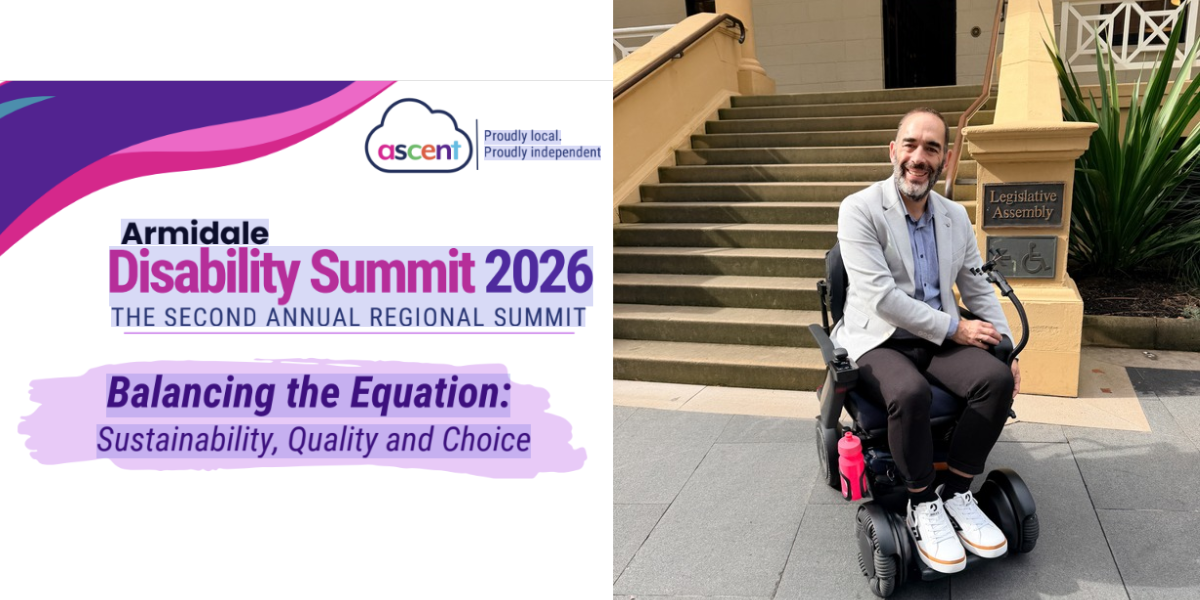
Mr Hope, who grew up in Gunnedah and Parkes, will give the opening keynote at the second annual Armidale Disability Summit on Wednesday, 2 December. People with disability, families, carers, providers, and government representatives will gather to work through what reform means for regional communities.
“In a regional town, if your disability service cuts back or closes, there may not be another down the road,” said Jeramy Hope, the NSW representative on the NDIS Reform Advisory Committee.
“Families and carers are often left to fill the gap.”
Mr Hope is also a member of Disability Council NSW, a former President and Chair of People with Disability Australia, and a former CEO of the Specialist Disability Accommodation Alliance. He is an NDIS participant and the father of a participant.
He said new rules introduced in October have begun reducing funding for affected social, economic, and community participation supports by 50 per cent, and affected improved daily living skills supports by 10 per cent. These are cuts to parts of a plan, not the whole plan. New planning starts rolling out from April 2027, and changes to access begin in January 2028.
“Knowing the dates doesn’t tell you what will happen to your own support,” Mr Hope said.
“Farming communities around Armidale know what it’s like to head into a season not knowing what it will bring. That’s when people lean on each other.”
“We need clear information from government, people with disability leading the conversation, and providers working together now to keep support close to home.”
Mr Hope said his regional upbringing showed him what communities can do when people know each other and pull together.
“I was eight when I went to Riding for the Disabled in Gunnedah. It had a lasting impact on me,” he said.
But distance remains a hurdle for participants and providers alike.
“A short train or taxi ride in the city can be a long drive from a farm or small town, assuming you have accessible transport you can afford,” Mr Hope said.
For providers, he said, the time between visits and the wear and tear on vehicles are real costs that are not always fully reflected in funding.
“Local ingenuity can make a lot possible. It shouldn’t be the only thing keeping the lights on,” he said.
Mr Hope said choice and control, a founding principle of the NDIS, can ring hollow where there is only one provider, or none.
“If your choice is to take the only support available or go without, that’s not genuine choice and control,” he said.
He cited Productivity Commission figures for NSW showing that in June 2025, participants in major cities used about 79 per cent of their plan funding. That fell to 72 per cent in inner and outer regional areas, and 52 per cent in remote and very remote areas.
“Unspent funding doesn’t tell us someone needed less support. We should ask what they could actually access,” Mr Hope said.
He said people living in Specialist Disability Accommodation or receiving Supported Independent Living services should feel safe and secure in their own home, with a real say in who supports them.
“Safety, dignity and access should never be optional extras. Too often, people are asked to make those compromises,” he said.
Mr Hope said technology can help close the gap. At Anglicare Southern Queensland, he said, telehealth was used across six regional hubs before COVID so people could see clinicians they could not easily reach in person.
“I’d challenge providers to ask people with disability: what are you already using, what’s still getting in your way, and what could we try together?” he said.
“Technology can give people more choice, especially in regional communities, alongside reliable hands-on support where it’s needed.”
Mr Hope said reliable support and good local jobs in Armidale go hand in hand, but they start with listening.
“Start by asking people with disability what they want to do, what gets in the way and who they’d trust to support them,” he said.
“If we skip that step, we can fill a roster and still miss what someone needs.”
He suggested local providers and training organisations could share training and pool backup workers for hard-to-fill weekend shifts, and recruit in places they do not usually look.
“A local hairdresser might be interested in training for a support role, provided the right checks and safeguards are in place,” Mr Hope said.
“The test is whether people get reliable support from workers they know and choose, and whether those workers get steady, paid hours and training to build a career locally.”
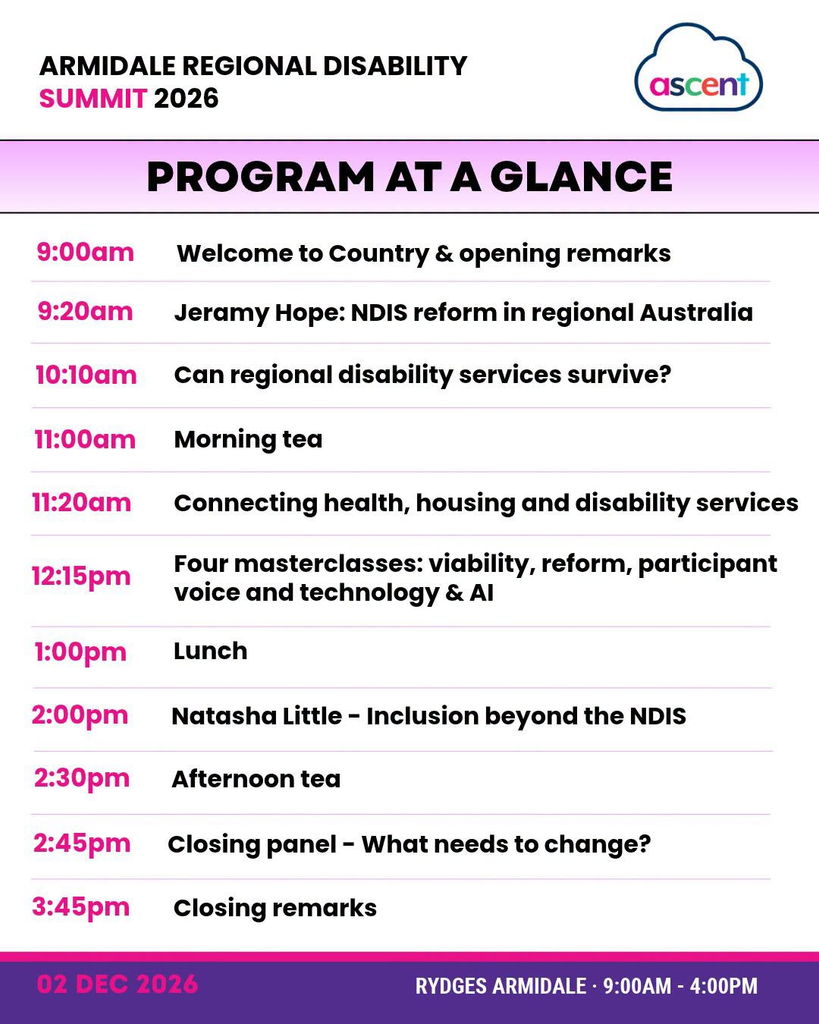
Whether regional providers can afford to keep delivering services will be the focus of the Summit’s first panel. A masterclass on staying viable in a thin market will look at pricing, costs, and service models such as outreach and partnerships.
Mr Hope said concern among participants and families is understandable.
“People want to know whether they can keep a worker they trust, what might change in their plan and who can help them if it does,” he said.
He said he changed his study arrangements 13 times during his MBA, and what helped was someone taking the time to explain his options.
“People need that now: clear information about what’s decided and what’s still open, someone they trust to talk it through with, and a way to find out what they can do if a decision doesn’t work for them,” Mr Hope said.
Mr Hope said the ABS counted 5.5 million Australians with disability in 2022, just over one in five, while the NDIS had around 792,000 participants in September 2026.
“Whether you have a plan shouldn’t determine whether you can join a club, go to a show or meet friends in town,” he said.
He said universal design is a good place to start.
“A lift helps me get upstairs in my wheelchair. It also helps an older person who finds stairs difficult, as well as a parent with a pram,” Mr Hope said.
Natasha Little will draw on examples from Tamworth to show how councils, businesses, and community groups can make inclusion part of everyday life without waiting for NDIS funding.
The Summit, hosted by Ascent Group Australia, will run under the theme Balancing the Equation: Sustainability, Quality and Choice.
“Regional services are facing financial pressure and major reform. Yet sustainability cannot come at the expense of quality, choice or control for people with disability,” wrote Ascent Group Australia Chief Executive Officer Penny Lamaro in her welcome to Summit guests.
The closing panel will bring together Northern Tablelands MP Brendan Moylan, Armidale Regional Council Mayor Sam Coupland, and Mr Hope to discuss what needs to change and who can make it happen.
The Summit runs from 9am to about 4pm at Rydges Armidale, 31 Marsh Street. It is open to anyone interested in disability support and inclusion in regional Australia, and people with disability, families, and carers are particularly encouraged to attend. Tickets are available at https://events.humanitix.com/2026-armidale-disability-summit
“You don’t have to understand every reform to be part of the conversation,” Mr Hope said.
He hopes people leave with a clearer idea of what to ask at their next NDIS plan meeting, who to call if support falls through, or someone local they can work with on a problem.
“We won’t have all the answers on Wednesday,” he said.
“But we can leave knowing more than we did when we arrived and knowing who we can take the next step with.”
“That’s how we create hope when things are uncertain.”
Got something you want to say about this story? Have your say on our opinion and comment hub, New England Times Engage