

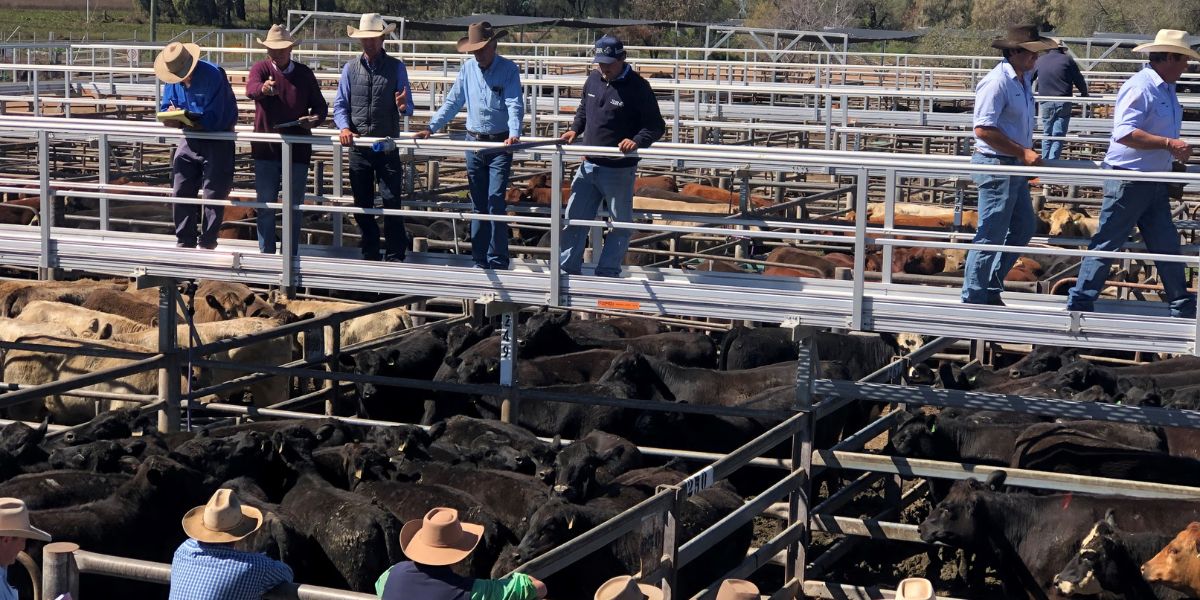
Cattle sales through Australian saleyards jumped 7.4 per cent in 2025-26, while sheep transactions fell 11.6 per cent, according to the latest Saleyard Survey from Meat & Livestock Australia (MLA).
The survey, run by MLA’s National Livestock Reporting Service (NLRS), recorded more than 5.18 million cattle and 14.5 million sheep transactions in the year to 30 June 2026. Cattle transactions rose by more than 356,000 head compared with 2024-25. Sheep transactions fell by about 1.9 million head.
NLRS Manager Stephanie Pitt said the survey gives an important snapshot of livestock movements through saleyards.
“The latest results show contrasting trends across Australia’s cattle and sheep saleyards, with increased cattle transactions in several key producing states alongside reduced sheep throughput across much of the country,” Ms Pitt said.
New South Wales and Queensland led the cattle increase, with year-on-year growth of 19.8 per cent and 21.6 per cent. NSW remained the biggest state, with 2.17 million head passing through 27 reported facilities. Queensland followed with 1.65 million head across 23 facilities.
Roma Saleyards in Queensland recorded the highest cattle throughput in the country, with 362,051 head, up 21.5 per cent.
In NSW, Dubbo Regional Livestock Market recorded 313,565 cattle transactions, up 31.8 per cent. Tamworth Regional Livestock Exchange rose 38.1 per cent to 241,244 head.
Not every state shared the lift. Cattle transactions fell 19 per cent in Victoria, 17.7 per cent in Western Australia, and 16.1 per cent in South Australia. Tasmania recorded a 5.5 per cent increase.
Sheep volumes fell across most states, down to 14.5 million head nationally. NSW remained the largest state for sheep, with 8.66 million head, down 6.5 per cent.
Victoria recorded the largest proportional decline among the major sheep states. Transactions fell 25.3 per cent to 3.61 million head. South Australia dropped 25 per cent to 722,937 head.
Western Australia was the exception. Sheep transactions rose 19 per cent to 1.28 million head, supported by more throughput at Katanning and Muchea.
Wagga Wagga Livestock Marketing Centre remained the country’s largest sheep selling centre, with 2.27 million transactions. Central West Livestock Exchange at Forbes was next with 1.86 million head.
Ms Pitt said saleyard activity can vary considerably between regions.
“The results demonstrate that saleyard activity can vary considerably between regions, reinforcing the importance of having reliable and consistent reporting across the industry.”
Ms Pitt said the NLRS continues to provide transparent livestock market information that helps producers and other industry participants understand market activity and make informed decisions.
The full 2025-26 Saleyard Survey is on the MLA Website
Don’t miss any of the important stories from around the region. Subscribe to our email list.