

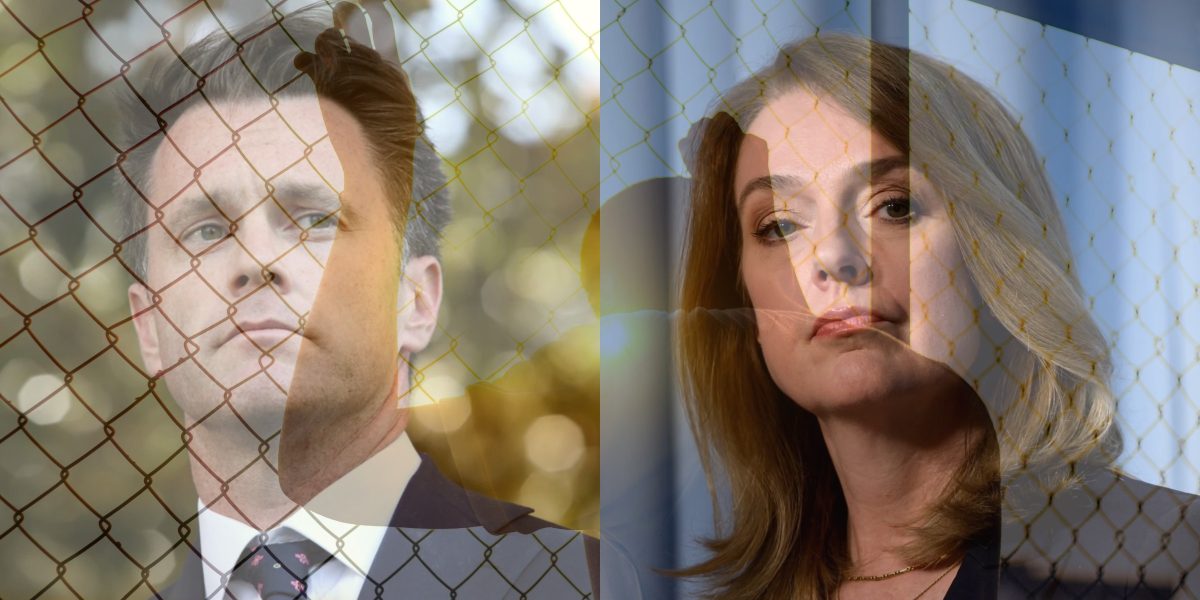
The NSW state election is less than six months away, and the campaign has found its favourite theme.
Politicians on both sides are competing to sound the alarm on crime, and to prove they would be the toughest on the issue. Harsher sentences, tougher bail, more prison beds, and drones in the sky are all on the table.
It is a well-worn strategy. Fear moves votes more strongly than any other emotion.
“Crime is a highly emotional issue,” said Associate Professor Kyle Mulrooney, co-director of the Centre for Rural Criminology at the University of New England in Armidale.
“It gets extremely emotive, especially in rural communities where people feel closer to crime.”
The tough on crime slogans that win votes rarely make good policy. And the evidence says many of them do not work at all.
A race to be the toughest
On Sunday, 13 September, the Coalition promised to bring in “Adult Crime, Adult Time” laws within its first 100 days if elected next March.
Under the plan, more offences would be added to the list of serious children’s indictable offences. That would let courts apply maximum adult sentences to young people for crimes such as aggravated and armed robbery, carjacking, firing a gun at a home or vehicle, and serious aggravated break and enter.
Detention would no longer be treated as a last resort in serious cases. Courts would be told to give more weight to the impact on victims than to the age of the offender.
“But if you commit a serious adult crime, there should be serious adult consequences,” said NSW Liberal Party Leader Kellie Sloane.
NSW Nationals Leader Gurmesh Singh put a local spin on it.
“Regional NSW has had enough. From Moree to Dubbo, families, business owners and older Australians have had enough of living with violent crime and kids running riot,” Mr Singh said.
Local Nationals quickly took up the call by happily regurgitating localised versions of the same press release. In Tamworth, Member for Tamworth Kevin Anderson was quick to back the policy.
“We need a stronger approach to get on top of crime, and the NSW Nationals have a plan to help keep our communities safe,” Mr Anderson said.
Member for Northern Tablelands Brendan Moylan, the Coalition’s Shadow Minister for Prevention of Regional Crime, also spruiked the plan.
“We must tackle crime from all sides, intervening early, deterring offending and throwing the weight of the law at those who commit crimes to keep NSW communities safe,” Mr Moylan said.
The Coalition plan also promises to double the Community Safety Investment Fund to $10 million and expand diversion and rehabilitation programs. Mr Anderson has lobbied for more youth diversion in Tamworth.
The announcement was made not long after the Minns Labor Government came out with its own take on adult crime, adult time. On Monday, 7 September, it announced that some young people could face adult penalties if convicted of organised crime violence.
But the policy of “adult crime, adult time” is little more than a campaign slogan, and it’s not even an original one.
Where the slogan came from
“Adult Crime, Adult Time” began as a Liberal National Party slogan in Queensland.
After winning the October 2024 election, the Crisafulli LNP Government wrote it into law in the Making Queensland Safer Act 2024. The Act requires children charged with serious offences, such as murder, grievous bodily harm, or robbery, to face adult penalties. That includes mandatory life imprisonment. It also removed the principle that detention should be a last resort for children.
An analysis in the Alternative Law Journal by Australian National University law school’s Evita Dickson found the government overrode Queensland’s Human Rights Act to pass the laws. It was the third time in under two years a Queensland government had done so for youth justice laws.
The first two were under Labor. In 2023, the former Palaszczuk Labor Government overrode the Act twice, including to allow children to be held in police watch houses and adult prisons. Ms Dickson described the 2024 laws as part of a bipartisan “race to the bottom”, with both major parties trying to look tougher on crime.
The government’s own statement of compatibility conceded the Act was “more punitive than necessary” and in “direct conflict with international law standards”.
The Crisafulli LNP Government says the laws are working. It points to Australian Bureau of Statistics figures showing 277,411 victims of crime in 2025, down 12,038 on the year before. Insurance Council of Australia data shows home burglary claims in Queensland fell 14.8 per cent in 2025-26.
But youth crime in Queensland was already falling before the laws came in. Ms Dickson’s analysis found youth crime hit its lowest recorded level in 2021-22. It fell a further 6.7 per cent between 2022-23 and 2023-24, before the Act was passed.
Her analysis also found the “crisis” was not what the headlines suggested. Violent crime made up only 7 per cent of proven youth offences. Almost half of all offences before the Childrens Court of Queensland were committed by just 10 per cent of child defendants.
Breach bail, go to jail
Queensland has another slogan in its tough on crime collection: “Breach Bail, Go to Jail”.
The Crisafulli LNP Government calls it the next expansion of Adult Crime, Adult Time. In late August, it introduced what it called the “strongest bail laws in the nation”. They target young people and adults who commit serious offences while on bail.
It has not stopped there. Since July, the state has also announced the “strongest parole laws in the nation”, Circuit Breaker Sentencing, and more than 2,000 new corrections officers. Each round is described as building on the last.
“These are positive results but we are not taking our foot off the pedal,” said Queensland Minister for Youth Justice Laura Gerber in September.
NSW is already heading the same way. On Thursday, 24 September, the Minns Labor Government passed laws extending a tough bail test for young people charged with repeat car theft and break and enter. Under section 22C of the Bail Act, a judge must have a “high degree of confidence” the young person will not reoffend before granting bail. It will now stay in place until April 2028.
A statutory review found the test has helped stabilise youth crime rates in regional NSW. The Coalition says it is not enough. It points to Bureau of Crime Statistics and Research (BOCSAR) figures showing the number of young people in court for breach of bail rose 13.6 per cent to 1,714 in the year to June 2026.
Tougher bail laws fill prisons. On Monday, 28 September, Premier Chris Minns announced nearly 1,000 extra prison beds. As of September, 6,398 people were on remand in NSW. That is 46 per cent of the adult prison population. One-third of people on remand now face domestic and family violence charges, after the Minns Labor Government made bail harder to get for serious domestic violence offences.
“It’s a consequence of tougher laws, and we make no apology for it,” Premier Minns said.
Remand is where the growth is. A new report from Just Reinvest NSW, Held at a Cost, released last week, found unsentenced prisoners grew from 28.4 per cent to 45.8 per cent of adults in custody in NSW since 2012-13. For young people, the share rose from 52.4 per cent to 77.8 per cent.
“A person on remand has been refused bail and is held in custody while their charge is before the courts. They have not been convicted of the offence for which they are held and may never be,” the report stated.
Dr Mulrooney said governments understand the strain repeat offending puts on towns. He said it is real when a young person is bailed and back offending the next day. But he said locking up young children is no answer.
“Are you going to take that 12 year old and lock them up for six months? It just doesn’t fix anything.”
Crushed for the cameras
While being tough on kids in trouble is popular, it doesn’t make for good video footage on the evening news. The NSW Labor Government has found a way around that by crushing kids’ toys for no reason other than the photo op.
On Thursday, 1 October, 23 e-bikes were fed into a crusher at a wrecking yard in Blacktown, in an attempt to make a “graphic demonstration” that the Minns Labor Government was tough on crime.
One bike had been taken from a 14-year-old. Another was a food delivery bike.
“This is a graphic warning to anyone riding or buying an e-bike: if you don’t want it turned into shrapnel, make sure it’s legal,” said Minister for Transport John Graham.
It was not even an original stunt. NSW was a few weeks behind Queensland, which pulled the same trick on Monday, 14 September.
Dr Mulrooney said much of the alarm about e-bikes comes from what people now see online.
“Kids recording themselves, having fun – this stuff was always going on,” Dr Mulrooney said.
“Now it’s just out there and available to share, and it’s in people’s face more.”
Drones are another tough on crime tool made for great TV. The Minns Labor Government has extended its police drone trial in Moree for two more years, and is looking to roll the technology out to other regional towns.
Crime in Moree has fallen, and the drones often get the credit – largely because people can see the drone footage of a suspected criminal being chased through town. However, BOCSAR executive director Jackie Fitzgerald said that is not what the numbers show.
“In fact, a lot of the crime declines that we’ve been reporting in Moree have occurred prior to the implementation of the drones,” Ms Fitzgerald said.
Not everyone in Moree welcomes the drones. Gomeroi man Ian Brown, Head of Advocacy and Engagement at Just Reinvest NSW, told the ABC some community members feel watched.
“They feel like they’re being surveilled and, yes, they acknowledge that youth crime is an issue, but they don’t want to feel like they can’t walk out into their own backyard,” Mr Brown said.
“At the end of the day we are the most researched, we’re the most over-surveilled community in Australia and I think we shouldn’t have to be that test case, especially our young people who are our most vulnerable in the community.”
What the evidence says
On Friday, 18 September, a cross-party Senate committee tabled its report into Australia’s youth justice and incarceration system. The Legal and Constitutional Affairs References Committee had taken evidence in every state and territory.
The committee found “compelling” evidence that community-based diversion, early intervention, and prevention programs are more effective and less costly than criminal justice responses. It found no evidence of the youth crime crisis used to justify a decade of harsher laws, and said sensational reporting had created a “false narrative”. Youth crime rates have fallen in every state and territory over the past two decades. In 2024-25, the number of offenders aged 10 to 17 dealt with by police fell by 5 per cent.
The committee also found 77 per cent of children under 14 in detention have unmet mental health, cognitive disability, or other health needs. It said what keeps communities safe is secure housing, mental health and disability support, effective family violence responses, better school engagement, and more Aboriginal community-controlled programs. Its four recommendations included national minimum standards for youth justice and a National Child and Community Safety Taskforce. The Albanese Labor Government largely rejected them, saying responsibility lies with the states and territories.
In NSW, BOCSAR data shows overall youth crime declined over the 15 years to June 2026.
But Coalition politicians choose to read the numbers differently. They point to BOCSAR figures showing the number of young people in court for non-domestic violence assault rose 20.2 per cent, from 982 to 1,180, in the year to June 2026.
“Most young people will never come anywhere near the criminal justice system, but when someone commits a serious violent crime there must be serious consequences,” said Shadow Minister for Police and Counter-terrorism Anthony Roberts.
The bigger question is whether prison works. Dr Mulrooney said it does, but only in the narrowest sense.
“We know generally it doesn’t work,” he said.
“Does it make the community safer for a very short period of time? Sure, I guess, you know, home invasions might drop per period or something like that, but it all comes back around.”
“It hasn’t really done anything to make these rural communities safer in the long term.”
Speaking to the ABC, Justice Reform Initiative executive director Dr Mindy Sotiri said prison makes reoffending more likely, not less.
“The current situation in Australia is that 85 per cent of children who go to prison return within 12 months,” Dr Sotiri said.
After decades of tough laws, Queensland still has the highest rates of youth incarceration and reoffending in the country. Ms Dickson found detention is widely recognised as making young people more likely to offend, not less.
“Tough-on-crime policies endure – not because they deliver results, but because they deliver votes. No such strategy has produced a lasting reduction in youth crime,” Ms Dickson wrote.
Taken off Country
Every tough on crime measure lands hardest on First Nations people.
“The overrepresentation of Aboriginal people in the justice system has become normalised and
remains unacceptable,” said Geoff Scott, CEO Just Reinvest NSW.
“We asked the question: if Aboriginal people came into contact with the criminal justice system at the same rate as their share of the population, how much less would that cost be?
“By analysing Report on Government Services (ROGS) data, we found that overrepresentation has a large price tag,” said Mr. Scott.
In NSW, Aboriginal people make up 3.3 per cent of the adult population but 34 per cent of adults in prison, the Just Reinvest report found. Aboriginal adults are imprisoned at 15.1 times the rate of non-Aboriginal adults. Aboriginal young people are held in detention at 16.5 times the rate of non-Aboriginal young people.
The report estimates the over-representation of Aboriginal people in NSW prisons, community corrections, and courts cost the government at least $718 million in 2024-25. That is up 41.7 per cent in five years.
“The money is not the argument. It is a measure of the scale of resources being spent on a pattern that governments have committed to ending.”
“We can do better, and we must do better,” Mr Scott said.
Independent Victorian Senator Lidia Thorpe, a Gunnai, Gunditjmara, and Djab Wurrung woman, sat on the Senate youth justice inquiry.
“There is nothing ‘tough’ about locking up a ten-year-old,” Senator Thorpe said.
“It does not make communities safer.”
“It takes children away from family, Country and culture and entrenches the trauma and disadvantage that governments are still failing to address.”
Dr Mulrooney sees that loss of connection in his work in Walgett. He said he had heard of children being sent to Sydney, “completely disconnected from family and relationships and structure”.
Some ended up “staying in Sydney and getting in trouble long term or coming back and having lost all those connections,” he said.
“You can’t consider those issues, especially in places like Walgett, for example, without considering those wider cultural aspects of criminalisation.”
He pointed to the planned youth diversion program at Yetta Dhinnakkal, a former correctional centre near Brewarrina, as a better model. It would offer young people wraparound support on Country.
“This is a sort of service-based approach that is connected to Country,” Dr Mulrooney said.
Feeling versus fact
If the evidence is so clear, why do politicians keep reaching for tougher laws? Dr Mulrooney said the answer is that crime is felt, not counted.
“So crime might happen more often in cities quantitatively. But people tend to feel more close to it in rural spaces because they usually know the victim,” he said.
Small numbers in small towns also make the statistics jumpy.
“Rural communities can be funny, because an increase of five offences could be, for instance, from five to 10,” Dr Mulrooney said.
“You’ve got a massive increase statistically, but really it’s not that many more offences. So it’s really hard to read statistics in rural places.”
“That’s why emotion tends to play more powerfully here.”
He pointed to Armidale’s spate of break-ins last Christmas. It became the talk of the town.
“And so crime became very highly salient in people’s minds,” he said.
“You got ring cameras on all the Facebook groups, the sort of loud noise around crime, when statistically, it’s not changing per se.”
The latest BOCSAR figures, released last month, tell a different story to the Facebook groups. Break and enter offences in Armidale fell 61 per cent, and motor vehicle theft fell 50 per cent.
Dr Mulrooney said punishment feels like safety to many people, even when it is not.
“People want to feel safe and they want safety. And they think a path to safety is to punish more and understand less.”
“The other stuff takes longer. It’s harder.”
The fear also obscures what drives young people to offend. Dr Mulrooney said the bigger drivers are boredom and having nothing to belong to, and importantly the lack of opportunity for kids to figure out their identity in healthy ways.
“I think a huge part of it, especially thinking about these Indigenous young people is identity, opportunity, and engagement,” he said.
He said crime can give a young person something they cannot find anywhere else.
“It gives someone respect that they otherwise don’t have,” Dr Mulrooney said.
Understanding the need for identity and belonging is at the core of BackTrack, the highly successful diversionary program based out of Armidale.
Dr Mulrooney said the program works because it gives young people something to be proud of. Part of identity, he said, is “being able to build something with your hands and being able to provide for your family”.
He said too much youth policy treats young people as a problem to be serviced, rather than as people with something to give.
“Everything’s about service intervention rather than how to create opportunities for young people to actually buy into things like civic community, for example,” he said.
“If those opportunities could be created where they could give back, there’s a lot of meaning and identity development in creating those opportunities rather than just pushing them to the margins,” Dr Mulrooney said.
He gave an example of smarter policy approaches from Canada in the 1990s. It had one of the highest youth incarceration rates in the world, and public pressure for harsher punishment kept growing. The government rewrote its youth justice laws but did it by “doing good by stealth”. It brought in very harsh penalties for the rare, very serious young offender. At the same time, it quietly turned down punishment for the stolen cars and break-ins that make up most youth crime.
The policy misdirection gave the tough on crime people what they wanted politically as the headline, while giving the vast majority of kids the break they needed to keep them out of a life of crime.
“What happened over time was a dramatic reduction in the youth incarceration rate,” Dr Mulrooney said.
“There’s a way to do it smartly.”
What works on the ground
Moree has carried an unwanted reputation as a youth crime hot spot. But it is also where the state has tried something different.
In March 2024, the Minns Labor Government committed $13.4 million to a place-based response in Moree. Decisions are shared with a local Youth Crime Governance Group. It includes the Moree Local Aboriginal Land Council, Aboriginal community-controlled organisations, Just Reinvest NSW, Moree Plains Shire Council, police, and the Department of Communities and Justice.
The money has paid for after-hours activities. PCYC’s U-Nites program draws an average of 40 young people a night. Miyay Birray’s StreetBeat bus made more than 8,300 pickups in its first year.
It has also paid for Maruma-Li Walaay, or Healing Camp. It is bail accommodation for young people who cannot safely live at home. It is run by three local Aboriginal organisations: Miyay Birray Youth Service, Pius X Aboriginal Medical Service, and Moree SHAE Academy.
The results are encouraging. BOCSAR figures show the number of young people charged with a crime in Moree fell from 240 in 2022-23 to 113 in 2025-26. Break and enters on non-residential buildings have halved.
Mr Moylan was cautiously upbeat.
“We still have a problem with crime in Moree, but I think we are starting to slowly but surely turn the corner,” Mr Moylan said.
The same thinking is spreading. Tamworth will get an $8.4 million voluntary diversion pilot by early 2027. It will offer wraparound support to children aged eight to 13 with complex needs, even if they have not been charged with anything.
Dr Mulrooney said that is the right direction, and each town needs its own plan. And he says he has hope, with governments across the region taling about prevention.
“I’ve been really surprised, particularly being engaged regionally lately to work on crime prevention,” he said.
“Even the typical conservative parties that tend to do well here, they’re talking diversion right now, which is interesting to me and at least gives me some hope.”
“That hopefully will actually invest where it can make a difference.”
Like what you’re reading? Support New England Times by making a small contribution today and help us keep delivering local news paywall-free. Donate now