

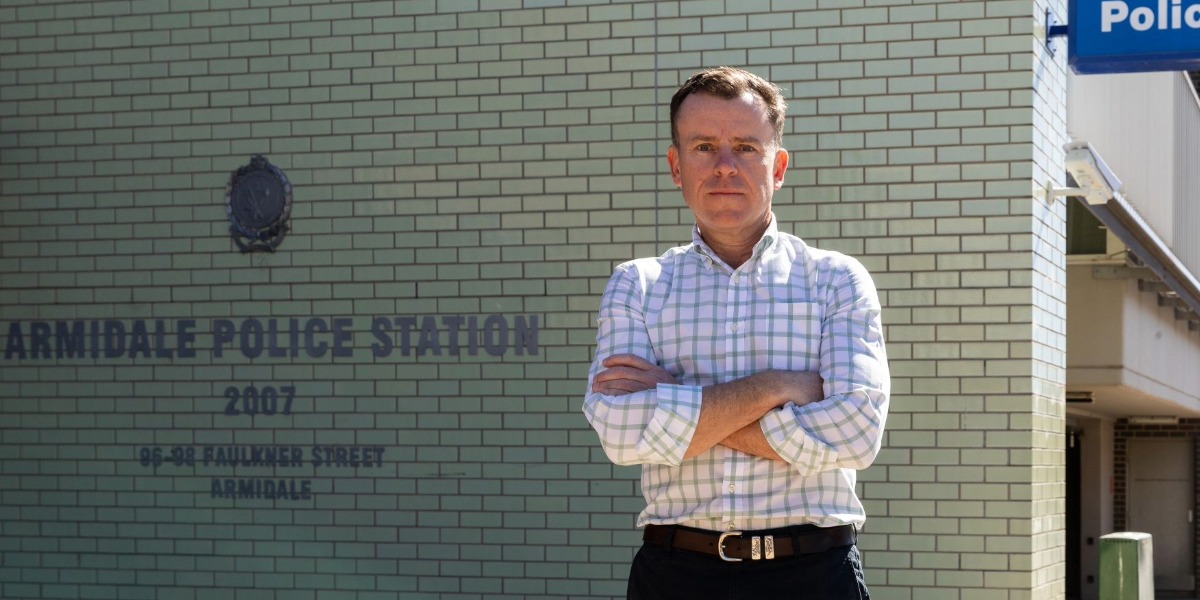
Moree’s domestic violence rate is more than three times the state average, and Member for Northern Tablelands Brendan Moylan says NSW needs to look overseas for answers.
Armidale, Inverell, and Gwydir shires all have domestic violence rates about twice the state average, while Glen Innes sits at 1.6 times.
Mr Moylan raised the latest Bureau of Crime Statistics and Research figures in Parliament last week, as the NSW Government announced nearly 1,000 extra prison beds to hold the growing number of alleged domestic violence offenders refused bail.
“Domestic violence is a scourge on our society and we need to do more to address it,” Mr Moylan said.
“In my electorate, we are fortunate to have many excellent organisations doing great work, such as the Women’s Shelter Armidale, amongst many others.”
“Too often in politics, when confronted with a difficult problem, we look only within our own borders for solutions.”
“We tweak existing programs, adjust existing policies and hope for a different result.”
Mr Moylan pointed to three countries that have tried something different.
In Austria, the system is built on a simple principle known as “whoever hits, leaves”. The victim stays and the offender goes.
“So rather than expecting victims and their children to uproot their lives, police immediately remove violent offenders from the home and connect victims directly and immediately with specialist support services,” Mr Moylan said.
“Importantly, interventions are also directed towards perpetrators, recognising that reducing violence often requires changing behaviour.”
Mr Moyland said Sweden has focused on stopping violence before it starts.
“In Sweden, they have invested heavily in education, early intervention and programs aimed at boys and young men, they have sought to challenge harmful behaviours before they become entrenched and to change social attitudes before police or courts ever become involved,” Mr Moylan said.
In Spain, authorities set up specialised courts, dedicated prosecutors, and integrated support systems designed only for domestic violence matters. Mr Moylan said the aim was to build a system victims could move through safely and confidently, not just to punish offenders.
“What is striking about those examples is not that one country found a miracle cure; it is that each was prepared to move beyond their traditional approach.”
“They treated it as a whole-of-society challenge that required innovation, coordination and long-term thinking and we must also become better at preventing violence before it starts.”
His call comes as the NSW Government moves to expand prison capacity.
The Government will reopen the 515-bed Dawn de Loas Correctional Centre at Silverwater and fast-track more than 360 additional beds at Parklea Correctional Centre. It is spending $47.1 million to recommission Dawn de Loas, which is expected to reopen in early 2027, and will hire around 150 staff.
As of September, 6,398 people were on remand across NSW, making up 46 per cent of the adult prison population.
The Government says one-third of people on remand now face domestic and family violence-related charges, following changes in 2024 that made it harder for alleged DV offenders to get bail.
“If a court decides someone is too dangerous to be released, then we need somewhere to put them,” said Premier Chris Minns.
“It’s a consequence of tougher laws, and we make no apology for it.”
The Government also points to $184.1 million to boost frontline domestic and family violence services by 50 per cent.
“We know reducing domestic and family violence takes more than prison beds alone,” said Minister for Corrections Anoulack Chanthivong.
“But when dangerous offenders need to be behind bars, we’ll make sure there is capacity for them.”
The Public Service Association of NSW (PSA) says more cells will not stop the next attack.
“We can’t just arrest our way out of domestic violence,” said PSA General Secretary Stewart Little.
“Prison can contain someone who poses a serious risk.”
“It cannot, by itself, protect a person before violence occurs or stop an offender returning to violent behaviour after release.”
The union is calling for specialised domestic violence courts, along with 15 new publicly owned domestic violence centres across NSW, compulsory diversionary programs for offenders on remand, and properly resourced programs for people leaving custody on parole.
The PSA has also questioned who will staff the new beds, saying one in 10 corrections officer positions in NSW is unfilled, roughly 700 positions.
“The Government has found the money and urgency for prison beds,” Mr Little said.
“It must bring the same urgency to prevention and support.”
Mr Moylan said prevention had to sit alongside tougher penalties.
“We need better integration between police, courts, health services and community organisations, and we need tough and appropriate sentences for perpetrators,” he said.
If you need help or are upset by this story, please seek support.
- 1800 RESPECT 1800 737 732
- Lifeline 13 11 14
- 13Yarn 13 92 76
- Beyond Blue on 1300 224 636
- Kids Helpline on 1800 551 800
- Headspace on 1800 650 890