

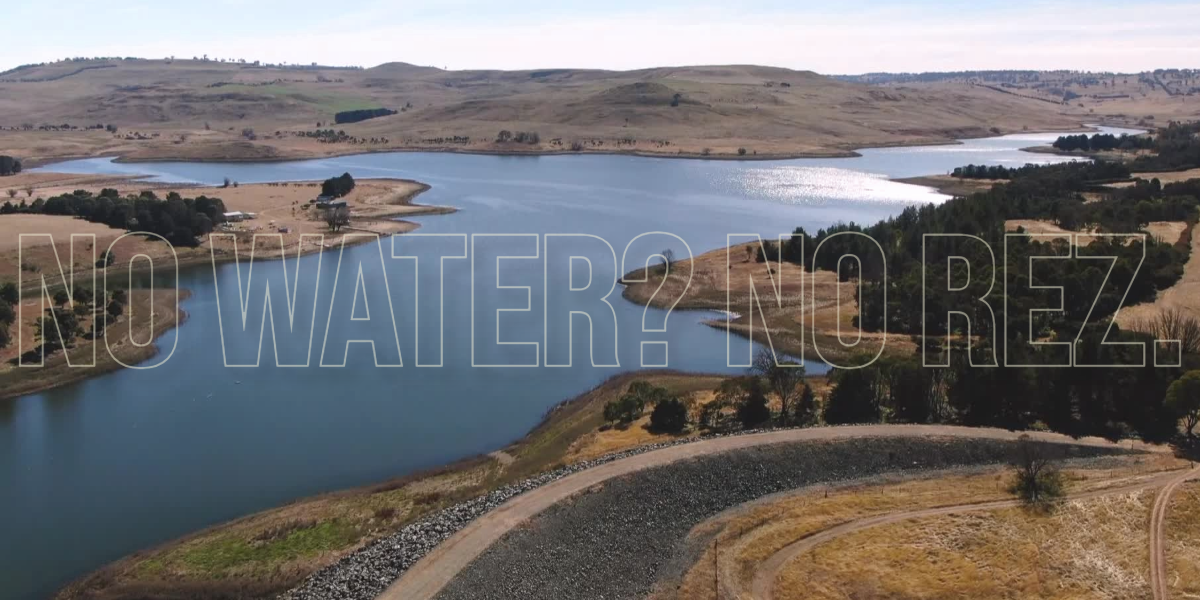
Armidale has been wanting to fix its water supply since before the New England Renewable Energy Zone existed. Now that the zone is coming anyway, Mayor Sam Coupland has decided that water is the one thing he will not simply hand over.
“If the state doesn’t come to the party with water, there just won’t be a REZ,” Mayor Coupland said.
It is not a new problem, nor a new complaint. But the REZ may be the first real leverage the region has ever had over it. Mayor Coupland is not pretending the negotiation that follows is a friendly one – and cautions that Armidale is not impressed by empty promises.
“There has been a lot of promise, and there’s been very little, to the extent almost nothing, that I can say hand on heart has been delivered,” Mayor Coupland said.
A decade-old issue
Armidale’s water security concerns did not start with the REZ. It started, in its modern form, with the 2017 to 2020 drought, the worst on the historical record dating back to the 1890s. Guyra and Uralla ran out of water. Armidale was planning for a “day zero” scenario, in which the town’s supply would run dry. The NSW Government assessed the region’s water supply as a Category 5 risk, its highest rating.
Out of that drought came a plan that has barely changed shape since: restore Oaky River Dam, build a transfer system from Oaky Dam to Armidale, and raise Malpas Dam.
In March 2019, then Armidale Regional councillor Peter Bailey moved a resolution to double the capacity of Malpas Dam through federal funding, telling councillors “there is money available Federally.” Then Mayor Simon Murray backed the push, warning against waiting “20 years down the track” to discover the region needed more water.
Seven years on from that meeting, the shape of the plan is barely different, but the price tag has grown. NSW Public Works Advisory was engaged in March 2020 to assess options for raising Malpas Dam, and its options report in March 2021 settled on raising the dam’s spillway by 6.49 metres, lifting storage from 12,200 megalitres to 27,600 megalitres. The estimated cost at that point was $25.8 million, including a 40 per cent contingency. A concept design report followed in November 2023, confirming the same 6.5 metre raise and an increase in storage from 12,500 megalitres to about 27,000 megalitres. The report stated the raised dam was “expected to meet the additional water security requirements of the Armidale Regional community well into the future.”
By 2026, Council had detailed design plans and was preparing to lodge a planning application, seeking classification of the works as Critical State Significant Infrastructure. Regional Capitals Australia, in a submission to a Productivity Commission inquiry into national water reform, uses Armidale as a case study, putting the current public estimate for the whole water security package, Oaky restoration, the transfer pipeline, Malpas Dam raising and treatment upgrades, at about $515 million, and argues that major projects like the REZ are being approved and funded faster than the water systems needed to support them.
The full water security plan recently presented by Armidale Regional Council comes to a total of $800 million. Money ratepayers do not have.
Rob Richardson, President of the Armidale Regional Ratepayers Association, said ARRA backs Council’s pursuit of water security, but not without reservations.
“ARRA is concerned that rate-payers in [Armidale Regional Council] will be required to bear the burden for adjacent Councils which are on different catchments, that the current two-stage project will not be realised for many years, if indeed, ever, and that it seems extremely unlikely the NSW Government would support the Council’s two-stage plan … to a degree that would in any significant way offset the cost facing rate-payers and residents,” Mr Richardson said.
“However, the ‘No Water No REZ’ position adopted by the Council could be useful in leveraging NSW State Government agreement to provide substantial, even full, funding for the Malpas Dam upgrade immediately,” he said.
Nobody disputes that the dam raising alone would only get Armidale part of the way. Even under the 6.5 metre option, the region’s own engineers and hydrologists say the increase would meet demand under historical climate conditions for a 30-year planning horizon, but not under mandated climate change scenarios. Mayor Coupland puts it more bluntly than the engineering reports do.
“We only have secure supply for 60 per cent of our current population,” he said. “Raising Malpas only gives us 80 per cent secure supply.”
Water becomes the price of the REZ
The New England Renewable Energy Zone was mapped out in 2018, during the drought, using a desktop study with 28 layers of geospatial data. None of those layers accounted for water supply or availability. The zone was formally announced by the NSW Government and the Australian Renewable Energy Agency in July 2020 and gazetted soon after. In June 2024, the REZ network infrastructure project was declared Critical State Significant Infrastructure.
It was not until EnergyCo published its Water and Wastewater Security Study in December 2025 that the scale of the problem was set out in writing. The study, prepared by Jacobs, modelled water demand across the construction period of the REZ network infrastructure project and the wider zone, running from 2027 to 2033. It found that in 2031, the peak year, the REZ and its network infrastructure could require 182.2 megalitres a day in average demand and up to 247.9 megalitres a day at peak, well above what the region would otherwise need.
Just over half of that additional demand, 58 per cent, is for concrete production for wind turbine footings and transmission towers.
The study, which by design documents the most extreme scenario, found water treatment capacity would potentially be exceeded in three of eleven local government areas under average demand, and in six of eleven under peak demand, including Armidale, Uralla and Walcha. In Uralla, treatment infrastructure utilisation could reach 333 per cent of capacity during peak demand across the two construction stages. In Walcha, it could reach 244 per cent.
In reality, if water is not available, then construction would just stop. Use of mining waste water and other ideas are being kicked around as potential alternative supply sources, with EnergyCo being clear that towns would not be without water.
“Under the NSW Water Management Act 2000, town water supplies and critical human water needs are prioritised above industrial and construction water use,” the spokesperson for EnergyCo said.
“This means water required for Renewable Energy Zone projects cannot come at the expense of household water security.”
Mayor Coupland says that the order of development will be key, a point he made at a parliamentary inquiry into the impact of renewable energy zones on local communities in early 2025 – the moment he first put the state on notice.
“The lack of water will actually dictate that sequencing, because we’ll be able to facilitate a quarter of a wind farm per annum [from current water storage capacity],” he said.
“That is firmly a them problem, not an us problem.”
The Mayoral Minute that Council adopted on 27 May 2026 turned that message into policy. The minute stated that “water is a binding constraint for the New England Region which is exacerbated by the NEREZ.” It resolved that council water supplies will not be allocated to any renewable energy project, generation or transmission, until there is “a clear and binding NSW Government commitment in place to resolve the New England regional water security deficit.”
It also commits Council to advocate for a funded state commitment, a coordinated state-led program of enabling infrastructure, and delivery of the Water Security Package as a priority.
Mayor Coupland said the hard line behind the minute had been building for years, not months, after friendlier approaches failed to get traction. He recalled telling one of Council’s own engineers, who suggested some water could be made available to EnergyCo, that the answer was no.
“No means no,” he said.
It was as blunt an opening position as any negotiation could offer.
Relief in private, caution in public
All major infrastructure developments involve a lot of back and forth in negotiations. The proponents push, the community pushes back, until agreement is reached.
New England Times understands that within EnergyCo and the broader NSW Government, Mayor Coupland’s ultimatum has been received with something close to relief: this is what is supposed to happen, and a fixed target is easier to work with than years of diffuse concern.
Publicly, EnergyCo’s language is more measured. In response to councils identifying infrastructure prerequisites such as water security at an early stage, an EnergyCo spokesperson pointed to work already under way, as well as a New England REZ Regional Steering Committee established in June 2026 to bring together senior representatives from local councils, EnergyCo and other state agencies on a quarterly basis.
“This early input has been valuable to inform our thinking around priority issues like water security,” the spokesperson said.
Whether EnergyCo itself could deliver the infrastructure Mayor Coupland is asking for, the spokesperson said, was a matter for several agencies working together, with funding pathways and delivery models still to be worked out depending on what new infrastructure proves necessary.
“EnergyCo is working with Armidale Regional Council as well as the Water Group of the Department of Climate Change, Energy, the Environment and Water and other agencies to determine appropriate initiatives to address water security in the REZ,” the spokesperson said.
“The NSW water management framework ensures that town water needs take precedence over industrial use, and EnergyCo is operating on the basis that REZ construction must not adversely impact local supply, especially during dry periods.
“To manage this, EnergyCo is working closely with DCCEEW Water and local councils to identify and secure dedicated water solutions, to ensure specific project needs are met without placing undue pressure on existing town infrastructure.
“Proponents developing projects in the REZ are encouraged to seek alternative water supply options rather than solely relying on town water supply in the first instance,” they said.
Renewable energy projects within NSW are required to secure their own water licences and allocations for construction and operational activities, just like other water users.
New England REZ deputy project director Jullian Watson told the ABC their Environmental Impact Statement, expected to be released later this year, will outline strategic solutions to water issues.
“The specifics will depend on what sort of solutions we can find, what other [water] sources we can find,” he said.
Mr Watson believes solutions would be found before construction on the transmission line started in 2028.
“We want to make sure that we can work with local government, work with communities to get a good solution that does not compromise the construction or the availability of potable water in the New England.”
Enter the Coalition and uncertainty
The reality of the REZ coming has been baked into local council planning across all 5 local governments for years. But last June, without consultation, the Coalition announced their election pledge to abandon the New England REZ by not building the new transmission line.
“We would revise the REZ back. We would still have a REZ in New England, but we would cap it and keep it at its current level, and prioritise upgrades to the existing infrastructure if necessary,” Opposition Leader Kellie Sloane said.
Sloane visited the region for the first time since becoming Liberal leader this week, travelling with NSW Nationals Leader Gurmesh Singh and local member Brendan Moylan, mainly to meet with highly curated groups that were believed to be opposed to the REZ, as well as a brief press conference in Walcha (to which this masthead was not invited).
Ms Sloane told the ABC she had settled on a policy for the region without first visiting it, relying instead on briefings from Mr Moylan.
Among those who did get time with Ms Sloane’s group was David Mailler, an Uralla Shire councillor who also works in solar development through his company Meralli Solar, as part of a small delegation from Business Uralla arranged by Mr Moylan. His overriding concern, he said, was less about whether the REZ should be scaled back than about the uncertainty a mid-project policy change would create.
“It’s very hard to plan for something where the goalposts keep changing,” he said.
“At the end of the day, our community is going to have to wear the burden of this, not their communities.”
Cr Mailler said he left the meeting in no doubt that Ms Sloane’s delegation understood exactly what uncertainty they were creating.
“If they didn’t get that, they’re not as smart as I thought,” he said. “It was made very clear that if you don’t know, it creates more uncertainty and more difficulty for everyone concerned.”
Mayor Coupland is unconvinced by the NSW Coalition’s recent election pledge to abandon the transmission build central to the REZ if elected in March 2027, and does not think it will ever be tested in government.
“If I were a betting man, I would say the Coalition knows full well they won’t get re-elected in March, and this is all about sandbagging seats,” he said.
“I think it’s a bit of a cynical play, and I think most of the participants in the market know that.”
Mayor Coupland is also not convinced the Coalition would actually change the plan if it did return to office.
“What I find disturbingly curious is that the people that say they are now going to take us on a different path are the very same ones that set us on this path. So I’ve got no faith whatsoever that we will be on a different path,” he said.
“They haven’t come up with a plan on how they’re going to backfill $24 billion of investment in our region.”
He said Armidale Regional Council is not changing its planning around what is being described by many as a ‘policy brainfart’.
“I’m not putting it into the risk planning because it becomes an ‘oh, shit’ moment,” he said, “and that’ll bring with it a whole bunch of other challenges that I’m sure they haven’t even considered.”
Ultimatum won’t stop the inevitable
Mayor Coupland does not pretend the process is friendly, even though he is representing a community that will genuinely benefit from, and supports, the transition. He understands that major infrastructure negotiations are inherently adversarial.
“There’s no point being nice with them or gleefully going along as your friend. They’ll just see you as a useful idiot.”
He estimates roughly 5 per cent of the population is, in his words, “delirious with excitement” about the REZ, largely those who stand to profit from hosting turbines or solar arrays; about 15 per cent openly opposed, mostly people near infrastructure or philosophically against it; and the remaining 80 per cent supportive or agnostic.
“There is pressure to become a megaphone for sectional interests,” he said. “It is a difficult thing to walk the line.”
His own approach, he said, is neither wholehearted welcome nor blanket opposition.
“The approach that I’ve taken is one of grudging acceptance that this is coming. Therefore, the best thing to do is to make the most for the community from it,” he said.
“If we were going to take a different path, this should have happened 15 years ago, 20 years ago.”
What has changed is that, for the first time, the region has something the state and EnergyCo clearly want, and a council willing to withhold it. Whether that leverage converts into an actual dam, an actual pipeline and an actual binding commitment, rather than another decade of concept designs and studies, remains a question, but Coupland knows that even this ultimatum will not stop the REZ.
“This is not going to stop this energy transition. It’s long term and it’s massive,” Mayor Coupland said.
“Therefore, I have to advocate for the best of the community.”
Like what you’re reading? Support New England Times by making a small contribution today and help us keep delivering local news paywall-free. Donate now