

With less than nine months to the next NSW Election, there are two things we can be certain of: many numbers will be thrown around in the campaign, and many of them will be bad numbers.
Over the past two months, the New England Times has traced bad numbers through the region’s transport plans, its council budgets and the reports governments use to justify their decisions.
In this final part of our New England Times investigation by RK Crosby, we look at two known forces that corrupt the numbers: culture and politics.
In amongst all the numbers that get thrown around by governments and politicians, there are some you think you can trust, and some that you know you shouldn’t.
The ones you think you should be able to trust are those that are produced by agencies and departments that are there to watch over others.
The ones you know you shouldn’t are all related to elections.
When the two combine, things get really bad.
Bad culture: an audit finds Armidale did not do the work
A NSW Audit Office review has found that Armidale Regional Council did not effectively develop the long-term financial plan that underpins its budgets.
“Armidale Regional Council has not effectively developed its Long-Term Financial Plan,” the report stated.
The Audit Office’s report, Long-term financial planning in local government, examined how two councils, Port Stephens and Armidale Regional, develop and monitor their long-term financial plans. Port Stephens passed. Armidale did not.
While ARC’s 2025-35 plan included the essential elements required under the Integrated Planning and Reporting guidelines, the auditors found the analysis lacked detail and the asset data used to build the plan was deficient. The Council also failed to update the plan when it developed its 2024-25 Operational Plan – the annual budget – as the guidelines require.
The report also found the plan was not integrated with the Council’s other strategies and plans, and that the Council was not proactively monitoring its financial risks or building them into the plan. That lack of integration, the auditors stated, limits the Council’s ability to accurately forecast its future financial position.
Perhaps most significantly for the councillors elected to represent ratepayers, the audit found the information was not making it back to them.
“The Council executive does not report regularly to the elected council on progress and is not fully informing the elected council of the long-term financial position and performance,” the report stated.
These issues are essentially on issues of culture – of how Armidale Regional Council goes about its business. The Audit Office made five recommendations to Armidale Regional Council, covering financial risk, the costing of planning commitments, asset data, scenario analysis, and regular reporting to councillors.
The finding is a pointed one for a council that has spent millions on fixing its culture. Beginning in 2021, Armidale Regional Council engaged consultancy Dattner Group on a multi-year cultural change and restructure program, branded internally as “Restore and Thrive”, which the consultancy has held up in a published case study as “a benchmark culture transformation”.
Yet while staff inside the Council report that internal relationships have improved significantly, the Council’s relationship with its community sits at one of its lowest points in many years. Residents have criticised a lack of transparency and effective communication, and a large rate rise drew strong opposition.
That rate rise was justified, in part, on the strength of the very long-term financial planning the Audit Office has now found wanting.
Ratepayers, in other words, were forced to accept a rate hike of58.8 per cent on the basis of a financial plan the auditors say was not effectively developed.
In a statement published on Tuesday, 23 June, the Council accepted the audit’s findings.
“Armidale Regional Council accepts the findings of the NSW Audit Office and is committed to strengthening its long-term financial planning and monitoring,” the Council stated.
The Council maintained the plan still met its legal obligations, while conceding the substance behind it needed work.
“While the Long-Term Financial Plan meets mandatory legislative requirements, improvements are needed to ensure it is supported by stronger data, analysis and evidence,” the Council stated.
The Council attributed the shortcomings largely to the council merger which took place a decade ago in 2016, long before administration in 2019 or cultural change processes that began in 2021.
“Ongoing system and data limitations stemming from the council merger have impacted financial forecasting, asset management data and reporting integration,” staff wrote.
Did the Audit Office do their work?
The bad numbers, though, are not the council’s alone. Most of the figures this series has examined trace back to the NSW Common Planning Assumptions, a central set of statistics and projections used by the entire government so they are all working from the one source of truth. Problem being, the New England population estimates in the NSW CPAs differ significantly from the official Australian Bureau of Statistics count. Those figures run through the entire NSW Government – every department, plan, and report related to the New England – and the Audit Office is not exempt.
The audit of Armidale Regional Council begins by stating that the region’s population has fallen 3.9 per cent over the past five years, a figure it drew from the Office of Local Government.
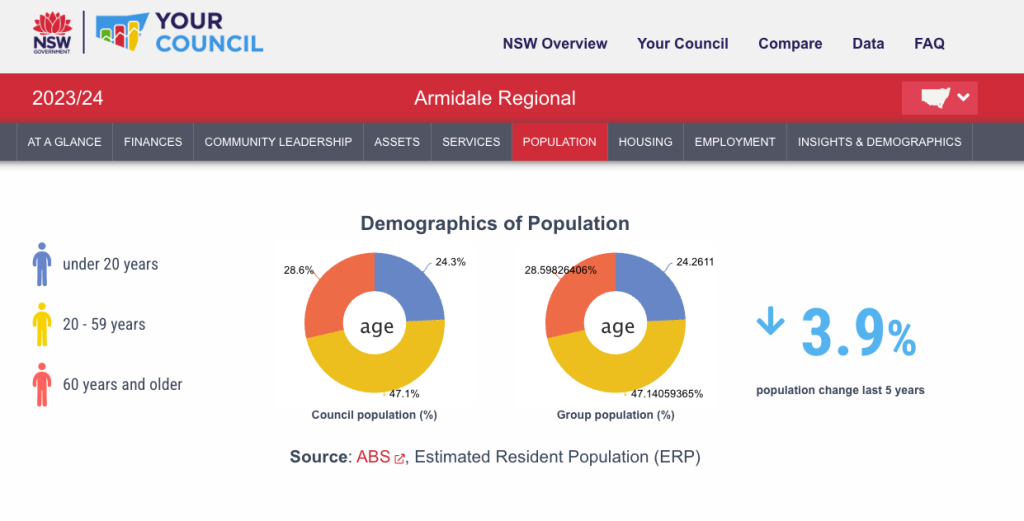
And the Audit Office was correct, the Office of Local Government’s Your Council portal, which lets residents look up data about their council and compare it with others, reported the same 3.9 per cent fall. The ABS, by contrast, records a 1.2 per cent rise over the same period.
When the New England Times asked the Office of Local Government about the discrepancy, the enquiry was redirected back to the source of the figures, the NSW Department of Planning, Housing and Infrastructure. On Monday, 6 July, an official from the Department called the New England Times to acknowledge that its figures were wrong, and to say they would be fixed.
Should the Audit Office, of all offices, have checked the numbers they used from the original source? Arguably yes, but as we have seen throughout this series, no one in the NSW Government questions the Common Planning Assumptions. The culture of the NSW Government is to assume Planning got the numbers right.
The difference of of 5.1 percentage points in the population of Armidale in the NSW Government figures in not a mere administrative error on a website. It may, for some programs, translate directly into a loss of 5.1% of funding that Armidale Regional Council should have received. That underfunding is not intentional or malicious, but the end result of bad culture that doesn’t question bad numbers.
Bad politics: a fair share of what?
If bad culture produces bad numbers unintentionally, bad politics produces them on purpose.
Political parties of every colour have long leaned on a few reliable techniques to make numbers work harder at election time. The best known is the reannouncement, where money already committed is unveiled a second, third or fourth time as though it were new funding, giving voters the illusion of millions more being spent on the things they care about most.
A less familiar cousin has become a favourite of the Coalition in recent months: the percentage pledge.
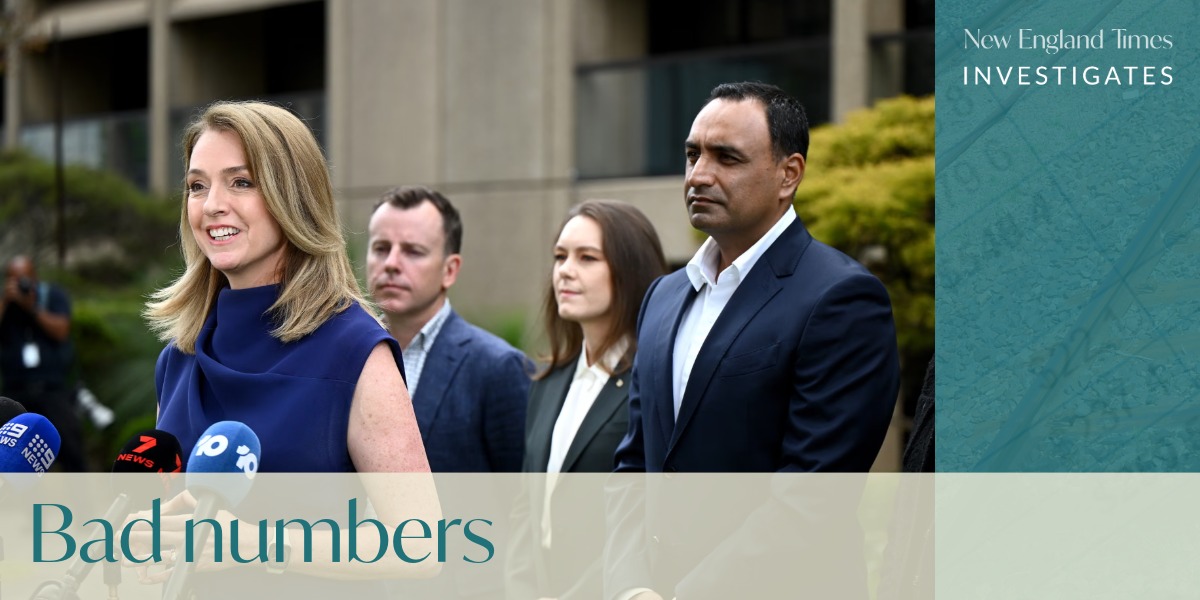
On Friday, 12 June, NSW Opposition Leader Kellie Sloane, Nationals Leader Gurmesh Singh and Shadow Minister for Infrastructure Natalie Ward announced a Regional Infrastructure Guarantee, promising that a Liberal and Nationals government would direct 25 per cent of infrastructure funding to regional NSW. Local members quickly translated it in to what it would mean for the local community, including Member for Tamworth Kevin Anderson.
The pitch is simple, and an easy ‘fair go’ type position that works well on a social post. A quarter of the state’s people, the argument runs, should receive a quarter of the state’s infrastructure spending.
Nationals Leader Gurmesh Singh said a quarter of all people in NSW lived outside Greater Sydney, Newcastle, and Wollongong, so they should get a quarter of the funding.
“All regional NSW asks for is a fair share, and under our government, that is what they’ll get,” Mr Singh said.
That 25 per cent figure depends entirely on where the line is drawn and how you define “regional”. The ABS counts about 35 per cent of the state’s population as living in the “Rest of NSW”, the area outside Greater Sydney. The Coalition arrives at 25 per cent only by also setting Newcastle and Wollongong aside as metropolitan, and presumably the smaller regional communities in between the cities are swept up in that as well.
The pledge is also far easier to promise than to measure. There is no agreed definition of what counts as regional spending or a regional project, which makes a 25 per cent guarantee difficult to calculate and harder still to enforce. The Coalition’s own statements points to the risk: it notes the Auditor-General found in 2026 that Labor had used the Regional Roads Fund to upgrade metropolitan projects, with two originally funded through the Urban Roads Fund and delivering no economic development in regional NSW. Money labelled “regional” moves to the city easily.
When the mechanisms of government lump regional and rural in with major cities – like Hunter New England Health – it also makes it possible for the government to claim that funding and resources given to, in this example, John Hunter Hospital, have been delivered to the New England.
Regardless of how you define what is regional and what isn’t, a population split, no matter how good it sounds in an Instagram reel, is not actually “fair” funding.
A funding share pegged to population is not a funding share pegged to need. The Coalition’s own release lists a regional road backlog the NRMA valued at almost $3 billion in 2025, brown drinking water and boil-water notices, and delays to projects such as hospitals. Deficits built up over many years of city focused government prioritising city spending are not answered by a formula that caps the regions funding to an arbitrary percentage.
The approach is not unique to Macquarie Street. In his federal Budget in Reply a month earlier, Federal Opposition Leader Angus Taylor made a similar commitment, promising that a quarter of his proposed Future Generations Fund would be “set aside for regional Australia, including the completion of Inland Rail”.
For New England readers, the link to Inland Rail blows up the percentage pledge mirage. Inland Rail is a single project linking Melbourne and Brisbane, of national benefit, and large enough that finishing it could swallow much, if not all, of the 25 per cent of infrastructure spending on its own, leaving nothing for other essential projects. A commitment of that scale sitting inside a regional cap leaves little room for the roads, water and services the rest of the regions are still waiting on, while allowing a government to say it is delivering for the regions.
The research on political promises helps explain why an empty pledge like this is so appealing to make and so hard to hold anyone to once elected. A 2023 study in the journal Political Studies found that parties make hundreds of promises, but voters do not treat them all as equally central – or to use the Howard era language, voters understand that some promises are “non-core promises”. Research has also found that pledges shift relatively few votes, only between 1 and 2% of votes will be decided by election promises. However, parties keep making them because they attract media attention.
In simple terms, politicians make percentage pledges knowing they’ll get some cheap headlines, but no one will come asking questions after the election, and even if they do they can be easily fobbed off with more bad numbers.
When Bad Politics and Bad Culture collide
The danger is that while the percentage pledge sounds good, and doesn’t change the election all that much, when it becomes policy it is more likely to act as a limit rather than a floor. Bureaucrats have a tendency to follow instructions, so when they are told to spend a certain amount on a certain thing, they do. Thus percentage pledges may significantly curtail government funding rather than guarantee it.
For an example of this literal interpretation, the NSW Government pledged to spend $3m of its advertising budget on regional newspapers. And it implemented this, to the letter, capping the spend on regional newspaper advertising at $1m per year. It also committed $3m on regional newspaper grant funding. In both cases, access to either the funding or the advertising is contingent on printing a physical newspaper. Which is why in areas like Inverell and Moree where there is no printed paper at all, there is no government advertising, also very low awareness of NSW Government activities and programs.
This is just one way fast and loose numbers of the election campaign can become set in stone once they pass into the bureaucracy, often with unintended consequences. This also means that the often wrong, exaggerated, or understated numbers – whichever way the numbers were manipulated to benefit the campaign – get absorbed as hard fact on the other side of the tape.
Is political manipulation the cause of the incorrect population figures that permeate through all of the NSW Government planning and reporting in relation to the New England? It is likely we will never know, and this masthead has reached the end of our ability to find out.
But this investigation has identified persistent issues with population and other numbers in various planning documents that largely stem from the New England North West Regional Plan 2041 published in 2021, which sources its population figures from the Department of Transport’s Travel Zone Projections 2019 document published two years earlier.
This means that if there was any intentional tampering of statistics, it likely happened in 2017 or 2018, a period of a number of ICAC proven irregularities under then Premier Gladys Berejiklian.
It is also unlikely we will ever know the full extent of the negative impact on the New England and funding for all of our Councils and projects over many years of bad numbers.
Read more from the Bad Numbers investigation
Like what you’re reading? Support New England Times by making a small contribution today and help us keep delivering local news paywall-free. Donate now