

In the first part of our Bad Numbers investigation, we looked at how transport planning assumptions at every level of government collapsed under scrutiny.
Now one local MP is pushing for a legislative fix that would apply to any bill that comes before NSW Parliament, requiring that legislation must have evidence and consultation before being passed by the parliament.
In this New England Times investigation by RK Crosby, we look at how bad numbers, assumptions, guesses, and misrepresentation, have led to plans at all levels of government not being worth the paper they are printed on.
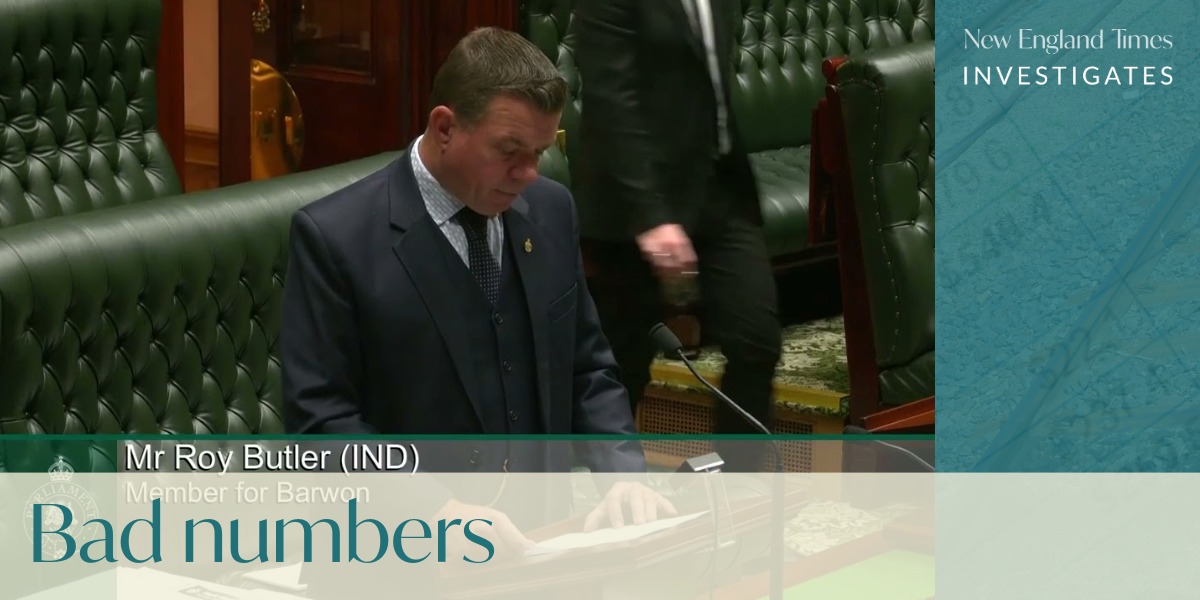
Roy Butler has had enough. The Member for Barwon says the same problem keeps showing up in NSW Parliament: laws get rushed through without the evidence to back them up, and the people who have to live with the consequences are never properly asked.
Earlier this month, Mr Butler put that argument squarely to the NSW Parliament, making the case for evidence and consultation based legislation.
“One of the fundamental pillars of our democracy is that our elected representatives create laws that are well considered, based on hard data and facts, and that they don’t make these laws in a vacuum, but talk to the people, industries, organisations and institutions that may be affected,” Mr Butler said.
His notice of motion asked Parliament to acknowledge “that the people of NSW deserve strong evidence and proper consultation to be used in the development of legislation.” It also called on members to accept that “public money needs to deliver public value.”
Mr Butler did not pull punches on who he believes is getting it wrong. “Several actions of, and legislation by, the NSW Labor Government have not any used evidence or consultation,” he said.
He also foreshadowed that he would soon introduce a ‘fairness bill’ to the NSW Parliament, requiring the use of evidence and consultation in any decisions or legislation.
“At the moment there is nothing enshrined in law to compel our lawmakers to use evidence to compile their legislation.”
EBPM – Not a new idea
Mr Butler is far from the first person to call for evidence based policy, as he noted in his speech. The push for evidence-based policy making – or EBPM – has a long history in Australia, with the practice long preceding the term that emerged out of the Blair Government in the UK in the late 90s.
In 2008, then Prime Minister Kevin Rudd told a gathering of department heads and senior public servants that “policy design and policy evaluation should be driven by analysis of all the available options, and not by ideology.”
“We’re interested in facts, not fads,” he said.
Rudd’s zealotry on the subject triggered waves of reviews and reforms, and a round table held by the Australian Productivity Commission on strengthening evidence in policy.
The case for evidence-based policy has also been made, in recent memory, by a member of the current Minns Government.
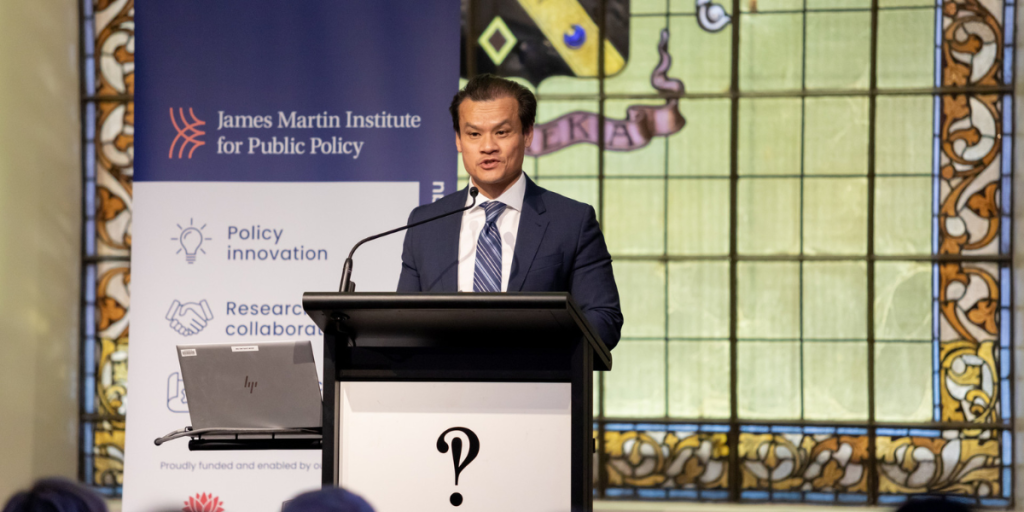
NSW Minister for Industry and Innovation Anoulack Chanthivong said in a speech in 2023 that “in government, it is vital to make informed decisions based on sound evidence, robust policy development, thorough consultation, and innovative thinking and approaches.”
“As an economist, I can strongly vouch for evidence-based decision-making. It is the approach that I have applied to all my professional decisions and it’s the same approach that I apply in my parliamentary duties,” Mr Chanthivong said.
Strong evidence of lack of evidence
In New South Wales, a flurry of activity around evidence based policy for NSW happened after the election of the Barry O’Farrell led Coalition Government in 2011. They commissioned the NSW Financial Audit, known as the Lambert Report, a comprehensive analysis of the state of NSW finances and detailed a range of systemic failures in the financial management and fiscal leadership of New South Wales. The findings were blunt.
“Infrastructure expenditure decisions have been made without a proper analysis of costs, benefits and formal business cases,” and that this “has contributed to poor project selection and a poor delivery record for major infrastructure works, with projects often running over time and over budget.”
The Lambert Report also found that nobody was checking whether programs already running were working at all.
“There is no process for systematically evaluating expenditure on the stock of current programs,” it stated, “either to avoid duplication and overlap; or to identify policies that are ineffective or fail to provide good public value.”
Multiple reports and reviews across various portfolios found very poor practices in requiring evidence in policy development, or evaluating effectiveness of policies after implementation.
The Law and Justice Foundation of NSW has raised similar concerns in the justice space just last December, identifying that the lack of evidence in legislation is still evident.
A paper examining the heated topic of bail reform points to the 2014 amendments to the Bail Act 2013 as a case where changes “were not backed by empirical evidence but appear to have been designed more so to placate public fear.” It stated that over 15 years of bail reform “changes have often been influenced more by political ideologies and public perceptions rather than a transparent evidence-based approach.”
Same story, different bill
In his speech to parliament, Mr Butler pointed to three recent pieces of legislation he says show NSW is continuing to repeat the same mistakes of rushed legislation without evidence.
The first is the Water Management Amendment (Easements for Inundation) Bill 2026, which Mr Butler said “threatens to inundate farming land.” He told Parliament the bill was “rushed through Parliament on the basis that turtles in the Gwydir were at risk due to a lack of water, and that bulk water release was urgently required.”
This legislation was first introduced in November 2025, but then amended and rushed through in early May after the ABC reported on the plight of the turtles in late April this year.
“No one in this House is arguing against protecting native species, of course that matters, but what was missing was any really real consideration of the broader impacts of that decision,” he said.
The second example he gave was the Prevention of Cruelty to Animals Amendment (Enforcement and Operational Powers) Bill 2026, which Mr Butler said “covers a wide range of issues from matters that most people would agree on, like leaving a dog in a hot car, through to measures that could have significant implications for agricultural practices, and that is exactly why proper consultation and evidence matter.”
The NSW Government’s own press release on this legislation makes it clear it was a populist measure. When New England Times enquired as to whether “dogs in cars” included working dogs on the back of utes, the Department itself had no understanding of how the new law would work.
For both bills, Mr Butler said “the broader operation of the legislation had not been fully thought out, little consideration was given to what effects the laws might have on people in regional areas.”

The third example he gave is the most politically charged: the firearms reforms introduced after the Chanukah Massacre at Bondi Beach. One of a series of rapid changes and announcements made without evidence or consultation, rushed through parliament on a bizarre recalled sitting before Christmas, and which like restrictions on protesting, faces significant opposition and potential legal challenge.
Mr Butler told Parliament that “what we’re seeing through the Royal Commission is that there may have been multiple intelligence failures leading up to that incident,” and that “the issue was not necessarily the laws, it was how those laws were being applied and enforced.”
“Instead of taking the time to properly consult, investigate, gather evidence about what would actually improve public safety, the government moved quickly to introduce sweeping, sweeping legislative changes,” he said.
“It is unlikely, I’d say worse than unlikely, that these reforms will actually deliver the safety outcomes intended.”
The cost of getting it wrong
Aside from costly legal battles, the price of skipping evidence, consultation and evaluation in the business of government is well documented.
The phenomenon of ‘failure demand’, a term used to describe the extra cost for failing to do something right the first time or failing to address the root cause of issues, has been attributed to billions of taxpayer dollars wasted at all levels of government every year. A recent paper from the Centre for Policy Development found that governments in Australia spend $16b as a result of failing to prevent childhood poverty, and up to $29b a year on potentially preventable disease.
The centre’s solution to the problem? Use better evidence to prevent avoidable costs.
The known cost of waste from not using evidence in deciding policy actions is also not new.
In a 2016 speech, the then Australian Productivity Commission deputy chair Karen Chester laid out just how high that price can be, using the example of Indigenous education.
“There has been no consistent improvement in the literacy and numeracy achievement of Indigenous primary school students over at least the last 16 years.”
“This can only but suggest that current policies are not working, and that we need a stronger evidence base about what might work to improve Indigenous education achievement.”
Ms Chester said the Commission could find only 34 case studies of “things that work” for its 2016 Overcoming Indigenous Disadvantage report, out of more than 1,000 Indigenous specific programs funded at a cost of $5.9 billion a year (about $8.2b in today’s money). Of those 34, only 24 met basic evaluation standards, leaving the other ten as “promising programs, but yet to be evaluated.”
“It is nothing more than common sense that to know whether things are making a difference on the ground, you need evaluations,” Ms Chester said.
She said the answer was not complicated.
“Stop looking for silver bullets and policy sound bites. And just get back to the dirt under the fingernail work of building evidence-based policy and building a much stronger evaluation culture.”
Political drivers of poor policy
The problem of poor policy driven by political pressure to act quickly is also at the heart of a recent paper from the UK’s Institute for Government. The paper argues that “geopolitical events have forced ministers and civil servants into a constant state of alert, normalising a culture of rapid policy making,” and that “speed is an expected feature of modern governance, and sometimes unavoidable.”
However, it makes the case that the way to manage this demand to respond quickly is still anchored in evidence. Drawing on “a wide range of evidence, information and expertise about the policy issue and the range of levers that can be used to achieve the desired outcome”, including “stress-testing policy proposals with a wide range of stakeholders, beyond the ‘usual suspects’,” is essential to ensure policies land effectively ‘stick’ in the long term.
But not all evidence is good evidence. Reports and other evidence commissioned to support an already determined political action can often be worse than no evidence, as they become hard to argue against once published.
For example, the decision of the Carr Government to axe rail services in regional areas followed the Parry Report, a Ministerial Inquiry into “sustainable transport in NSW” (at a time when sustainability meant ‘could you afford to keep it going’ rather than something to do with the environment). The dramatic slashing of regional train services proposed was necessary to fund a budget blowout of some $114m for the ‘Millennium Trains’, the withdrawing of regional services to pay for city trains allegedly predetermined because of the looming costs of replacing ageing wooden bridges, and the cost to regional communities for that loss of public amenity was not accounted for.
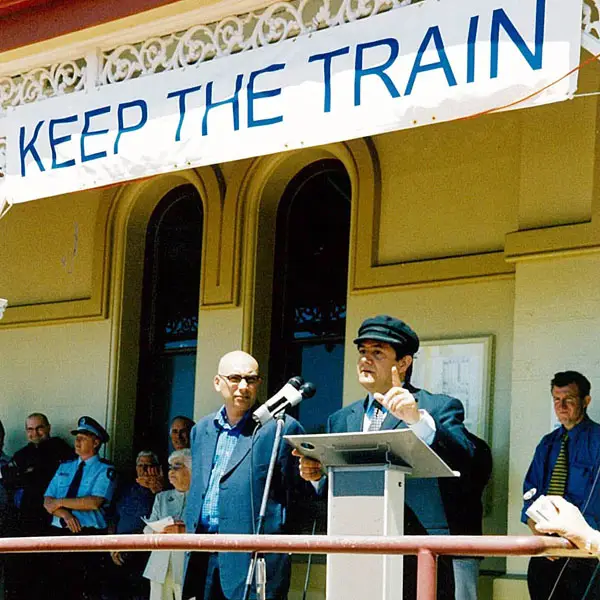
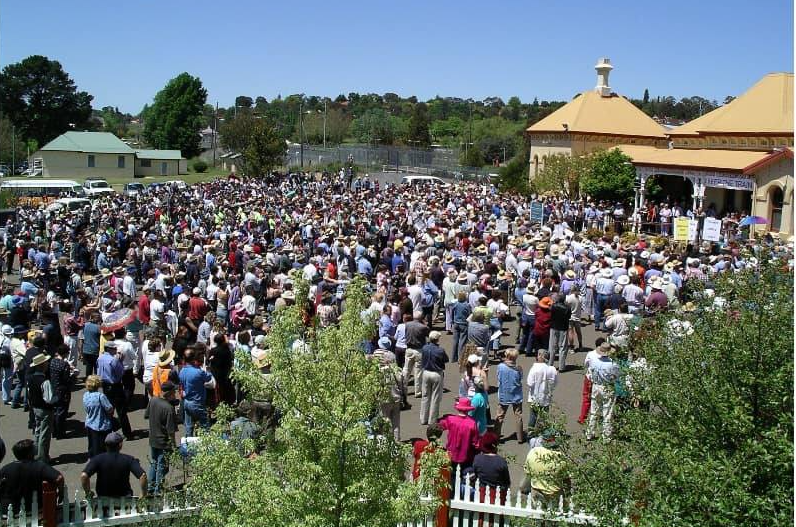
Community opposition, including a rally of some 3000 people in Armidale in October 2003, kept the line open to Armidale. Protests from regional communities across the state was so intense that by September 2005, after Carr’s retirement, the Morris Iemma led government announced that no further recommendations of the Parry inquiry would be implemented.
Then Member for Northern Tablelands Richard Torbay spoke bluntly at the time about the lack of consultation and over-riding political motivations.
“There has been a deliberate attempt to run down this service, and many aspects of the report are what the government wants to hear,” he told the Glen Innes Examiner.
If is not clear if Roy Butler intends to include some kind of quality assurance in his forthcoming Fairness Bill to prevent the use of junk evidence, but he is clear the proposed law would not stop government from acting fast when it genuinely needs to.
“Any bill on evidence I introduce in this area will include an emergency provision, so that government can remain agile when it needs to be, but those situations should be the exception, not the norm,” he said.
Butler argues people grant the authority to govern but expect that the government acts carefully and in the best interests of all they govern. His bill is intended to force the government to act on hard facts and data, consulting with those affected.
“You need to understand how those rules will work in practice. You need to test whether they are realistic, enforceable, and fair,” Mr Butler said.
“I urge anyone who believes in democratic process and good policy to contact their local member and encourage them to support the concept and the bill.”
Read more from the Bad Numbers investigation
Got something you want to say about this story? Have your say on our opinion and comment hub, New England Times Engage