

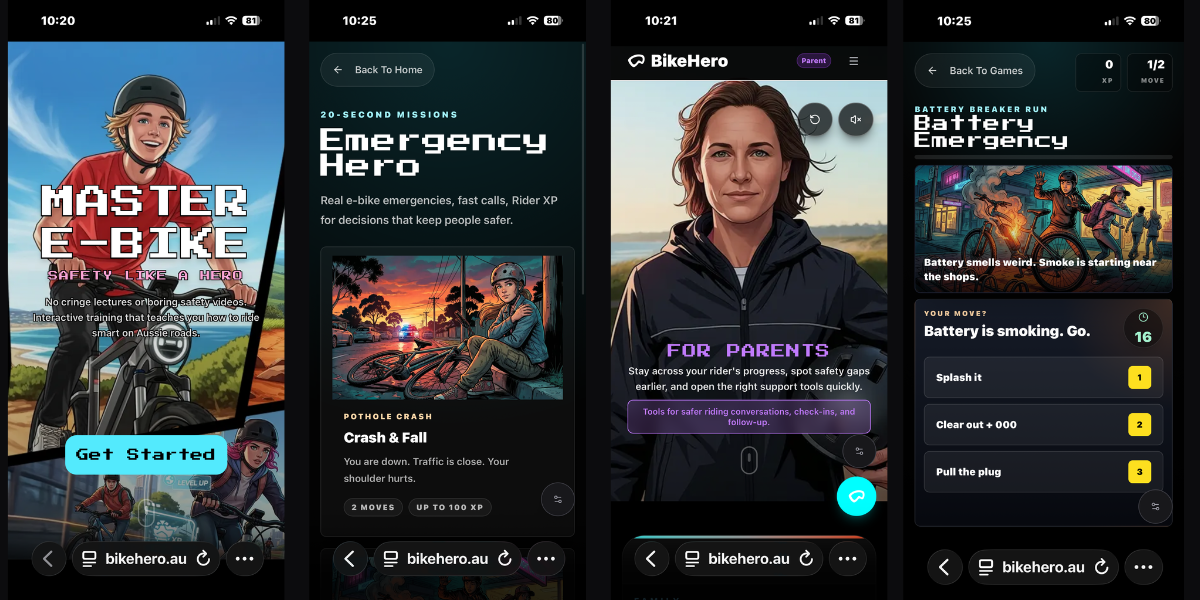
From school runs in Tamworth to teenagers riding to sport in Armidale and around smaller regional communities, e-bikes are becoming part of everyday life across New England – but safety education is struggling to keep pace.
As debate continues around minimum riding ages and tighter regulations for e-bikes, the founders of BikeHero say regional families cannot afford to wait for legislation before teaching young riders how to stay safe.
BikeHero, an online safety education platform aimed at riders aged 11 to 17, was created by two Northern Beaches families: designers Paul Gawman and Trish Steel, and Daniel and Mary Payne, a firefighter and former paramedic and nurse.
Co-founder Paul Gawman said the idea came after watching the rapid rise of e-bike use among teenagers in their own community.
“Two Northern Beaches families, five kids between them, watching the same thing play out across the community: teens getting e-bikes for birthdays and Christmas, then heading straight onto roads and shared paths with no real safety education attached,” Mr Gawman said.
“We were hearing about crashes, near-misses, confused parents and kids riding bikes they didn’t fully understand.”
Mr Gawman said many regional families were facing challenges different to those in metropolitan areas.
“Regional towns can have quieter local streets, which is a real advantage,” he said.
“But the connecting roads can have higher speeds, less rider infrastructure, longer distances, and a heavier mix of utes, tradies, trucks and tourist traffic than a city teen might deal with every day.”
In many regional communities, e-bikes are increasingly being used by teenagers travelling to school, sport, part-time jobs and friends’ homes, often in areas with limited public transport options.
Mr Gawman said education was critical regardless of what laws may eventually be introduced.
“Regulation matters, and we support sensible regulation,” he said.
“But laws set the floor. Habits keep teens safer day to day.”
He said practical riding awareness could make a significant difference for young riders navigating regional roads.
“A young rider who head-checks before moving out, understands how to approach a roundabout, knows why the door zone is dangerous, and rides predictably around pedestrians is safer regardless of which rule is being debated that month.”
Mr Gawman said parents consistently raised concerns about speed, group riding behaviour and battery safety.
“Modern e-bikes feel familiar because they look like bikes, but they carry speed differently,” he said.
“Parents often underestimate how quickly their teen is moving, especially on shared paths, driveways and school routes.”
He also warned that teenagers riding in groups could increase risk.
“Teens ride differently in a pack than they do alone. One bad call can pull the whole group into it.”
Former paramedic and nurse Mary Payne said the injuries associated with e-bike crashes could be severe.
“The injuries that worry me most are head and spinal injuries from going over the bars, and collarbone, wrist and arm fractures when riders put a hand out to break a fall,” Ms Payne said.
“Speed makes everything worse. A crash at 35 km/h on a heavy, non-compliant e-bike is a very different impact than a fall from a regular pushie at a lower speed.”
Ms Payne said one of the biggest concerns was that many young riders had never been taught how to identify common road hazards.
“The one that worries me most is riding right alongside parked cars, in the door zone,” she said.
“It is one of the easiest ways to come to grief, and most teens have never been taught to look for it.”
She encouraged parents to start safety conversations now, rather than waiting for future regulation changes.
“To parents, don’t wait for the law to settle. Your teen is riding now, so the learning needs to happen now,” she said.
BikeHero is currently operating in an invite-only beta phase involving a small group of Northern Beaches families in NSW, with a broader public launch expected shortly.
The founders said while the platform was designed for families across Australia, they did not currently have New England users participating in the beta program.
At launch, the platform will feature short learning modules, scenario-based safety lessons and a Certified Rider course families can complete together.
Mr Gawman said online education could help bridge the gap for regional communities where access to rider training programs may be limited.
“That matters because regional families should not have to wait for a council program or school session before their kids learn how to ride safely,” he said.
Advertising with New England Times is a cost effective and reliable way to reach New England locals who are interested and engaged. Find out more here.