

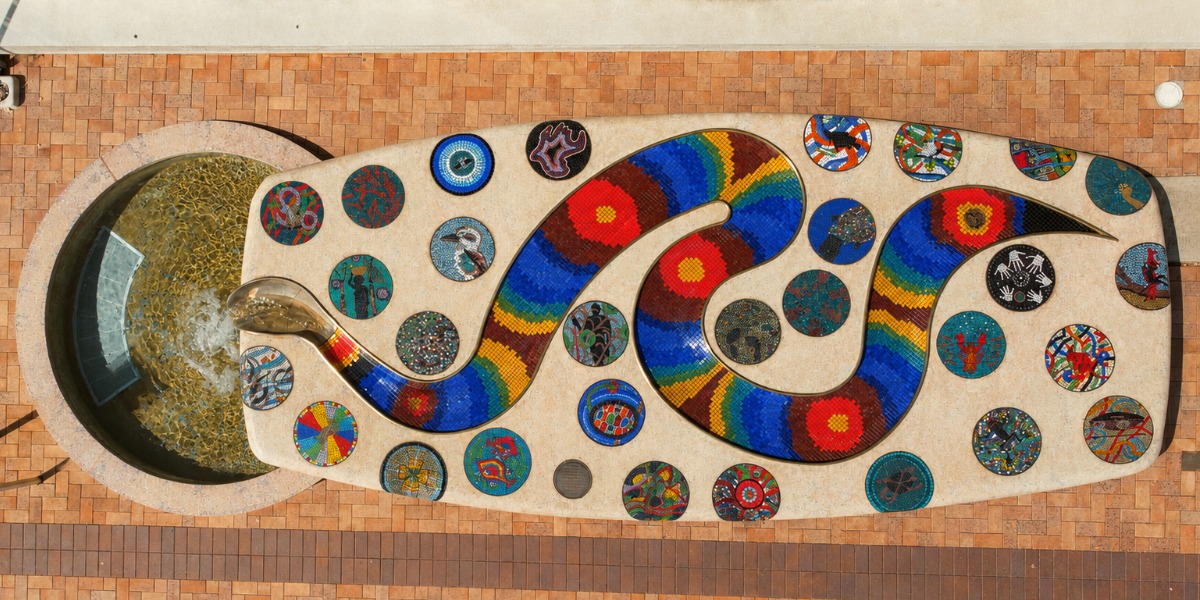
The painstaking restoration of Gunnedah’s Rainbow Serpent Water Feature, a project judges called “a labour of love”, has been recognised in Keep Australia Beautiful’s 2026 Tidy Towns Sustainability Awards.
Gunnedah Shire Council won the Heritage and Culture Population Category C (5,001 to 12,000).
Waterforms International restored 29 glass circular mosaic tiles designed and handcrafted by nine women of the Kamilaroi Women’s Group.
The artists were the late Ellen Draper, Shirley Long, Janet Wanless, the late Delma Jones, Gloria Foley, Cindy Foley, June Cox, Alison Cox, and Rita Long.
The 500mm mosaics feature traditional motifs, totems, and stories. They sit within the curves of the shimmering 9.2-metre Rainbow Serpent, a central figure in Kamilaroi Dreaming stories.
Created almost 20 years ago, the mosaics eroded after the artwork was installed in 2020, partly because of its west-facing position at the entrance to The Cultural Precinct.
The restoration was delivered in four stages from March to May this year. It was funded by a $50,640 grant from the Office of Responsible Gambling Club Grants Category 3 Fund (Arts and Culture), which was matched by council.
“Winning this award showcases the importance of ensuring our public art pieces are maintained and preserved for future generations,” said Gunnedah Shire Council Director of Community and Planning Andrew Johns.
“It also highlights how continued consultation and engagement with the original artists ensured their connection to the mosaics was not broken.”
“The community’s efforts to collect thousands of the loose tiles over an extended period also contributed to the project’s success as each and every tile was placed back into the original mosaics by stone mason specialists Dimitar and Svetlana Todorovski,” Mr Johns said.
“Council’s painstaking efforts to involve the artists in all aspects of the project demonstrated an enduring respect for the artists and their work and also highlighted the intrinsic value of the Rainbow Serpent’s story to the Shire’s cultural heritage.”
The judges described the project as “incomparable in terms of its cultural value, heritage significance, symbolism, and all the painstaking work that came with it”.
“The most unique element of this project is that it is a project crafted by women – Aboriginal aunties, mothers and elders. What a statement,” the judges said.
“The restoration process itself also created opportunities for public education and strengthened the sense that Indigenous cultural artwork is valued and worthy of long-term care.”
Something going on in your part of the New England people should know about? Let us know by emailing newsdesk@netimes.com.au