

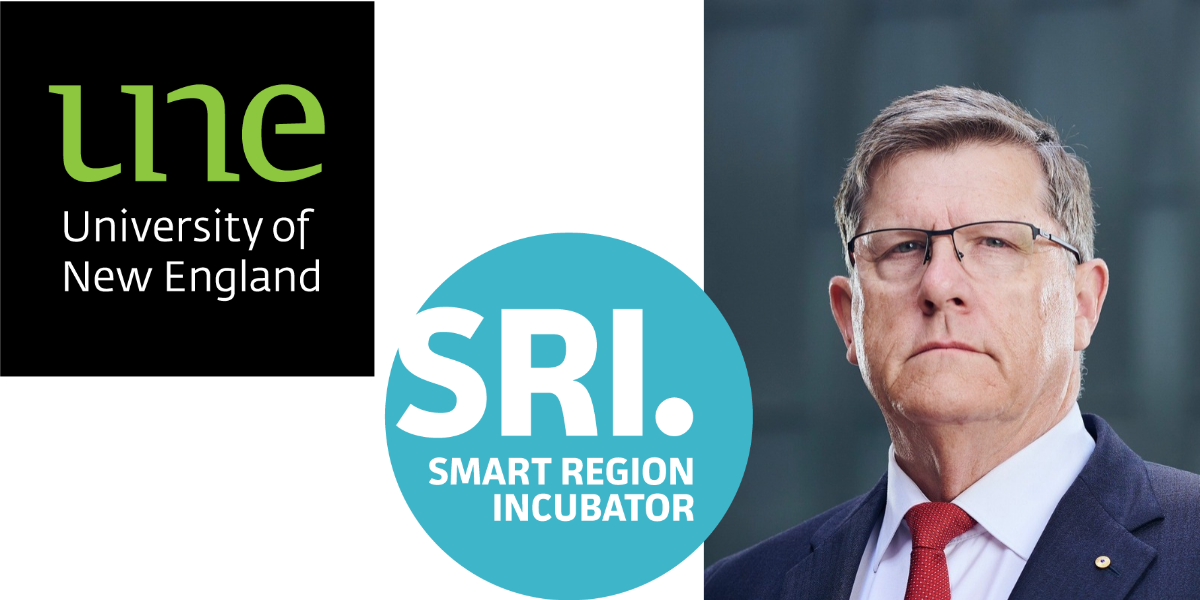
Armidale will host a morning forum on Friday, 16 October, asking how academic research can do more to prepare regional, rural and remote Australia for challenging and disruptive futures.
The event is the idea of Warwick student Elizabeth Ure, who is studying online with the University of New England (UNE) and co-convenes the Remote, Regional and Rural Thematic Group of The Australian Sociological Association (TASA).
It runs from 9:30am to 1:30pm at the UNE SMART Region Incubator, 122 Faulkner St, Armidale, and online. TASA and UNE Humanities, Arts and Social Sciences are hosting it.
Ms Ure said she started the event after taking on the co-convenor role earlier this year. She first joined TASA as a mature-aged undergraduate studying by distance, and attended a TASA conference in Melbourne. As a self-funded attendee, a non-academic and a rural person, she said she felt like a bit of an outsider.
“I’ve always believed RRR voices and knowledge are vital, and that they’re often missing from city-based events,” said Ms Ure.
She said the central question grew from a frustration shared by many people in regional Australia.
“There’s no shortage of good research. It just mostly doesn’t make an impact in the places it’s needed,” said Ms Ure.
In her view, two steps are missing between research and impact. One is the development of research-informed solutions, and the other is getting them adopted.
“Frameworks and protocols can be adopted. Physical objects and formulas can be adopted. But papers and articles can’t be adopted,” said Ms Ure.
The panel brings together researchers, a practitioner and a strategic policy voice. UNE’s Dr Johanna Garnett (sociology and peace studies), Professor Neil Argent (human geography) and Dr Louise Morley (social work) will speak, along with Andrew Henderson from the Australian Strategic Policy Institute.
The guest speaker is UNE alumnus Air Vice-Marshal (Retired) John Blackburn AO, who will join the forum online. Ms Ure said he argues Australia is dangerously underprepared for complex, cascading risks. She said his view is that the country’s problem is less a shortage of knowledge than a failure to act on it.
Ms Ure said Air Vice-Marshal Blackburn also points out that research is mostly organised around single hazards, while real crises cascade across fuel, food, freight, power and communications. That matters most in regional areas, which sit at the end of long supply chains and rely on diesel for freight, farming and power.
“For example, what happens to New England if fuel is rationed for a month?” said Ms Ure.
The morning will be moderated by Rev. Simon Hansford, Minister at the Armidale Uniting Church. Rev. Hansford was Moderator of the Synod of NSW and the ACT for the Uniting Church from 2017 to 2023. He has served in ordained ministry for more than 25 years across rural and regional NSW.
Ms Ure said she wanted someone from outside academia, close to the community and with a strong rural advocacy background, to hold the event together.
“Simon is a gracious and encouraging facilitator,” said Ms Ure.
She said she did not want to guess what will come up on the day, because people in the room will raise their own concerns. But she pointed to pressures regional communities already feel. These include the cost of living, fuel insecurity, water uncertainty, and loneliness and disconnection. Community groups such as the CWA, the Men’s Shed and local sports clubs are also struggling to find volunteers, she said.
“The question isn’t whether these disruptions are coming. It’s how research can better support communities, government, industry and other actors relating to regional, rural, remote and very remote areas to prepare, adapt, and keep looking after each other,” said Ms Ure.
She said regional voices must be heard because country towns are often hit first and recover last.
“Regional communities feel disruption first and live with it longest,” said Ms Ure.
She said local knowledge, such as which roads go under and who checks on whom, is often overlooked by city institutions. She pointed to research after the 2022 Northern Rivers floods, which found local knowledge drove community action but was often overlooked by state systems. A 2024-25 NSW Government survey in that region found 72 per cent of residents relied on word of mouth for flood information.
“If research doesn’t travel through those channels, it doesn’t travel at all,” said Ms Ure.
She said regional universities like UNE are well placed to work with communities, not just study them.
The format is built for participation rather than long speeches. Ms Ure said more than half the morning is set aside for exchange.
“The format is highly interactive with more than half the morning dedicated to exchange of ideas, where productive disagreements are encouraged,” said Ms Ure.
A working group has tested a range of engagement tools, including anonymous options, to help quieter attendees take part. Online participants can join in too. A follow-up survey will ask for feedback and ideas for next steps.
The event is open to academics, teachers and students, church and community leaders, political activists and organisers, local councillors and government agency staff, and anyone interested in how the region prepares for disruption.
Ms Ure said her hopes are modest but practical.
“Mostly, I hope people leave having met someone they didn’t know before and have at least one conversation they want to continue,” said Ms Ure.
Morning tea and lunch are provided. Attending online is free. In-person tickets cost $10 for TASA members and $20 for non-members. Walk-ins are welcome, but registering helps with catering.
“There is still capacity for more in-person attendees, and I’d warmly welcome last-minute registrations,” said Ms Ure.
Questions can be sent to eure@myune.edu.au. Register at https://tinyurl.com/TASA-ReadyOrNot.
Advertising with New England Times is a cost effective and reliable way to reach New England locals who are interested and engaged. Find out more here.