
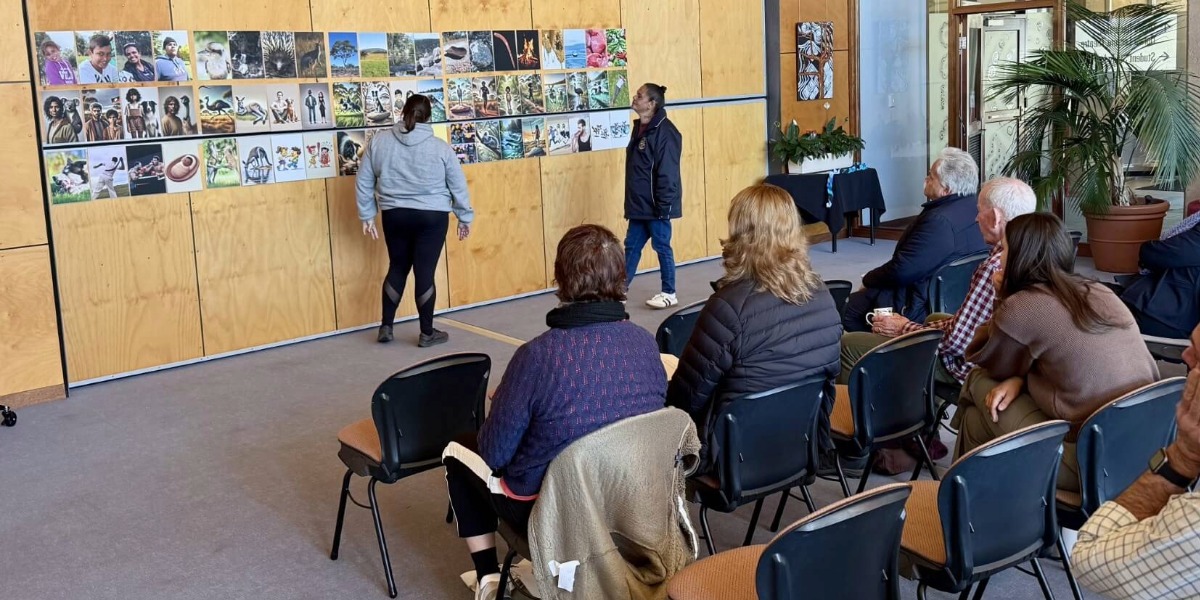
Every Thursday morning, the Anēwan language is being spoken and learnt again at the University of New England’s Oorala Aboriginal Centre, more than a century after it was pushed into dormancy by colonisation and forced assimilation.
Anēwan, also spelt Anaiwan, was the language of the lands now occupied by UNE in Armidale. Those wanting to relearn it in the early 2000s had little to work with: 10 minutes of audio from 1963 and a handful of written records left by pastoralists and amateur anthropologists.
“People often ask why we have so little to work with,” said Anēwan/Ambēyang linguist, historian and UNE alumnus Dr Callum Clayton-Dixon.
“Understanding that process of colonisation provides some of the answers. It was not that our people didn’t cherish their language, its dormancy was a product of the intense and severe impacts of colonisation. But the language was never lost.”
Classes are led by the Armidale Aboriginal Cultural Centre and Keeping Place’s Senior Language Apprentice John Roberts, UNE’s Cultural Engagement Officer Larissa Ahoy and Dr Clayton-Dixon.
For Anēwan Elder Uncle Steve Widders, UNE’s Aboriginal Employment Consultant and the driving force behind the classes, learning his own language for the first time has been a liberating experience.
“I was never taught Anēwan because my parents and grandparents were not allowed to pass the language on. Learning it now is helping to fill in the gaps of who I am, in my heart and my mind.”
“As a place of learning, the university is the ideal venue for learning the language of the original inhabitants. It is just as important as Greek or French or Indonesian, and part of all of our history.”
Ms Ahoy said she was excited to be sharing her people’s words and the traditions they embody.
“Language connects us to our Country and makes us stand tall and proud. One of the best ways to learn about a culture is by speaking its language.”
The classes use the Accelerated Second Language Acquisition technique developed by Arapaho linguist Dr Neyooxet Greymorning, who ran a workshop at UNE in 2017. The method draws on how children acquire their first language, using visual representations of actions and situations to build comprehension without translation or rote memorisation.
Dr Clayton-Dixon co-founded Armidale’s local language revival program in 2016 alongside Uncle Steve Widders. He went on to complete a Master of Applied Linguistics at UNE and a PhD at the University of Technology Sydney, producing the first comprehensive analysis of his ancestral language. He is now developing a series of thematic Anēwan dictionaries, with two published so far.
About 15 to 20 people, including Elders, other local language workers and educators, have been attending the Oorala classes over the past month.
“Language carries our ancestors’ ways of understanding the world and relating to each other and to Country,” Dr Clayton-Dixon said. “Relearning it reconnects us with Country, our Old People, and our stories and traditions.”
UNE Pro Vice-Chancellor Indigenous Professor Peter Anderson said he was proud UNE could play a role in the initiative.
“When a language returns to Country, it does not simply fill a silence, it restores and breathes life into sovereignty.”
Aunty Cathy Trindall, chair of the NSW Aboriginal Languages Trust, attended the first Anēwan class at Oorala.
“NSW ALT has two key principles: language belongs to Country and, as custodians, communities determine their language needs and priorities. The second is that language thrives when we share knowledge and learnings.”
Uncle Steve said the language is beginning to flow into everyday speech.
“If we learn it and share it, others will learn our language, too. If we talk it every day, it is revived and will survive.”
The class runs at Oorala on Thursdays from 11am to 12pm and is open to all.
Got something you want to say about this story? Have your say on our opinion and comment hub, New England Times Engage