

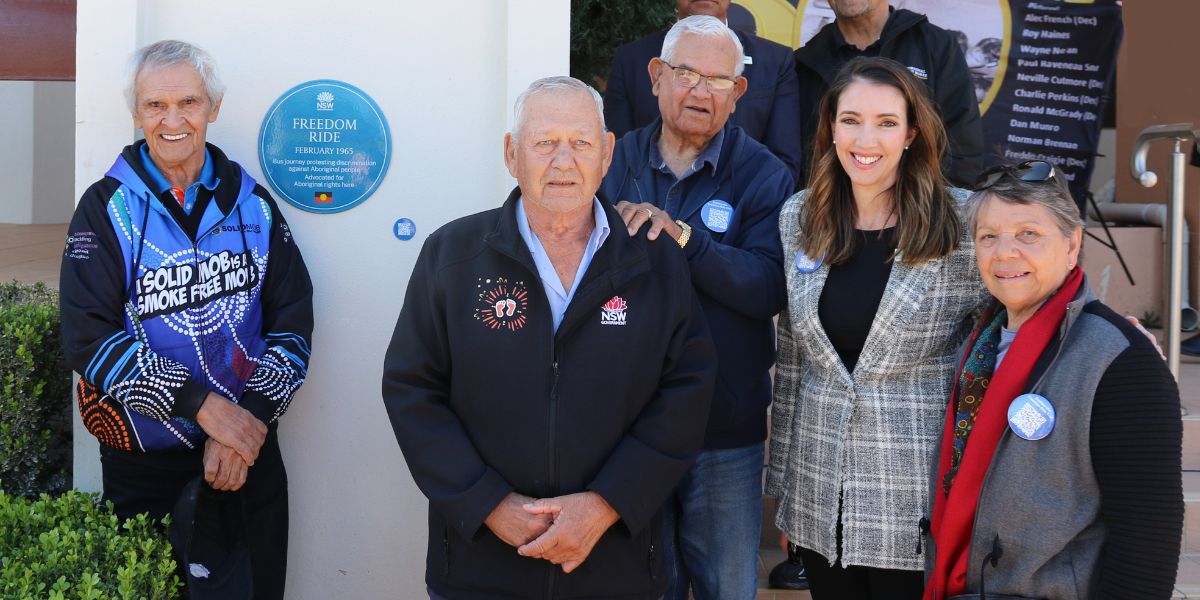
Moree Plains Shire Council officially unveiled its Freedom Ride Blue Plaque on Thursday, 13 August, as part of the NSW Government’s initiative recognising Moree’s significance in the landmark 1965 Freedom Ride.
The plaque was unveiled by Moree Elder and academic Uncle Darryl French following an official smoking ceremony by Paul Skuthorpe Spearim and dancing by James Smith to mark the occasion. The morning began with a Welcome to Country by Uncle Barry Sampson, followed by an address from Mayor Susannah Pearse.
Deputy Mayor Wayne Tighe, councillors, representatives from the Moree Local Aboriginal Land Council (LALC) and Moree Elders were present for the unveiling.
Led by Dr Charles Perkins and a group of university students, the 1965 Freedom Ride travelled through regional NSW to draw attention to discrimination and segregation. Moree was a significant stop on the journey, with the Freedom Ride helping to bring national attention to racial inequality and contributing to social change in Australia.
The campaign to end the longstanding ban on Aboriginal people accessing the Memorial Hall and Moree Baths became one of the defining moments of the Freedom Ride and Australia’s civil rights movement.
The occasion brought together community members, Elders and council representatives for a light lunch at the Banquet Hall to reflect on the significance of the Freedom Ride. Elder representatives included Lloyd Munro (LALC), Uncle Barry Sampson, Uncle Darryl French, Diane Creighton, Deb Swan and Shirley Johnson, among others, who shared their personal experiences of the Freedom Ride.
Deputy Mayor Wayne Tighe acknowledged the importance of the occasion to the Aboriginal community in a speech to attendees.
Pearse said the plaque provided an opportunity to acknowledge Moree’s history while ensuring the story of the Freedom Ride continued to be shared with future generations.
“The Freedom Ride is an important part of Moree’s history and Australia’s broader story of social change. This plaque gives our residents and visitors an opportunity to stop and think about the injustices of the past and the impacts they had on our community members who were a part of that history,” said Pearse.
“I am however proud that the Moree Plains is not the place it was back then. We have grown as a community and we will continue to embrace positive change, especially for our Gamilaroi/Gomeroi people”.
The Freedom Ride Blue Plaque is now a permanent part of Moree’s Memorial Hall and the National Trail, providing visitors and the local community with an opportunity to connect with this chapter in Australian history.
As one of six plaques forming the Freedom Ride Blue Plaque Trail, the Boggabilla plaque recognises the place where Aboriginal families welcomed the university students and openly shared their experiences, despite being warned not to speak with them. Residents invited the students into their homes and spoke about overcrowding, poor living conditions and the lack of basic services.
The Blue Plaques invite visitors to retrace the journey through an interactive QR code and explore the stories, people and events that helped shape Australia’s civil rights history.
Like what you’re reading? Support New England Times by making a small contribution today and help us keep delivering local news paywall-free. Donate now