
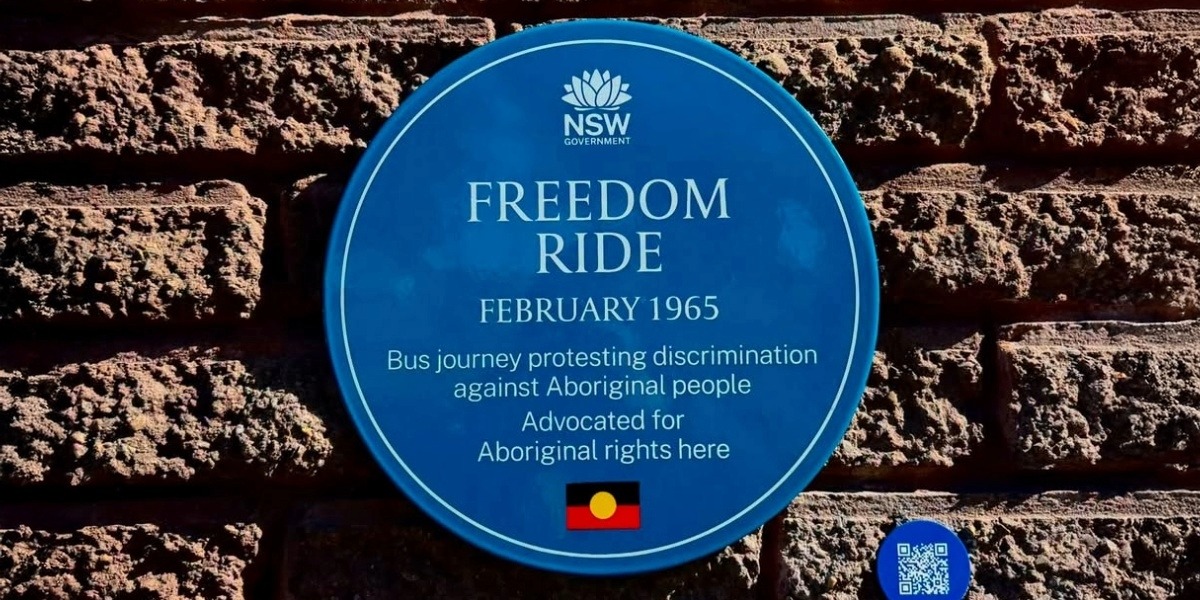
Moree’s place in Australia’s civil rights history will be marked with a Blue Plaque this week, as the NSW Government also opens nominations for the next round of the state-wide program.
The plaque will be officially unveiled at Moree Memorial Hall, Balo Street, at 11am on Thursday 13 August, marking the town’s inclusion in Australia’s first Freedom Ride Blue Plaque Trail.
Moree was one of the most significant stops on the 1965 Freedom Ride, the student-led bus tour through northern NSW led by Dr Charles Perkins that drew national attention to racial inequality and helped drive lasting social change. The campaign to end the ban on Aboriginal people accessing Moree’s Memorial Hall and swimming pool became one of the defining moments of the Freedom Ride and Australia’s civil rights movement.
The national trail features six Blue Plaques installed at key locations along the original Freedom Ride route, with an interactive QR code inviting visitors to retrace the journey and explore the stories, people and events that shaped the movement. Kempsey’s plaque was unveiled last week.
The unveiling will include a Welcome to Country from Uncle Barry Sampson of the Moree Elders Group, with addresses from Moree Local Aboriginal Land Council Chairperson Harold French and two representatives from the Elders Group. Mayor Cr Susannah Pearse will also attend, and is expected to speak on the significance of Moree’s inclusion in the trail and council’s commitment to preserving and sharing local history.
The Moree event coincides with the opening of nominations for a fresh round of Blue Plaques, the broader program that recognises the people, groups and events that have shaped the state’s history. More than 70 plaques have now been installed across NSW, from Broken Hill to Bondi, with recent recipients including performer Peter Allen, whose global success grew from a childhood in regional NSW, and Aboriginal performer and LGBTQIA+ activist Malcolm Cole.
Allen’s own plaque is a New England story through and through. He was born in Tenterfield, where his grandfather George Woolnough worked as the town’s saddler, a family history he immortalised in his 1972 song Tenterfield Saddler, and he grew up in Armidale from six weeks old until he was 14.
Anyone with a story about an individual, group or landmark event that has left a lasting mark on their community can now nominate for the next round, whether that is a long-serving local branch of the Country Women’s Association or a landmark event history has since forgotten. Nominations must relate to a person, group or event with a lasting impact on a NSW community, be appropriate and engaging for a wide public audience, and relate to a person who died more than 20 years ago or an event that occurred more than 20 years ago.
NSW DCCEEW Executive Director for Heritage Sam Kidman said the strength of the program came from the community itself.
“Every community has a story worth celebrating. We’re calling on people across NSW to share the stories of the individuals, groups and events that have made our state what it is today,” Mr Kidman said.
“These stories are more than just a moment in history, they remind us who we are and where we come from, and inspire future generations to create their own legacy.
“The strength of the Blue Plaques program comes from the community. We know there are countless fascinating, quirky and lesser-known stories waiting to be discovered and shared.”
Nominations can be submitted online through the NSW Government’s Have Your Say website and close on Sunday 13 September. Heritage NSW and a panel of community representatives will assess nominations against the eligibility criteria, with recipients selected in 2027.
Something going on in your part of the New England people should know about? Let us know by emailing newsdesk@netimes.com.au