

Construction on the proposed Inverell Battery Energy Storage System (BESS) could begin as early as 2028, with the project now moving toward a major public consultation stage next week.
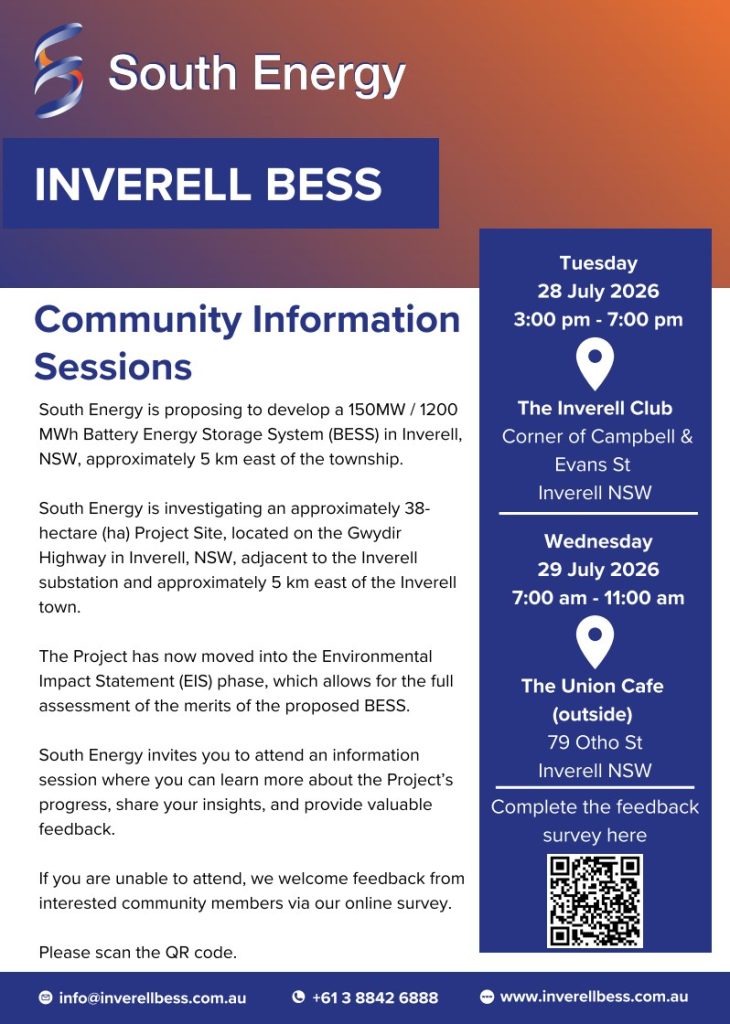
South Energy will hold community information sessions in Inverell on Tuesday, 28 July and Wednesday, 29 July, giving residents a chance to hear directly from the project team and raise questions about the 150MW battery proposed for a site roughly 5km east of the town, next to the Inverell 132kV substation.
Project Manager Linh Nguyen said the company expects to lodge its Environmental Impact Statement (EIS) with the NSW Department of Planning, Housing and Infrastructure around September 2026, kicking off a lengthy assessment process. The EIS will then go on public exhibition for 28 days before South Energy responds to feedback from agencies and the community.
“This likely will take up to 1 month, resulting in final submission of responses around early 2027,” Ms Nguyen said. She said the Department is expected to hand down a final decision on the project in the second or third quarter of 2027, with construction likely to start in early 2028, “subject to the approval for the grid connection and other financial arrangements.”
If the Department raises concerns, Ms Nguyen said the usual approach is to adjust the project rather than abandon it. “The standard pathway is to modify the layout or operating conditions to address them,” she said. “If they do not approve the project outright, then the proposal in its current form does not proceed.”
Site access and transmission connection routes, still being finalised, are expected to be locked in ahead of the September EIS submission, with feedback from next week’s sessions to be factored into that planning.
Local jobs are a key focus for the project, which is forecast to support around 250 full-time equivalent construction roles. Ms Nguyen said the company wants tradespeople and businesses from the region to fill as many of those positions as possible, particularly in civil works, earthmoving, concreting, electrical work and logistics.
“We want to target 30-50% local hire and businesses for the civil and balance-of-plant works,” she said. A Local Procurement and Supplier Register will also be set up so regional accommodation providers, caterers and suppliers can register ahead of peak workforce demand during construction.
Beyond construction, Ms Nguyen said the project would leave a lasting economic footprint through ongoing maintenance contracts, ranging from vegetation and civil upkeep to security and emergency response training, alongside a small permanent team of asset management staff.
A community benefit fund, to be managed by Inverell Shire Council over the life of the project, is also planned. Ms Nguyen said the fund would follow the NSW Guideline for Benefit Sharing released in November 2024.
“Our community benefit funding will align with the NSW Guideline for Benefit Sharing (November 2024), contributing a fixed rate per MWh to the local Council to support community initiatives,” she said. Residents keen to shape how that funding is used are encouraged to share ideas at next week’s sessions, with input needed at least a month before the EIS submission to be meaningfully incorporated.
Battery fire safety, a common community concern for BESS projects, will also be addressed directly at the Tuesday session, where a battery technology provider has been invited to speak. Ms Nguyen said the system includes multiple layers of protection.
“The BESS uses modular containers equipped with automatic gaseous fire suppression, thermal runaway isolation, and continuous remote battery management systems (BMS),” she said. Fire and Rescue NSW and local Rural Fire Service brigades are statutory consultees on the project, and a Fire Safety Study covering dedicated water storage and defensible space setbacks must be completed before construction begins.
On decommissioning, Ms Nguyen said the modular nature of BESS technology means the site can be returned to productive use once the project’s roughly 20-year lifespan ends, with components removed and recycled and the land rehabilitated for uses such as grazing or agriculture.
South Energy, founded in 2018 and backed by property group Growland Group, is aiming to deliver 3GW of renewable energy capacity across solar, wind, battery storage and hydrogen projects over the next five years. Ms Nguyen said Inverell holds a prominent place in that pipeline.
“The Inverell project is a priority component of South Energy’s portfolio,” she said. “It is our first 8-hour duration storage project with more to come in the pipeline. We are committed to seeing the project through all permitting process and reaching a financial investment decision.”
Residents can raise questions or feedback at the July sessions, by emailing info@inverellbess.com.au, through the project website, or by phone on (03) 8842 6888.
Got something you want to say about this story? Have your say on our opinion and comment hub, New England Times Engage