

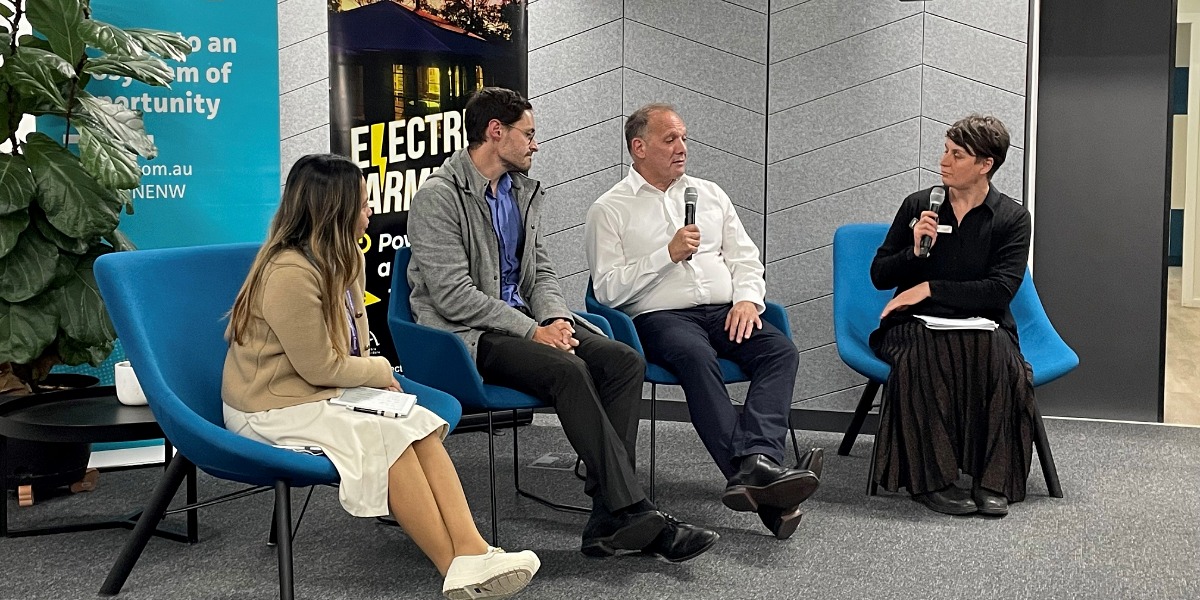
The New England region is positioning itself to play a leading role in solar recycling, as community members, councils, researchers and renewable energy experts gathered in Armidale on Monday night to examine how the region can manage end-of-life solar infrastructure.
The public forum, Closing the Loop: Recycling Solar in the New England, focused on the opportunities and challenges facing the region as increasing numbers of solar panels reach the end of their working life.
Held at NOVA and online, the event formed part of the Armidale Community Driven Shift to Renewable Energy and Sustainability program, supported by the Foundation for Rural and Regional Renewal and delivered with regional partners including Electrify Armidale, Sustainable Living Armidale, Community Power Agency and the UNE Smart Region Incubator.
Opening the discussion, Trevor Brown, from Electrify Armidale and the University of New England, said the region needed to plan now for the full life cycle of renewable energy technologies.
“Solar panels are built to last, but not forever,” Professor Brown said.
“As more panels reach the end of their useful life, we need practical systems for reuse, repair, recycling and responsible disposal. We also need to consider New England’s role in regional collection, recycling and processing pathways.”
Speakers highlighted that New England’s geographic position and growing renewable energy footprint could make it a hub for regional collection and processing, rather than relying on distant metropolitan facilities.
The forum heard that end-of-life solar panels should not simply be treated as waste, with valuable materials — including aluminium, glass, copper, silicon and silver — offering potential for a regional circular economy if local systems are established.
Darren Johannesen, Executive General Manager Sustainability at the Smart Energy Council, said Australia already had the technical capability to recycle panels, but regional areas like New England faced structural barriers.
“The myth that solar panels can’t be recycled is just that, a myth,” Johannesen said.
“Australian PV recyclers are already proving that they can recover over 95 per cent of the materials, with some retrieving rates as high as 99 per cent. This isn’t just a future concept. We’re doing it right here in Australia, right now.”
He said logistics remained a key challenge for regional communities.
“The real issue we need to contend with is the logistics trap,” he said.
“It is still cheaper in many cases to throw a panel into a hole than to put it on a truck. A mandatory national product stewardship scheme is the only way to break this cycle.”
Dr Kas Gregory, lecturer in computational, physical and theoretical chemistry at UNE, said developing local capability in New England could unlock both economic and environmental benefits.
“Most of the mass is easy-ish to recover, but most of the value is hard to recover,” Gregory said.
“The aluminium frame and glass are relatively straightforward, but the high-value materials such as silicon, silver and copper are embedded in the solar cell layers.”
He said overcoming technical barriers, such as separating polymer encapsulants, could enable higher-value recovery within the region.
“Circular solar is the next problem we need to solve,” he said.
“If we can use safer, greener methods to recover high-value silicon, silver and copper, and do that locally, it creates both environmental and economic opportunities for the New England region.”
The discussion also highlighted the importance of clear frameworks for renewable energy projects across the region.
Dr Megan Kessler, policy and research director at RE-Alliance, said regional communities needed confidence in how infrastructure would be managed at end of life.
“Decommissioning should not come down to trust,” Kessler said.
“There should be good systems in place to make sure it happens well.”
She said demand for clear, locally relevant information was growing among landholders.
“We developed our toolkit because landholders were telling us they were interested in hosting renewable energy projects, but they wanted to understand what would happen at the end of life,” she said.
“That information needs to be accessible, practical and specific to Australian conditions.”
From a local government perspective, Armidale Regional Council is already seeing rising volumes of solar waste, underscoring the urgency of regional solutions.
“We have received about 1,000 solar panels this year, and the number is increasing,” manager regional waste Guada Lado said.
“At the moment, what we do with them is not fantastic. We can salvage the aluminium frame, but the glass is crushed and much of the rest goes to landfill.”
Lado said regional councils across New England were working together where possible, but faced ongoing constraints.
“Markets play a really important role,” she said.
“We do work regionally with other councils to try to achieve economies of scale, but the logistics and costs are significant.”
The panel, moderated by Uralla Shire Council’s Emily Sims, explored how New England could develop local processing, improve reverse logistics and reuse panels that still have remaining life.
In closing, UNE Smart Region Incubator director Cameron Turner said the transition to renewable energy presented a significant opportunity for the region.
“We have a huge, once-in-a-generation transition happening in this region,” Turner said.
“The question is how we extract maximum value from that to make the lives of people in New England better.”
Turner said capturing more of the value chain locally would be key.
“This sounds like such a good opportunity,” he said.
“It would be great if we could extract some of that value here in the New England, or at least close by, so the region gets to benefit from it.”
Participants agreed New England has the potential to help lead practical, regional solutions to solar recycling, but said coordinated action across government, councils, industry, researchers and communities would be essential.
Something going on in your part of the New England people should know about? Let us know by emailing newsdesk@netimes.com.au