

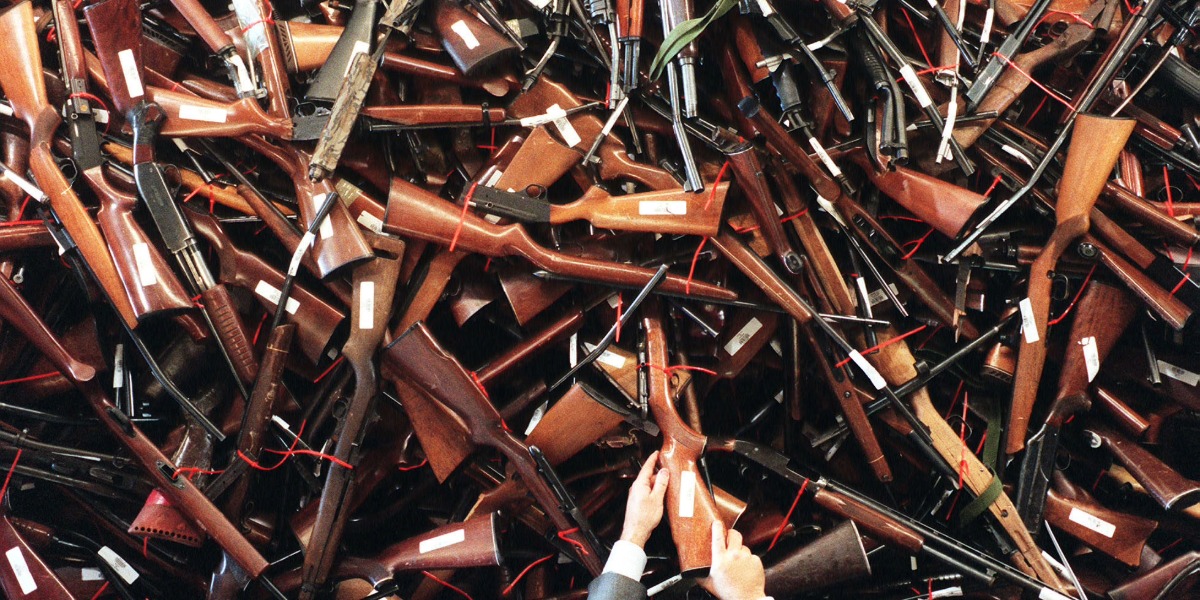
The fate of a promised national gun buyback scheme has become increasingly unclear, with the once-urgent reform now stalled amid disagreement between governments and lingering questions over whether it will proceed at all.
Announced in the immediate aftermath of the Bondi Beach Chanukah Massacre, the buyback was framed as a decisive, nation-shaping response. Four months on, it has yet to secure the support required to get off the ground.
The Albanese Government pledged in December to deliver the largest overhaul of gun laws since the aftermath of the Port Arthur massacre, including a national buyback scheme to remove newly banned and illegal firearms from circulation.
At the time, the language was unequivocal.
“This national buyback scheme will help get guns off our streets, and help keep all Australians safe,” Prime Minister Anthony Albanese said.
“Australia led the world in gun control after Port Arthur. A generation later it’s time to update our laws to keep our country safe,” Home Affairs Minister Tony Burke said.
The urgency of the moment was driven by the December attack at Bondi Beach, described by the government as a deadly antisemitic terrorist incident that exposed gaps in both firearms access and broader counter-terrorism settings.
In New South Wales, Premier Chris Minns and Police Minister Yasmin Catley moved quickly to introduce what they described as “the toughest gun law reforms in a generation,” including strict caps on firearm ownership, tighter licensing rules and enhanced compliance checks.
A buyback scheme was central to those reforms, intended to accompany new restrictions and encourage owners to surrender firearms that would become illegal.
But the confidence and clarity of those December announcements have given way to a far more uncertain reality.
A March deadline set by the Commonwealth for states and territories to agree to the scheme has come and gone without consensus. Several jurisdictions have refused to sign on, effectively halting progress on what was intended to be a nationally consistent reform.
Federal officials have struck a frustrated tone in response.
“It’s for states and territories to justify to Australians if they intend to stand in the way of getting those guns off our streets,” a federal government spokesperson said.
“All governments should be working to help to keep Australians safe. National cabinet agreed to strengthen gun laws across the nation. The reforms would be the largest since Port Arthur in 1996.
“Gun laws are only as strong as the weakest state. Having laws that are national and consistent is vital to their effectiveness.”
While the Commonwealth has led the policy push and proposed a 50:50 funding model, responsibility for implementing the buyback rests with the states and territories. Without their agreement, the scheme cannot proceed in a meaningful way.
At the time, the Commonwealth had set an ambitious timeline: agreement by March 2026 and legislation in place by July. That schedule now appears increasingly unrealistic.
New South Wales maintains it is still committed to the national approach, saying they are still working on that which is doomed to fail.
“In the wake of the worst terrorist attack our nation has seen, the Government took decisive action to protect the community,” an NSW Government spokesperson said.
“The NSW Government is working on a national gun buyback scheme with the Commonwealth, other states and territories.”
So far, Queensland and the Northern Territory have now both stated they will not participate in the buyback, and South Australia does not intend to tighten gun laws. Victoria is not committing either way. At the other end of the spectrum, Western Australia has implemented its own buyback and Tasmania is under way with one. ACT has signed on with NSW to the federal program.
Neither NSW nor federal government spokespeople would give a clear answer on what will happen given the lack of agreement from other states, leaving local gun owners in limbo.
Critics say the current impasse was predictable from the outset, pointing to what they describe as a rushed and poorly consulted policy process.
Federal Member for Parkes Jamie Chaffey said the reforms were driven more by political urgency than practical planning.
“Both the New South Wales and Federal Labor governments charged into these reforms boots-and-all following the horrific events at Bondi on 14 December,” Mr Chaffey said.
“It was not a considered or an effective response. It was a desperate attempt to be seen to be doing something.”
He said the lack of consultation with key stakeholders, including farmers, sporting shooters and gun retailers, had undermined confidence in the proposal from the beginning.
“These changes were rushed through without any consultation with gun owners, and they have had huge consequences for farmers, for sports shooters and for gun-shop owners,” he said.
“There is no word of compensation or any other measures of support to ease the desperate situation of gun shop owners and pistol clubs.”
Mr Chaffey said the failure to secure agreement from the states and territories confirmed deeper problems with the policy.
“The mishandling of this has only been confirmed by the states and territories who have walked away from the gun buyback,” he said.
“Instead of finding a way forward, we are left with no direction at all.”
Got something you want to say about this story? Have your say on our opinion and comment hub, New England Times Engage