

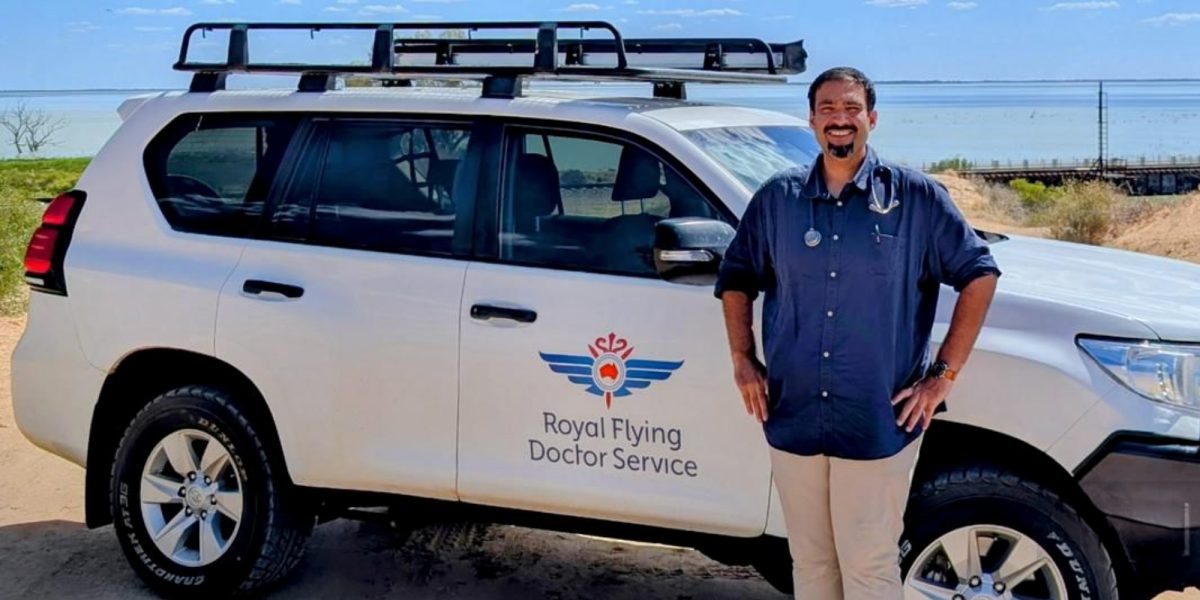
Tanvir Kapoor thinks some young men in rural areas take better care of their utes than their bodies.
“There is a perception about toughing it out, or ‘she’ll be right’,” the Royal Flying Doctor Service general practitioner told AAP.
Data from the aeromedical service has revealed that for every 10 women aged 21 to 30 seen by its GPs, only four men in the same age group sought treatment.
The figures from the service’s southeastern section, which covers NSW and the ACT and has four permanent remote clinics, show the gap only lessens once men age.
Dr Kapoor, who works in both outback NSW and at a Queensland hospital, said clinical engagement with young men was a challenge across most rural health settings.
Long distances and workloads were a major barrier to care, but physical isolation also meant there were limited personal support networks for men.
“For example, that stigma about talking about mental health is very real,” Dr Kapoor said.
“How can you bring that up in a community that’s so small?
“You’re worried about what people are thinking and … you hold that very close to your chest.”
While access to primary healthcare slightly improved nationally in 2024/25, people in outer regional and remote areas were still less likely than their urban counterparts to see a GP, according to Australian Bureau of Statistics data released in November.
Rural patients were instead more likely to present to an emergency department, be admitted to hospital, or see a GP for urgent medical care.
One area of slight improvement was an increase in the proportion of Australians who reported being able to see their preferred GP, at 67 per cent.
Continuity of care has been a major focus for rural medicine groups in recent years, with targeted efforts to boost the workforce.
The Royal Australian College of GPs has partnered with the Rural Doctors Association to encourage more students and junior doctors to get exposure to remote practice.
The nation’s two GP colleges are also oversubscribed for the first time in many years, and more trainees were expressing a desire to work outside the cities.
The Council of Presidents of Medical Colleges has also launched a push for regional specialist training centres that would help keep young doctors in the bush.
The Rural Flying Doctor Service has increasingly stepped in to run face-to-face clinics in remote areas, regularly flying GPs in to provide continuity of care.
“Young men can come and see the same doctor over and over again, and that trust is there,” Dr Kapoor said.
As efforts continue to improve healthcare access in rural areas, including a raft of federal government incentives, he urged young men to seek help.
“I want to see you in the clinic so I don’t see you on the plane,” Dr Kapoor said.
If you or anyone you know needs help:
- Lifeline on 13 11 14
- 13YARN on 13 92 76
- Beyond Blue on 1300 224 636
- ifarmwell at ifarmwell.com.au/farmer-friendly-mental-health-resources
- Farmer Health Support Hub at farmerhealth.org.au/support-hub
- Kids Helpline on 1800 551 800
- Suicide Call Back Service on 1300 659 467
- Headspace on 1800 650 890
- ReachOut at au.reachout.com
- MensLine Australia on 1300 789 978