

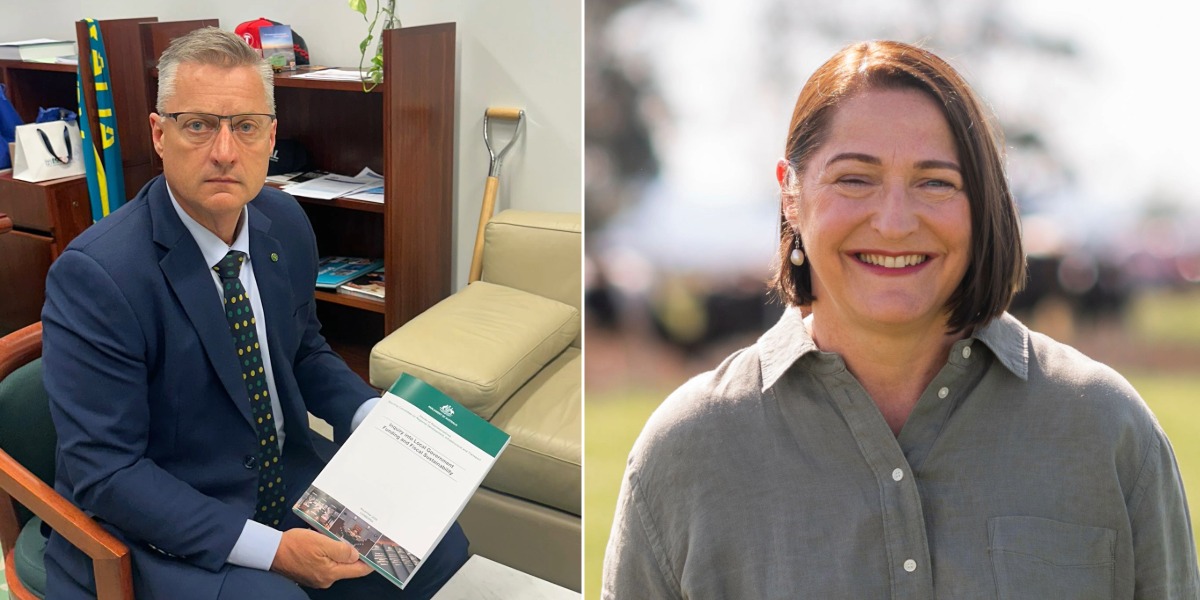
Parkes MP Jamie Chaffey and the state’s country mayors are both demanding action on a long-awaited federal report into council funding, warning it gives regional councils plenty of recommendations but no money and no timeline.
The final report of the Inquiry into Local Government Funding and Fiscal Sustainability was tabled in Federal Parliament on Wednesday, 25 November.
After two and a half years, two Parliaments, 26 hearings, 265 submissions, and 390 witnesses, the committee has made 33 recommendations. Member for New England Barnaby Joyce served as the committee’s deputy chair for part of the inquiry in 2025.
Committee Chair Fiona Phillips said a clear and consistent message had emerged.
“Councils are being asked to do more while their capacity to fund and deliver services is being stretched,” said Mrs Phillips.
“In many communities, councils have become the provider of last resort.”
“At the same time, councils must maintain and renew an asset base estimated to be around $775 billion.”
They include a “staged fiscally responsible increase” in Financial Assistance Grants, the main untied Commonwealth funding for councils, but set no dollar figure, no timeline, and no commitment to more funding any time soon.
The report also calls for a formal agreement between all three levels of government through a proposed Federation Compact, and for states to let councils raise more of their own revenue. That includes making sure councils hosting nationally significant projects can recover the infrastructure and service costs those projects create, changing developer contribution rules, and requiring industry and resource organisations to pay rates.
It recommends a National Local Government Workforce Strategy, with particular attention to regional, rural, and remote councils, and reforms to disaster resilience and recovery funding.
“Regional, rural and remote councils carry the heaviest load with the least capacity to raise their own revenue,” said Shadow Assistant Minister for Local Government and Federal Member for Parkes Jamie Chaffey.
“They can’t wait another Budget cycle, and they shouldn’t have to.”
The Country Mayors Association of NSW (CMA) welcomed the report but warned the real test would be whether governments actually delivered reform.
“Regional councils have been discussing these issues for decades,” said CMA Chair Mayor Russell Fitzpatrick.
“We have participated in inquiries, reviews, parliamentary investigations and countless submissions outlining the financial pressures facing local government.”
“The challenge is not identifying the problem. The challenge is getting governments to act.”
The Australian Local Government Association (ALGA) was more upbeat, calling the report a strong foundation for resetting federal funding.
“Our preliminary assessment of the report points to strong alignment between the Committee’s recommendations and a number of ALGA’s key advocacy priorities,” said ALGA President Mayor Matt Burnett.
“It is particularly encouraging that the Committee, in its first recommendation, has recognised the value of a Federation Compact with local government.”
Financial Assistance Grants total about $3.6 billion in 2026-27. That is just 0.49 per cent of Commonwealth tax revenue, well below the roughly 1 per cent councils received historically.
ALGA has called for the grants to be restored to at least 1 per cent of Commonwealth tax revenue. Mayor Burnett repeated that call before the committee in July, tabling a letter of support signed by the president of every state and territory local government association.
“Labor promised councils ‘fair increases’ before the 2022 election,” Mr Chaffey said.
“Yet on the Government’s own Budget numbers, councils’ share of Commonwealth tax is stuck at half a per cent at best. If nothing changes, it slips to around 0.47 per cent by 2032-33.”
“Labor’s department told this inquiry councils already get more than 1 per cent, by counting competitive and one-off grants that come and go. You can’t plan a road program on a grant you might not win.”
The report recognises the “distinct circumstances” of regional, rural, and remote councils, which manage vast road networks with small rate bases through repeated floods, fires, and droughts. It also suggests a possible review of minimum grant rules.
Uralla Shire Council Mayor Robert Bell told the inquiry’s Taree hearing in May that his shire of about 6,000 people was expecting around 1,700 workers linked to a renewable energy project.
“Our water supply won’t sustain any further population growth,” Mayor Bell said.
“Can we remind people that Sydney, Newcastle and Wollongong aren’t all of New South Wales? There’s a whole lot of the rest of us out here that haven’t seen much of that money.”
Mayor Fitzpatrick said many country councils had already been through large rate rises just to keep operating and maintaining long-term assets.
“For many country councils, the struggle for financial sustainability is not a future challenge. It is today’s reality,” he said.
“The financial pressures facing regional councils are not the result of poor management. They are the result of a structural mismatch between responsibilities and available funding.”
Shadow Minister for Local Government Senator Bridget McKenzie said councils had acted in good faith.
“Councils trusted this process,” said Senator McKenzie.
“Thirty-three recommendations, and not one dollar and not one date. That isn’t respect. It’s a filing exercise.”
Coalition committee members, including Deputy Chair Alison Penfold, Tom Venning, and Michelle Landry, also warned that recommendations calling for further reviews “risk delaying meaningful reform”.
The CMA said it also feared the report could gather dust.
“There is a risk this becomes another well-intentioned report that attracts headlines for a few weeks and then quietly disappears without delivering the structural reform councils desperately need,” Mayor Fitzpatrick said.
The CMA is calling on the Commonwealth and State Governments to respond publicly and set a clear timetable for implementing key recommendations.
Senator McKenzie and Mr Chaffey have called on Local Government Minister Catherine King to respond to all 33 recommendations before MYEFO, put a dollar figure and a date on increased Financial Assistance Grants, and put regional, rural, and remote councils first in line for any increase.
“Respect for local government means treating councils as a genuine partner and backing them with secure, untied funding,” Mr Chaffey said.
“Labor talks about partnership. Councils need to see it in dollars.”
ALGA said it would now work through the detail with the state and territory local government associations.
“We recognise that all governments are operating in a challenging economic environment,” Mayor Burnett said.
“That makes it even more important that federal investment reaches the communities where it can make a tangible difference.”
Mayor Fitzpatrick said the report would be judged on what happened next.
“Our communities do not need another review. They need certainty,” he said.
“The success of this report will not be measured by the number of recommendations it contains, but by the number that are actually implemented.”
Don’t miss any of the important stories from around the region. Subscribe to our email list.