

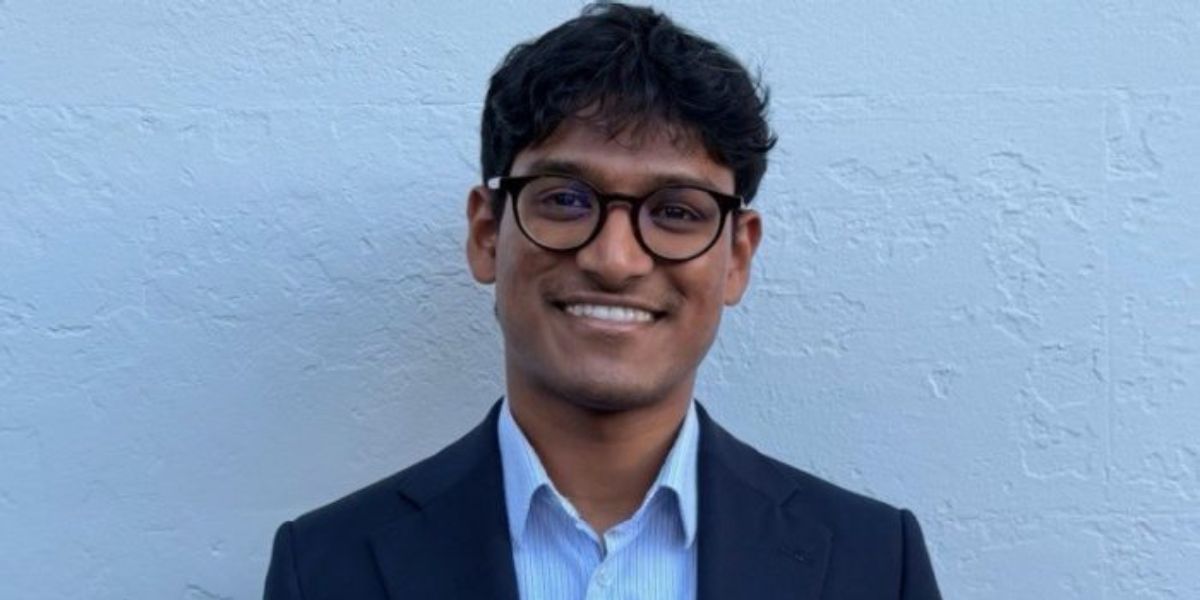
A former Guyra boy and Dux of The Armidale School (TAS) has won one of Australia’s most prestigious postgraduate scholarships, and he plans to use it to help make sure a patient’s postcode no longer decides the surgery they can get.
Dr Sambavan Jeyakumar is one of 18 Australians named 2027 John Monash Scholars, in recognition of their academic excellence, leadership potential, and impact for Australia.
He has been awarded the Tim Fischer John Monash Scholarship and intends to undertake a Master of Research in Medical Robotics and Image-Guided Intervention at Imperial College London.
His studies will explore how robotic technologies could improve access to specialist surgery for people in rural and remote Australia.
Dr Jeyakumar grew up in Guyra, where his father was the local doctor, and was Dux of TAS in 2018.
He is now a surgical resident at Royal Prince Alfred Hospital in Sydney, with a particular interest in robotic and paediatric surgery. He is also a UNSW Sydney alumnus and an Adjunct Associate Lecturer in UNSW Medicine & Health.
“Growing up in rural New South Wales and training as a doctor in Alice Springs, Coffs Harbour and Sydney, I have seen first-hand how much your postcode can shape the surgical care you receive,” Dr Jeyakumar said.
With specialist expertise concentrated in cities, patients in rural and remote areas often have to wait longer and travel further to reach it.
“Robotic and remote telesurgical platforms have the potential to extend that expertise to the patient rather than the other way around,” Dr Jeyakumar said.
“But of the roughly 150 robotic platforms in Australia and New Zealand, only 14 are in rural and remote hospitals.”
His interest in technology began during his Honours year at St Vincent’s Hospital, where his supervisors introduced him to heart failure devices and transplantation.
“Watching their work, what struck me was how clearly a clinical need drives the technology: what does this patient need that we can’t currently provide?” he said.
“I want to ask that same question for patients in rural and remote communities.”
The scholarships are valued at $100,000 a year for up to three years of study and are awarded each year after a highly competitive nationwide selection process.
With that support, Dr Jeyakumar plans to study how data-driven assessments of robotic surgery could support a standardised, competency-based training pathway, particularly for rural centres.
After his studies, he hopes to contribute to a national robotic surgery curriculum and help build partnerships between city teaching hospitals and rural health districts.
“Dr Jeyakumar’s selection as a John Monash Scholar is a wonderful recognition of his academic excellence and commitment to improving health equity for regional Australians,” said Dean of UNSW Medicine and Health Professor Cheryl Jones.
“We’re proud to see him take this next step in his career and look forward to the contribution he’ll make to the future of surgical care in Australia.”
The 2027 cohort was chosen from a record number of applications across Australia. Now in its 23rd year, the General Sir John Monash Foundation has invested more than $44 million to support 318 scholars to study overseas.
“In an uncertain world that is moving away from broad globalisation to a focus on more nuanced regional trade, national security and knowledge-based industry, investing in Australia’s future leaders through state-of-the-art international postgraduate education strengthens our national capability,” said General Sir John Monash Foundation Chief Executive Officer Ross Youngman.
“Our John Monash Scholars past and present are demonstrating, across multiple fields, the impact that a smart, well-educated and driven individual can make.”
Named in honour of Australian leader General Sir John Monash, the scholarships are supported by the Federal Government, all mainland state governments, the business community, and individual donors.
For Dr Jeyakumar, the goal is simple.
“Ultimately, I’d like where a patient lives to matter less to the surgical care they can access,” he said.
Something going on in your part of the New England people should know about? Let us know by emailing newsdesk@netimes.com.au