

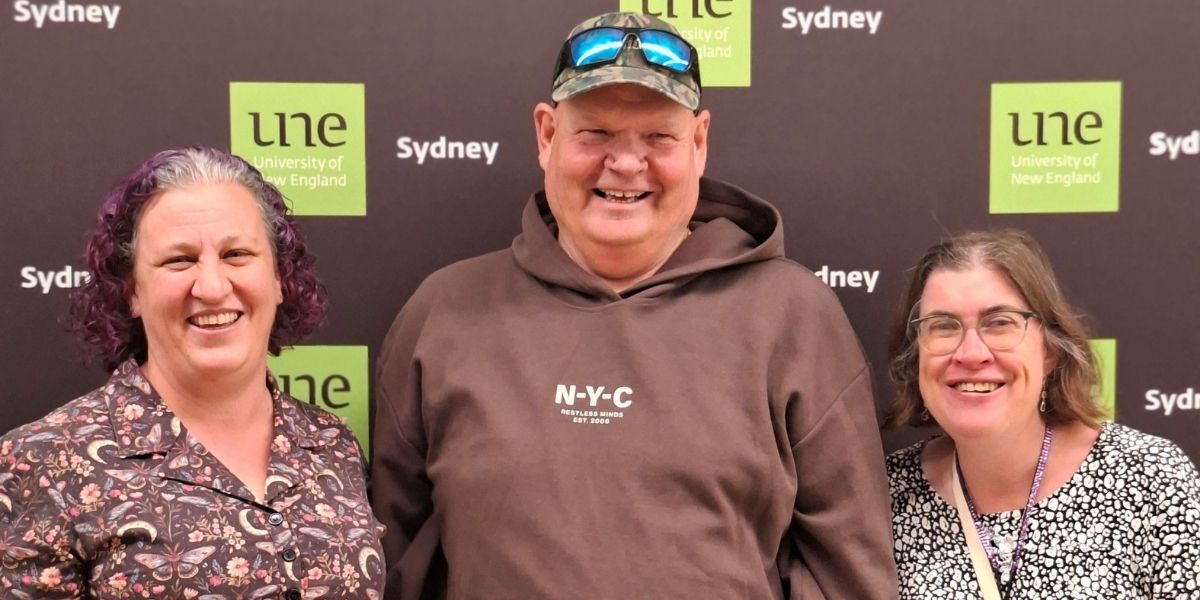
People with intellectual disability are helping shape a major University of New England (UNE) research project aimed at improving access to health care for older Australians living in rural communities.
The five-year Rural Compass project is investigating barriers faced by rural residents with intellectual disability when accessing health services, with the goal of developing more accessible and effective care.
Funded by the Medical Research Future Fund, the study has appointed two people with lived experience as co-researchers, ensuring their perspectives influence every stage of the project.
Penny Dutton, from NSW, and Michael Parker, from Western Australia, are contributing to survey design, interviews, focus groups, data analysis and the communication of findings.
The approach aims to ensure the research reflects the experiences of people with intellectual disability rather than relying solely on academic perspectives.
“I decided to contribute to this research because l believe the topics are important. I wanted to share my thoughts and experiences of what people actually go through in life … to help researchers better understand people with intellectual disability,” said Penny.
“It’s a chance to have my voice heard and to contribute to positive outcomes for people who might be going through something similar.”
Michael said the project offered an opportunity to advocate for people who may struggle to communicate their health care needs.
“They rely on healthcare but sometimes can’t speak for themselves, which can be frustrating. I really like helping people and being honest with people and hope the research will help make others happier in life,” Michael said.
“By being courageous and part of the research, I hope I encourage others to be involved, too.”
Project manager Dr Hannah Ford said involving people with lived experience from the beginning would help ensure research materials were accessible and relevant.
“It grounds our project in reality and helps ensure we are asking the right questions and getting the data we need,” she said.
“We are particularly interested in the early intervention care that’s getting missed and which can result in unnecessarily lengthy hospital stays.”
While advances in health care have increased life expectancy for people with intellectual disability, they often experience earlier signs of ageing and develop chronic conditions at younger ages.
Researchers hope identifying gaps in rural health services will lead to improved physical and mental health outcomes, particularly through earlier intervention and better access to community-based care.
Support worker Miranda Vanry has also joined the project to help Penny and Michael participate fully in the research process.
“Knowing Michael and Penny would be paid the same as me showed their lived experience was valued equally to the skills and knowledge of others on the team,” Miranda said.
Dr Ford said people with intellectual disability were frequently excluded from research because of communication barriers.
“Having Penny and Michael as co-researchers gives us the very best chance of ensuring that the voices of people not traditionally consulted are captured.”
UNE School of Rural Medicine professor and lead chief investigator Stuart Wark said the project represented an important shift towards research conducted with, rather than simply about, people with intellectual disability.
“This is best-practice research,” Professor Wark said.
“It gives people with a practical understanding of living with intellectual disability input into research that’s ultimately designed to help them. Penny and Michael will directly impact the direction our research takes, help us to overcome acquiescence bias and enable us to gather richer data and devise more relevant interventions. At its heart, this is about valuing their experiences and expertise.”
Penny and Michael have already co-authored two published journal articles and recently presented on the importance of lived experience in research at a conference hosted by UNE and the Australasian Society for Intellectual Disability.
“I hope our research project is a stepping stone for Penny and Michael into future research,” Professor Wark said.
The Rural Compass project involves researchers from Southern Cross University, Western Sydney University, Charles Sturt University, Central Queensland University, Notre Dame University and Trinity College Dublin.
It is also working with disability service organisations Enable WA, Lifely, Microboards Australia and Sunnyfield.
An online survey is now open to rural Australians aged 40 and over who have an intellectual disability.
Participants can respond independently, with assistance from a carer or through a family member, friend or carer acting on their behalf.
Researchers will collect information annually over three years to better understand changes in participants’ health, treatment preferences and access to support services.
The findings will be shared with disability organisations, health providers and governments to help inform improvements to rural health care.
Eligible participants can complete the survey at redcap.link/ruralcompass.
Like what you’re reading? Support New England Times by making a small contribution today and help us keep delivering local news paywall-free. Donate now