

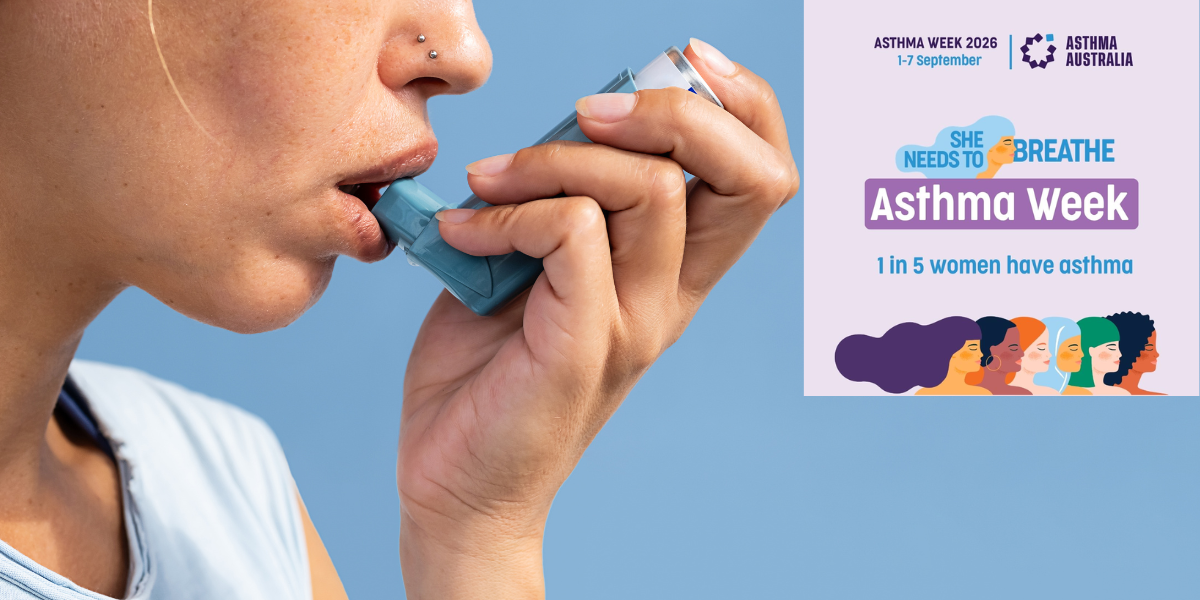
Asthma Australia is calling on New England women to pay closer attention to their breathing, as the charity’s national Asthma Week campaign turns its focus to women’s health from Monday, 1 September to Sunday, 7 September.
This year’s theme, “she needs to breathe,” highlights new data showing one in five Australian women live with asthma, and that women are twice as likely to die from the condition as men.
The issue has already had a local airing in Armidale, which last year was chosen for Asthma Australia’s Make the Switch trial, a scheme offering homeowners a subsidy to swap wood heaters for reverse cycle air conditioners after the city was found to have among the worst air quality in the nation.
Asthma Australia says wood smoke is a known trigger for asthma attacks, and this year’s campaign builds on that local connection by turning attention to how the condition affects women differently across their lives.
From childhood through to older age, girls and women carry a heavier burden of asthma than men, with higher rates after puberty, more hospital admissions through adulthood, and more than double the number of deaths.
Asthma is the leading cause of disease burden in girls aged one to nine, and about 5000 girls are hospitalised each year because of it. After puberty, the pattern shifts again. Asthma becomes more common in females than males, and girls and women are hospitalised at around twice the rate of boys and men from age 15 onwards.
Pregnancy brings its own risks, with hormone changes sometimes making asthma harder to control at a time when good management matters for both mother and baby. Most daily preventer medicines are considered low risk during pregnancy and should be continued, with flare-ups treated early.
Midlife brings another shift. Asthma can place a heavy load on women during perimenopause and menopause, a period Asthma Australia says is often compounded by social and financial pressures. One woman, describing the strain of balancing her own asthma care with her daughter’s, said in a social media comment shared by Asthma Australia, “I often miss out on my asthma medicine because I make sure that my daughter has hers, and we can’t always afford both.”
Older women fare worst of all. Women aged 75 and over account for nearly half of all asthma deaths in Australia, even though many of those deaths could be prevented with proper care. Asthma Australia says the condition often presents differently in older adults, and can be masked or complicated by other health conditions common in later life.
The campaign sets out four signs that asthma may not be under control: waking at night because of symptoms, wheezing or coughing more than two days a week, needing a reliever more than twice a week, and finding symptoms get in the way of exercise, work or daily life.
Asthma Australia is encouraging women across the region to check in on their symptoms during Asthma Week, and to speak to a healthcare provider if their asthma does not feel under control. Anyone with questions can call the free Asthma Educator support line on 1800 ASTHMA (1800 278 462) or email asthmasupport@asthma.org.au.
More information on this year’s campaign, including the push to put asthma on the national women’s health agenda, is available at asthma.org.au/get-involved/events/asthma-week/asthma-week-2026.
Got something you want to say about this story? Have your say on our opinion and comment hub, New England Times Engage