

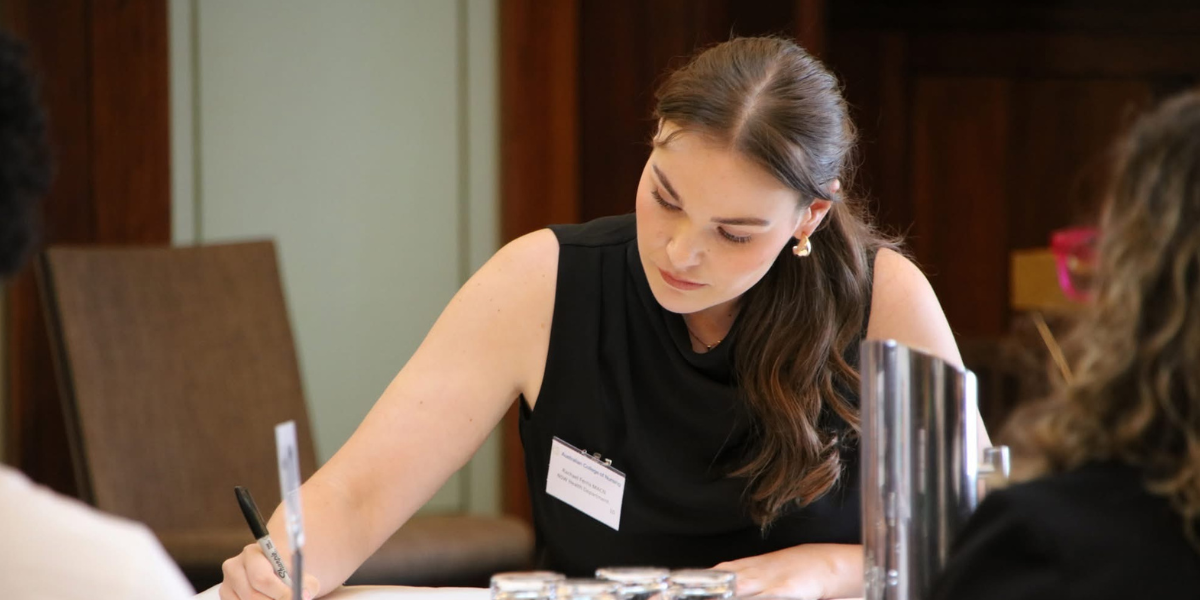
An Armidale nurse has used a national platform to push for the governance changes needed to keep nurses working in rural and remote communities.
Rachael Ferris presented to hundreds of nurse leaders from across the country at the Australian College of Nursing’s National Nursing Forum, held Thursday 6 to Friday 7 August at the Melbourne Convention and Exhibition Centre under the theme “Power of Nurses in a Changing World.”
The audience included the Chief Nurses of each state and the Commonwealth Chief Nurse. Her presentation coincided with the launch of Australia’s first National Nursing Workforce Strategy.
Ms Ferris, a Clinical Nurse Specialist in Refugee Health and Clinical Nurse Educator with NSW Health, said the response from the room was overwhelmingly positive.
“It was overwhelmingly positive, which was really nice to hear,” she said.
She said many people at the forum sit at governance level and are removed from clinical practice, making it valuable to hear directly from someone working on the ground.
“They appreciated the candour and the vulnerability of it,” she said, of feedback from people in governance positions.
The focus of her presentation was the wellbeing of rural and remote nurses, drawing on her own year working as a Remote Area Nurse in the Northern Territory. Ms Ferris pointed to workforce figures showing about 40 per cent of new graduate nurses leave the profession within two years, with most nurses gone from the profession entirely within seven years.
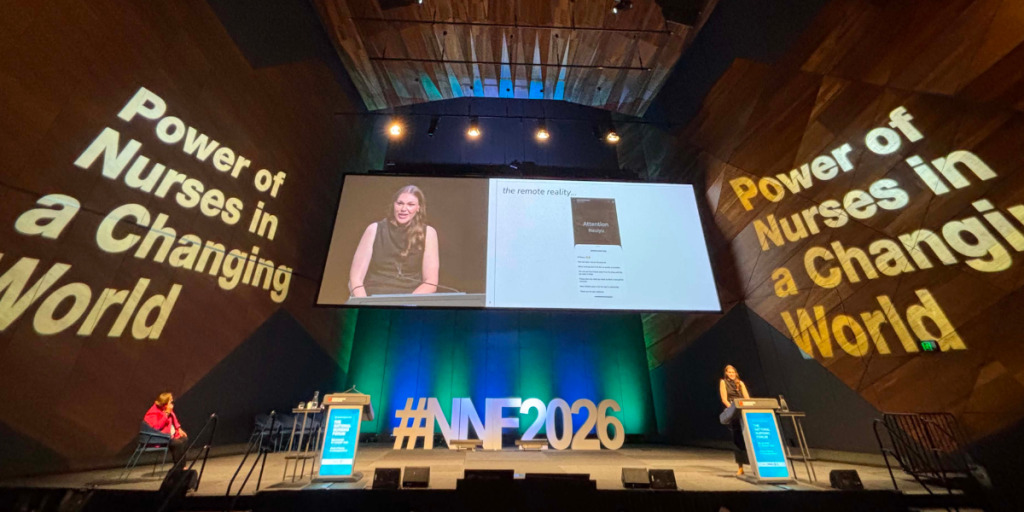
She said the answer lies in addressing the system, not asking individual clinicians to absorb its shortfalls.
“We have lots of conversations around patient safety and the resilience of individual clinicians,” she said. “If we want nurses to stay in these settings, we need to address the system that is making them leave.”
Ms Ferris said nurses in remote settings often work without doctors on site, using clinical judgement to fill the gaps, and that trust in that expertise matters more than ever with the recent introduction of RN prescribing.
“Nurses are using that critical lens and thinking about what needs to be done,” she said.
Alongside her clinical and advocacy work, Ms Ferris has just taken on a new role as Program Lead: Planning, Evaluation and Communication with NSW Health’s Multicultural Health Service.
She will continue as Clinical Nurse Educator two days a week while implementing an on-demand interpreter service for emergency departments, starting in Tamworth and Newcastle before a hoped-for rollout across the district. She is also a Sessional Academic at the University of New England.
She has also presented a poster on a palliative care initiative developed in the “living and dying with dignity” space, work she said reflects the innovation rural nurses bring when they informally work around gaps in the system.
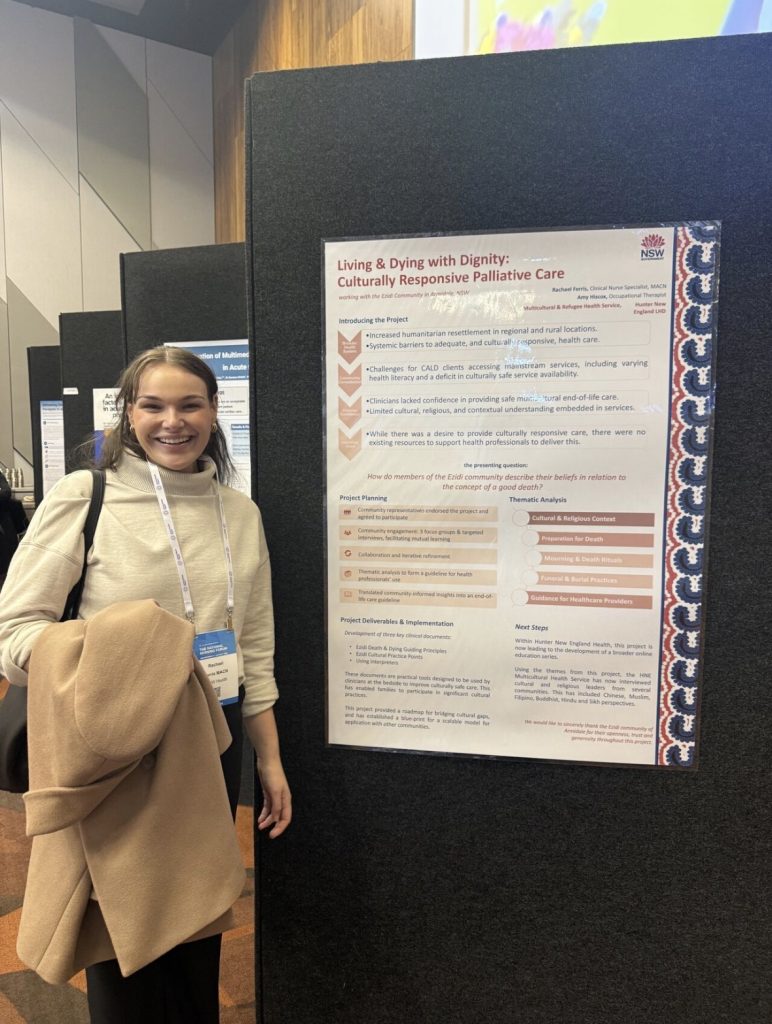
“Often we informally address them by creating workarounds,” she said. “Our model was quite unique that we formalised that process, which has meant that other communities are now able to pick that up and run with it.”
On the newly launched National Nursing Workforce Strategy, Ms Ferris said it was too early to know exactly how it will play out, with implementation working parties only now being formed.
“I think it could go in a few directions at the moment,” she said.
She said reducing reliance on locum and agency staff by better supporting the existing rural workforce should be a priority.
“We have this significant reliance on locum and agency staff, which is great that we have access to those resources for the shortfalls we do have. But if we can support our rural nurses, then I think it would reduce the financial burden in the long run,” she said.
Ms Ferris, a policy fellow with the Australian College of Nursing, said she has been asked to join a working party on the strategy’s implementation and hopes it will ensure rural voices are part of the conversation.
“Sometimes a lot of discussions about the rural setting happen without people from those communities,” she said. “Getting a chance to have a seat at the table is really valuable.”
The strategy is built around four priorities: workforce planning and education, innovation, elevating the nursing profession, and building a sustainable workforce. Ms Ferris said all four have relevance to rural and regional communities, pointing to nurse-led models of care as an example of the profession’s potential beyond the bedside.
She cited the work of Port Macquarie nurse Mel Freeman, whose nurse-led clinic has delivered projected government savings in the millions of dollars through early intervention.
“Imagine if we could have the legislation looked at from that perspective, that nurse-led models of care become the norm,” Ms Ferris said. “The savings would be astronomical. The reduction in the burden on the tertiary health care system would be reduced.”
Ms Ferris said changing the broader narrative around nursing, particularly the perception among student nurses that burnout and moral injury are inevitable, will be key to bringing people back to the profession.
“At the moment, the perception even for student nurses is that at some stage in the early years of their career, they will leave the workforce because of moral injury,” she said. “This is the first step in changing the system.”
She said the frustration many in the community feel about emergency department wait times is understandable, but often overlooks the pressure clinicians are working under behind the scenes.
“Nobody comes to ED feeling their best. Nobody wants to sit in ED for hours on end,” she said. “But then behind the scenes, the work that goes on is quite incredible in terms of the skill of the clinicians behind the scenes to manage that.”
She said services such as Armidale’s are seeing more patients than they are funded to see.
“We do actually deliver a pretty exceptional service with what we have,” she said.
Ms Ferris encouraged nurses to stay connected to professional bodies such as the Australian College of Nursing, CRANAplus and Rural Health Pro, saying isolation can compound the pressures of the job. She has been part of ACN’s Emerging Nurse Leader Program and is currently in its Emerging Policy Leader Program.
“That’s been really important to help me see those next steps and sustain that passion for nursing and the nursing workforce, because I feel connected to something bigger,” she said. “It can become very easy to be burnt out, I think, when we are seeing the shortfalls of the system day to day, when we have people so often on overtime or extra shifts or sometimes there’s unsafe patient ratios.”
She said improving conditions for nurses will not fall to any one group alone.
“If we want to see change, it will be the result of communities full of passion…the onus doesn’t lie with any one individual. It doesn’t even lie solely with the government. It really does need to be a whole of community approach,” she said.
Ms Ferris said she hoped the national strategy would ultimately ease pressure on services and improve public understanding of the work already being done in stretched rural systems.
“I really would hope that we do see a return of people who have left the profession to come back once they see these changes actually being implemented,” she said.
Got something you want to say about this story? Have your say on our opinion and comment hub, New England Times Engage