

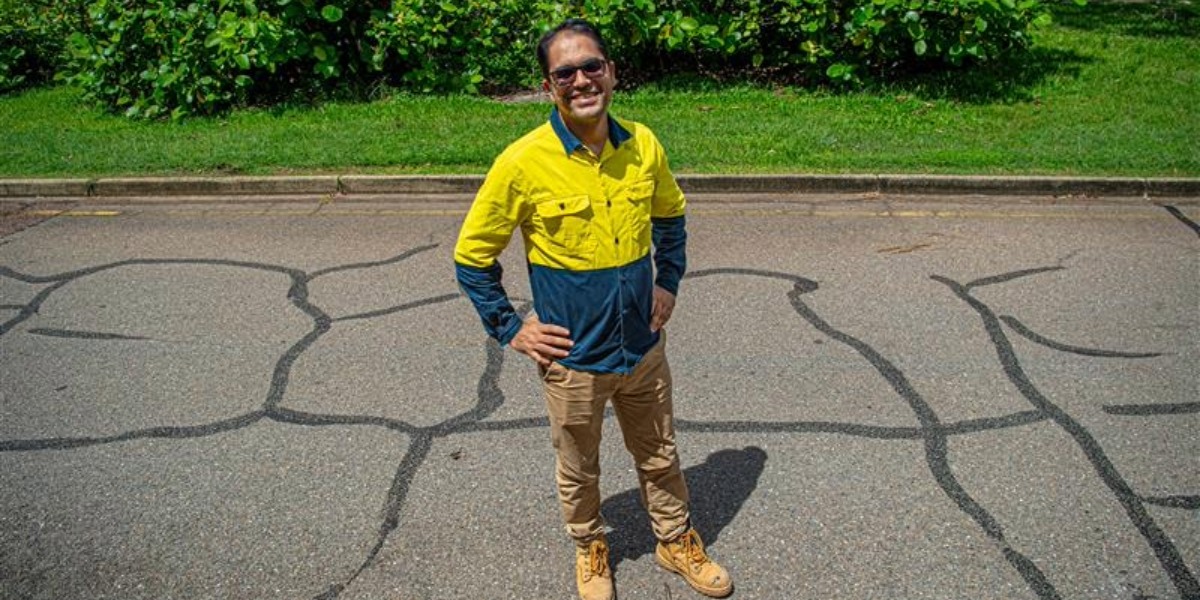
Inverell Shire Council began trialling AI cameras last month to spot cracks and defects across its 2,254 kilometres of local roads. Now, researchers are working on the next step: a robot that can find a crack and fix it on the spot, before it turns into one of the potholes that plague roads across the region.
The work is part of a new $1.2 million partnership between Charles Darwin University (CDU), Civiltech Solutions and the Additive Manufacturing Cooperative Research Centre (AMCRC), combining LiDAR road scanning, artificial intelligence, robotics and additive manufacturing to detect and repair cracked roads with minimal human involvement.
CDU’s Centre for Asphalt and Road Technologies (CART), which received half a million dollars in funding as part of the partnership, is contributing expertise in robotics, materials engineering and additive manufacturing to build on Civiltech Solutions’ existing LiDAR-based road scanning platform – similar to the one being trialled in Inverell.
CART Director Dr Ali Rajabipour said the project was still in its early stages.
“We are in the phase of crack detection and then integration of these systems,” Dr Rajabipour said.
“The LiDAR technology, and the company offering that system to us, has a track record in that business for quite a while. For crack detection, most of the problem has been solved and properly investigated. The matter now is integration of the systems.”
Dr Rajabipour said Civiltech’s scanning system was already used commercially, including in Darwin.
“The normal practice is you see the cracks visually, and then there is a wand, and you spray a bit of cement over it, which is called crack sealing,” he said.
“But the proper process is you scan the road, you prioritise which crack is more critical, and then you manage the amount of material and select the right material for that. If you want to do that process with humans, it takes ages. With this AI and laser scanning, you can do it much, much faster.
“The AI system recognises the cracks, and then the robot reaches that crack, looks at it closely, and then sprays the right amount of material at the right rate.”
Dr Rajabipour said the collaboration demonstrated valuable applications for emerging technologies in addressing real-world infrastructure challenges.
“This project brings together a range of technologies and industry insights to solve real-world infrastructure problems while building advanced engineering capability in the Northern Territory,” he said.
Asked what would happen if the AI found damage too severe for a robot to handle, Dr Rajabipour said that task would fall back to Civiltech’s existing scanning and reporting service, which flags critical defects so road authorities can send out a crew.
He said the system could also classify cracks by how far advanced they were.
“There are different reasons why cracks happen, and there are different stages of crack development,” Dr Rajabipour said.
“The very last stage is called a fatigue crack, which is commonly known as a ‘crocodile crack’, because the cracks form like squares attached to each other.”
Most potholes start out as cracks, he said.
“What happens with a pothole is you have a crack, and then water diffuses into that crack and reaches the base and sub-base, which are unbonded materials like gravel, and it starts washing them away,” Dr Rajabipour said.
“That undermines the surface, and then the whole thing collapses.”
Dr Rajabipour said the system could also factor in traffic volumes and climate data for a given road.
“When we have the traffic count, which I believe for most main roads you have, and the climate data, you can determine which source of binder should be used for sealing the crack, and in what amount,” he said.
Civiltech Solutions founder and chief executive officer Leigh Carnall said the project represented a major step toward modernising road maintenance.
“Road maintenance is still largely manual and reactive,” Mr Carnall said.
“By combining AI, robotics and advanced manufacturing, we can detect defects earlier and repair them with far greater precision, helping road authorities maintain networks more efficiently.”
Additive manufacturing will allow lightweight, custom components to be designed and built for the robotic dispensing system, suited to operating in harsh or remote conditions.
Additive Manufacturing CRC managing director Simon Marriott said the project showed how the technology could be applied well beyond the factory floor.
“Additive manufacturing allows highly specialised components to be designed and produced both rapidly and cost effectively, which is critical when developing advanced robotic systems,” Mr Marriott said.
“This collaboration highlights how industry and research organisations can work together to develop scalable solutions that improve productivity, sustainability and capability across Australia’s infrastructure sector.”
Got something you want to say about this story? Have your say on our opinion and comment hub, New England Times Engage