

New England is often portrayed as an “anti-net zero” heartland – derided for being sceptical of climate action and resistant to change.
While the electorate has historically leaned conservative, the extreme “anti-net zero” framing is recent and driven by national media. The reality is far more complex and a much longer story.
In part two of our New England Times investigation by Emily Longhurst, we look at how the sustainable living community shows all its colours at the Black Gully Festival.

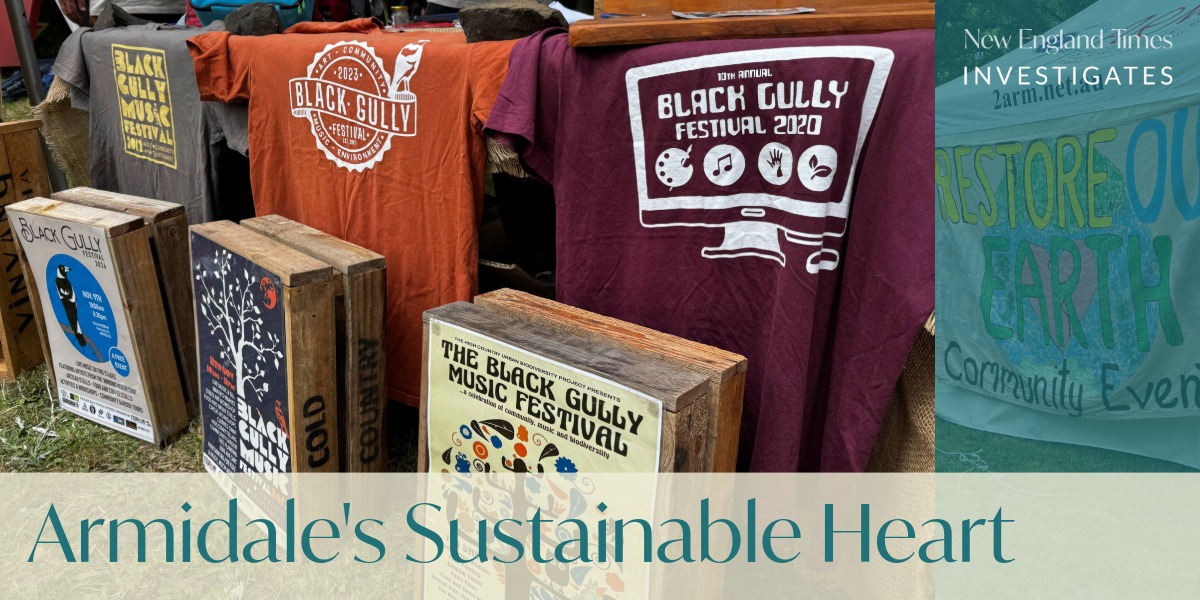
Each year, the Black Gully Creek Reserve behind the New England Regional Art Museum fills with music, colour and conversation as the Black Gully Festival returns to Armidale. Free, community-run, and open to all, the festival has become a much-loved local event, demonstrating that sustainability is not just a policy discussion but something that can be experienced, shared, and enjoyed.
“The Black Gully Festival brings together community, culture, and environmental care in a very hands-on way,” said Sustainable Living Armidale representative and Black Gully Festival organising committee member Annette Kilarr.
“It’s all connected through atmospheric art and music, but at its heart are activities that help people see how sustainability fits into their daily lives.”
Set among the trees and walking tracks of Black Gully, the festival brings together families, students, long-term residents, and visitors for a day that blends entertainment with practical learning. Live music and performances create a relaxed atmosphere, while hands-on activities encourage people to think differently about caring for the local environment and reducing everyday waste.
“The Black Gully Festival brings environmental care inside something joyful,” said Kilarr.
“Sustainability becomes real when people can touch it, share it, and take it home.”
The setting itself carries deep history. Black Gully is a biodiversity hotspot that has been restored and nurtured by volunteers for more than 30 years. Fifteen years ago, the High Country Urban Biodiversity (HiCuB) project removed invasive weeds and replanted native species, an achievement that sparked the very first Black Gully Festival. Since then, ongoing maintenance, revegetation, and planning have continued through volunteer effort and partnerships with local ecologists and Landcare groups.
In 2025, the Black Gully Rejuvenation Plan entered its third stage, alongside renewed interest in long-term stewardship. At the festival, around 40 people joined a revitalised Friends of Black Gully Landcare group, laying the groundwork for future planting days, weed management projects and creative ecological restoration.
“A single festival can’t protect an ecosystem on its own,” Kilarr said, “but it can shift attitudes, build networks, and help stewardship become a shared responsibility rather than a one-off celebration.”
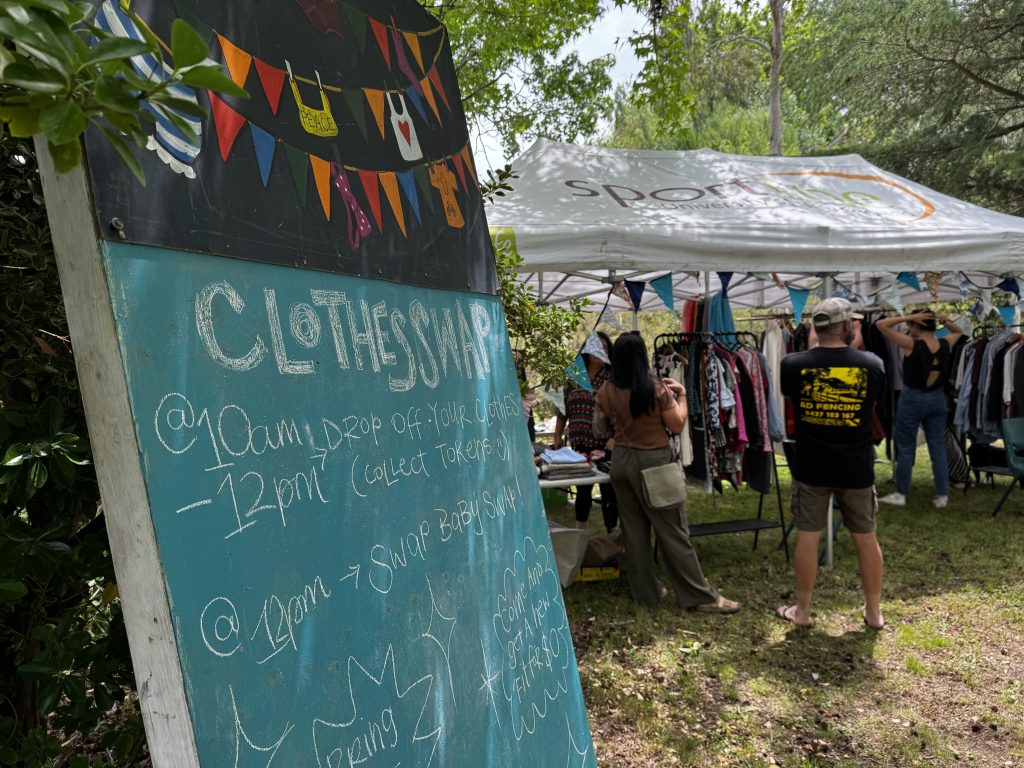
One of the festival’s most popular features is the clothing swap, where attendees browse racks of pre-loved garments and take home something new-to-them at no cost. The swap has become a lively social space, sparking conversations about waste reduction and fast fashion while offering a practical alternative to buying new clothing.
“Rather than buying new clothes, people see that reuse can be fun, accessible, and communal,” Kilarr said.
Community garden tours are another highlight, providing locally relevant advice on composting, seasonal planting, and growing food in Armidale’s often challenging climate. Rather than formal workshops, the sessions encourage open discussion, with participants sharing what has worked, and what hasn’t, in their own gardens.
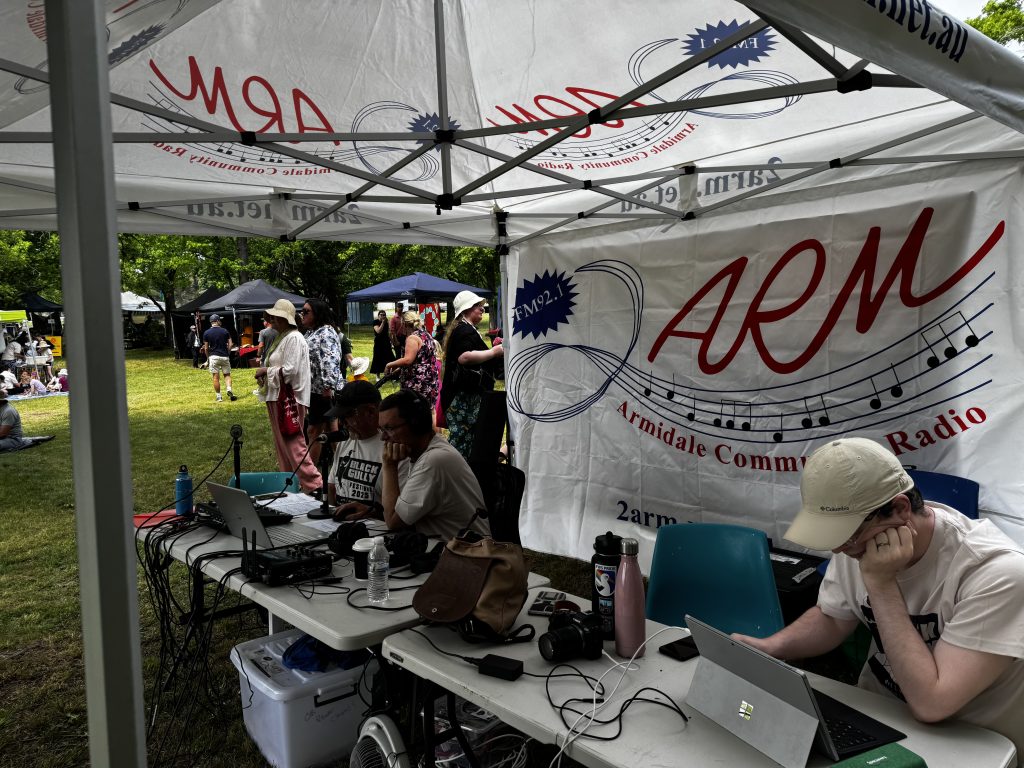
In recent years, local community radio station 2ARM has played an increasing role in the festival. Over the past three years, the event has been live streamed on air and online, allowing a wider audience to tune in and extending the festival’s reach beyond the gully.
Science and play run side by side throughout the day. Creek bug collecting, led by UNE Aquatic Ecology, invites participants to handle and identify aquatic insects, learning how water quality shapes life in Black Gully Creek.
“It tells a story of the High Country New England catchment,” Kilarr explained, “and helps people understand why healthy headwaters matter, whether water flows west or east from here.”
Large catchment maps allow participants to locate where they live, making issues like runoff, pollution, and habitat protection personally relevant.
For Sustainable Living Armidale Convenor and University of New England Senior Lecturer Jennifer Hamilton, the festival reflects the organisation’s broader approach to sustainability, one that recognises complexity and connection rather than single-issue solutions.
“SLA is not a homogeneous organisation tackling one issue at a time, but rather a cluster of different groups with ‘convenors’ who facilitate activities related to each theme. We have energy, climate, wildlife and habitat, food, community gardening, water, transport, rivercare groups.”
“Each group would likely see their issue as the most urgent for a range of reasons, but the rationale for this structure is that the environment is complex and interconnected and so every issue is also linked. This diversity of focus is a real strength of SLA.”
That same collaborative spirit and embrace of diversity underpins other Sustainable Living Armidale initiatives, including the annual Home Grown Garden Tour. Held over a February weekend, the tour invites residents to open their gardens, from small suburban plots to larger rural properties, and share practical ideas for growing food locally.
Hamilton also notes the changing face of the climate change narrative.
“I think over time the debate around how to respond to environmental crisis has changed a lot.”
“I have only been in Armidale since 2018, but that was the year a lot changed up here with the drought unfolding so badly, then the fires; it’s more obvious that the climate is changing,” she said.
“So it’s less about convincing people that climate change is real and more about what to do about it. I think also that progress is not linear.”
“I think we need to get better as a community at valuing the complexity of complex issues … and start to see the connections between environmental crisis, social inclusion, and colonisation. I think biodiversity matters in the environment, and so environmental sustainability also requires social cohesion.”
That question sits at the heart of the Black Gully Festival. Through art, music, shared learning, and simple participation, it presents sustainability not as an abstract ideal but as something tangible – lived, felt, and built together.
“The shift now is clear,” Hamilton said.
“People understand the climate is changing, and the conversation has moved from ‘is this real?’ to ‘what can we actually do, and can we do it together?’”
The Home Grown Garden Tour is on Friday 13, Saturday 14, and Sunday 15 February. Tickets are available via Eventbrite: Armidale Home Grown Garden Tour Tickets, Fri, 13 Feb 2026 at 6:00 pm | Eventbrite
This is part of an investigative series about the sustainable living movement in Armidale. Read the series.
Like what you’re reading? Support New England Times by making a small contribution today and help us keep delivering local news paywall-free. Donate now