

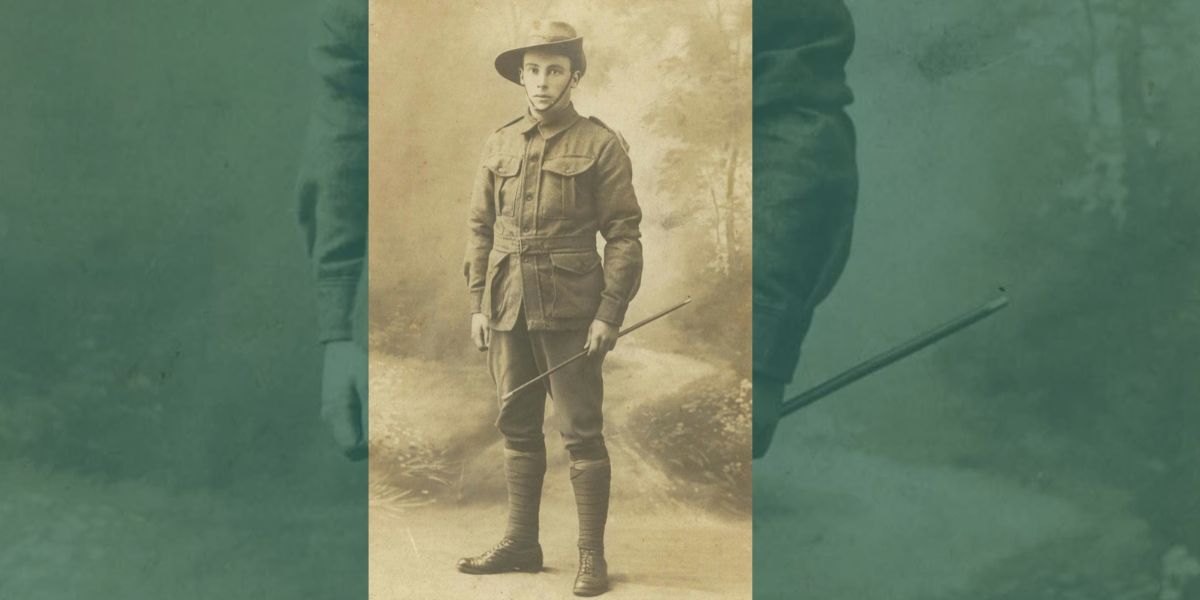
An Armidale soldier killed when a German plane bombed his battalion during a night march in France has been named, more than a century after he was buried as an unknown Australian soldier.
Private Roy Hawkins, service number 4476, of the 3rd Battalion AIF, was 26 when he died at Harbonnières on the night of Friday, 9 August 1918, during the Battle of Amiens.
He is one of 11 Australian First World War soldiers who have now been formally identified, with their names announced on Remembrance Day.
“Today, on Remembrance Day, we honour the service and sacrifice of eleven Australian soldiers of the First World War who, for more than a century, were known only as unknown Australian soldiers,” said Minister for Veterans’ Affairs Matt Keogh.
Private Hawkins enlisted on Monday, 23 August 1915, and served on the Western Front.
He was wounded at Gueudecourt on Monday, 1 January 1917, with shrapnel wounds to his left foot and right thigh. He was treated in hospital in England and went back to his unit in France in October 1917.
On the night he died, the 3rd Battalion was moving from Gailly to Harbonnières. Members of the battalion headquarters had stopped for a rest when a German aircraft dropped bombs that landed among them.
Private Hawkins was one of 33 casualties in the attack. Of the battalion’s dead from that day, he was the only one whose whereabouts could not be accounted for.
Until now, he has been remembered on the Australian National Memorial for the Missing at Villers-Bretonneux.
This year, the Australian Army’s Unrecovered War Casualties – Army (UWC-A) team found evidence linking Private Hawkins to an unknown Australian soldier buried at Heath Cemetery, Harbonnières.
The 11 identifications followed archaeological, historical, and DNA investigations by UWC-A. The team worked with the Office of Australian War Graves, the Commonwealth War Graves Commission, French authorities, independent researchers, and descendants of the soldiers.
“Through the dedication of military historians, archaeologists, researchers, forensic specialists and family members, these soldiers have now been identified and will be commemorated by name for the first time in more than a century,” Keogh said.
“As we pause on Remembrance Day to honour all Australians who have served, we also remember these eleven soldiers who gave their lives during the First World War and whose identities have remained unresolved for more than a century,” said Deputy Prime Minister Richard Marles.
The other soldiers identified came from Ballarat, Lilydale, Melbourne, Bundaberg, Randwick, and Adamstown. They were killed in France and Belgium between 1916 and 1918.
Four of them were members of the 2nd Australian Field Ambulance AIF. They were killed on Saturday, 5 May 1917, during the Second Battle of Bullecourt, when an artillery shell hit a Regimental Aid Post set up in a railway cutting.
UWC-A recovered the four men during a dig at Riencourt-lès-Cagnicourt, France, in April 2025. They came from Preston and Brunswick in Victoria, Fremantle in Western Australia, and Queenstown in Tasmania.
“These men died at Fromelles, the Somme, Bullecourt, Menin Road, Passchendaele, Amiens and during the Advance to the Hindenburg Line,” Marles said.
“They served in infantry battalions, machine-gun units and field ambulance formations, and each made the ultimate sacrifice in service to Australia.”
For many families, the news ends decades of not knowing.
“The identification of these soldiers who were killed in action across France and Belgium will provide long awaited answers for families who have experienced generations of uncertainty,” Keogh said.
“Our commitment to this ongoing work is the ultimate expression of the timeless adage – ‘Lest we forget’.”
Don’t miss any of the important stories from around the region. Subscribe to our email list.