

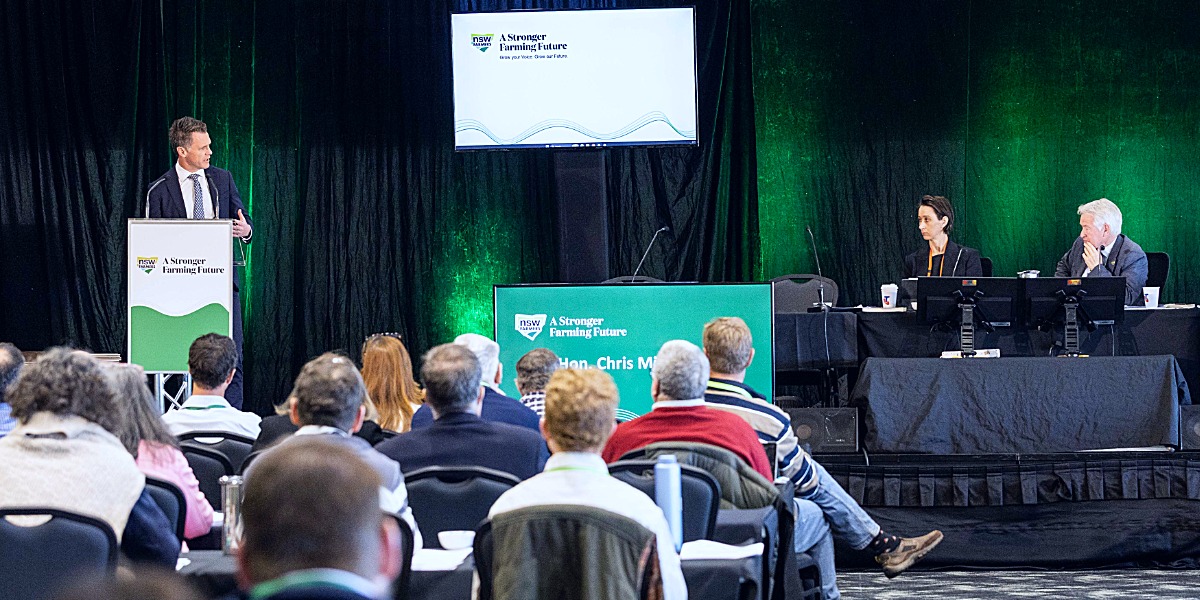
NSW Premier Chris Minns and Energy Minister Penny Sharpe have used the NSW Farmers conference to outline the government’s response to fuel security, regional crime, renewable energy and native vegetation regulation.
Addressing delegates at Rosehill, Mr Minns said recent pressure on fuel supplies had shown the importance of cooperation between farming communities, regional mayors and government.
“It’s been good messages from New South Wales farmers, as well as responsible business and civic leadership from many people in this room,” he said.
Mr Minns said the expected fuel supply crunch had not eventuated, despite pressure on petroleum and diesel supplies following conflict in the Middle East.
“We can manage it here in Australia while minimizing the disruptions to the marketplace and ensuring production continues,” he said.
But he warned the state and Commonwealth governments needed to build greater resilience in fuel supplies.
“There’s got to be a big resilience piece both from the New South Wales government and the Commonwealth government about fuel supplies here in Australia,” he said.
Mr Minns said NSW agriculture had produced $25 billion in recent years and described the sector as a “bedrock and hugely important industry” for the state and the nation.
He highlighted government spending on biosecurity, feral pest management, sustainable agriculture, Landcare, farm business resilience and the agricultural commissioner.
“We need to protect agriculture as an important part, an intrinsic part of our economy, but it’s also a growing part of our export base,” Mr Minns said.
The Premier also pointed to regional youth crime figures, saying youth crime across regional NSW had fallen 12 per cent in the past 18 months. In Moree, youth break and enter was down 18 per cent over two years and youth vehicle crime had fallen 37 per cent, he said.
“I’m certainly not coming here declaring that all of the problems when it comes to crime in regional communities are solved,” Mr Minns said.
“I am suggesting to you that the combination of investment, recruitment of new police officers, and changes to the law are starting to have a real impact.”
Ms Sharpe said the conference came at a difficult time for farmers, citing fuel disruption, dry periods, environmental law reform, the energy transition, bird flu, varroa mite, ants, cattle ticks and weeds.
“We can’t deal with these issues alone, and we must work together,” she said.
The minister said NSW imported about 80 per cent of its refined fuel and that the disruption of the Strait of Hormuz had quickly affected farms, trucks and freight.
“The energy transition gives us a unique opportunity to get Australian farms powered by Australian energy energy made here, not reliant solely on the Middle East,” she said.
Ms Sharpe highlighted a hydrogen and ammonia plant near Moree and the Griffith Biohub, while saying renewable energy zones would bring investment to regional NSW.
However, she acknowledged the concerns held by landholders affected by transmission infrastructure.
“There are opportunity and there are costs,” she said.
“If we are to avoid blackouts and price spikes in the future, we must deliver the plan, and we must ensure that there is support for impacted landholders and a long-term legacy for their communities.”
Ms Sharpe announced $14 million in co-funding to improve mobile coverage and internet access across the Central West Orana Renewable Energy Zone.
The minister also addressed native vegetation regulation maps, saying they would be published for rural NSW, while transitional arrangements would continue in Bland and Temora as issues around Mallee Broombush were considered.
“The work to refine the map has to continue. It is not set in stone, and it can be corrected over time,” she said.
Farmers who raised concerns over inaccurate maps, roads, transmission projects and forestry were told their views would continue to be considered.
“Put simply, we can’t protect this state’s environment without the people in this room,” Ms Sharpe said.
Got something you want to say about this story? Have your say on our opinion and comment hub, New England Times Engage