

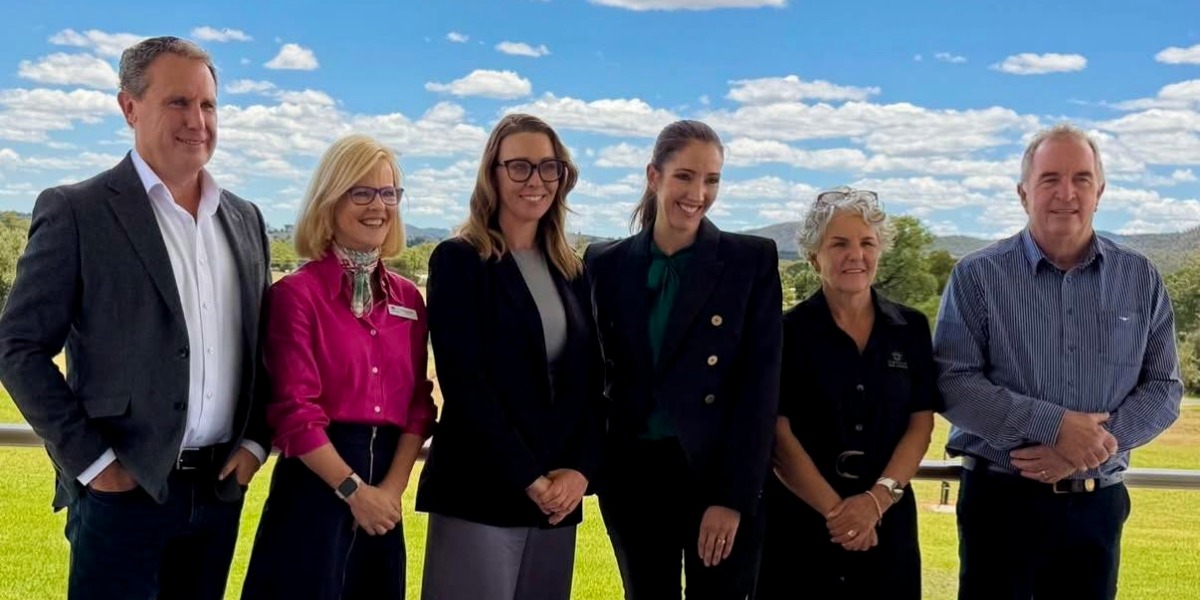
Councils across the Northern Tablelands are reshaping how they work together, announcing a new regional water security agreement between Armidale, Uralla and Walcha councils while also moving to establish a broader Northern Tablelands Regional Organisation of Councils.
The twin developments mark a significant reset in regional collaboration, following the quiet demise of the New England Joint Organisation, which was established in 2018 with considerable fanfare but has been in hiatus since early 2023.
NEJO to be replaced by NTROC
At a regional collaboration forum held in Bingara on 16 February, mayors and general managers from across the electorate agreed in principle to form the Northern Tablelands Regional Organisation of Councils, or NTROC. Representatives from Uralla were absent due to the event coinciding with the funeral of councillor Lone Peters, but have been included in the agreement.
The move follows correspondence from Local Government Minister Ron Hoenig acknowledging that the existing Joint Organisation model “is not delivering for all councils” and offering a more flexible pathway for regional collaboration. The defunct New England Joint Organisation will be formally wound up as part of the move.
In a meeting described as “highly productive” by a number of attendees, it was widely agreed that the region needs to unite to fight for what it needs.
Moree Plains Shire Mayor Susannah Pearse said she was really looking forward to working with other councils on shared problems.
“The challenges that our residents speak to us about – health, roads, water security, mobile connectivity, just to name a few – are often shared across the region.
Working together and acting as a united group in these instances can make our voice stronger when working with state and federal governments decision makers, and in turn, deliver better for our residents,” she said.
Glen Innes Severn Mayor Margot Davis said she was also looking forward to the collaboration and that the new body would not have the same overheads as the previous joint organisation.
“This is a bipartisan, mayoral-led initiative. It is not a new layer of bureaucracy. It has no secretariat, no additional staffing structure and no cost to ratepayers beyond standard travel expenses.
“It is simply mayors working collectively on common regional priorities.
The Northern Tablelands is interconnected. Our workforce, supply chains, tourism flows and health services don’t stop at council boundaries,” she said.
When we advocate separately, we dilute impact. When we speak together, we increase leverage.””
Inverell Shire Mayor Kate Dight said the proposed model was intended to provide “greater flexibility” and a “valuable platform for joint advocacy and for pursuing projects that deliver mutual benefit across the region” .
The new body will include the six councils of the Northern Tablelands electorate: Armidale Regional Council, Glen Innes Severn Shire Council, Gwydir Shire Council, Inverell Shire Council, Moree Plains Shire Council, Uralla Shire Council and Walcha Shire Council. A draft constitution for the new organisation is being prepared ahead of an inaugural meeting scheduled for 18 May 2026 .
Cooperation raises prospect of amalgamation
While the broader NTROC proposal spans seven councils, Armidale, Uralla and Walcha have also entered into a more targeted coalition to lobby collectively on water security, with each facing a similarly significant challenge in providing the necessary water security for the Renewable Energy Zone.
The new Regional Water Security Working Group will investigate regional responses to present and future water security issues and potential solutions. The move follows a report from EnergyCo last December showing all three councils do not have the water or wastewater capacity to deal with the impact of the REZ developments.
But for at least one councillor, the renewed push for collaboration has also reopened the issue of whether our councils are too small. Armidale Regional councillor Brad Widders told this month’s council meeting that the region may need to consider whether informal cooperation is enough.
“If you hear the word amalgamation, I do and you get scared from it, I apologise,” he said when beginning his comments.
Widders argued that individually, the region’s small councils have limited influence with the state government.
“As each individual Council, we don’t have much pull… in getting the state government to change their mind, to do different things differently. Whereas a group, I think gives us more power,” he said.
He suggested the idea of amalgamation had come to mind as he considered how councils might respond to shifting goalposts around the Renewable Energy Zone. Widders said the region’s small population base limited its leverage.
“We have a very small population and we need to be as big as possible to make the biggest noise to get stuff done,” he said.
It’s water now. But what is it next week? What is it the month after that, we have to join up with these other two councils and pushing for?”
He pointed to housing affordability, water constraints and schooling capacity as examples of structural pressures that may require a stronger, unified response.
“So we’re not having people who are low income earners are being forced out because they can’t afford housing, the water isn’t being run out because there’s too many people, and we don’t have enough schooling because we’ve only got the one public high school in the area.”
Widders stressed that any move toward amalgamation would ultimately be a community decision, so he believed that the community should start talking about it.
“So it’s something that the community needs to start looking at now, because it’ll be a community decision.”
The comments revive memories of the 2016 forced merger process, when it was recommended that Armidale Dumaresq, Guyra Shire, Uralla Shire and Walcha councils be combined into a New England Regional Council. Uralla and Walcha successfully fought to retain their independence, while Guyra was merged into Armidale Regional Council.
Walcha, with a population of just 3177, has historically been bitterly opposed to merger, having to resist a proposal that it be absorbed into Tamworth, as well as the New England proposal. Uralla residents have also expressed long-standing concern about being merged with Armidale, fearing higher rates and service reductions, as have befallen Guyra since being merged with Armidale.
Walcha and Uralla Shire Council were asked if they have a formal position on amalgamation. Walcha did not reply and Uralla did not answer the question.
Got something you want to say about this story? Have your say on our opinion and comment hub, New England Times Engage