

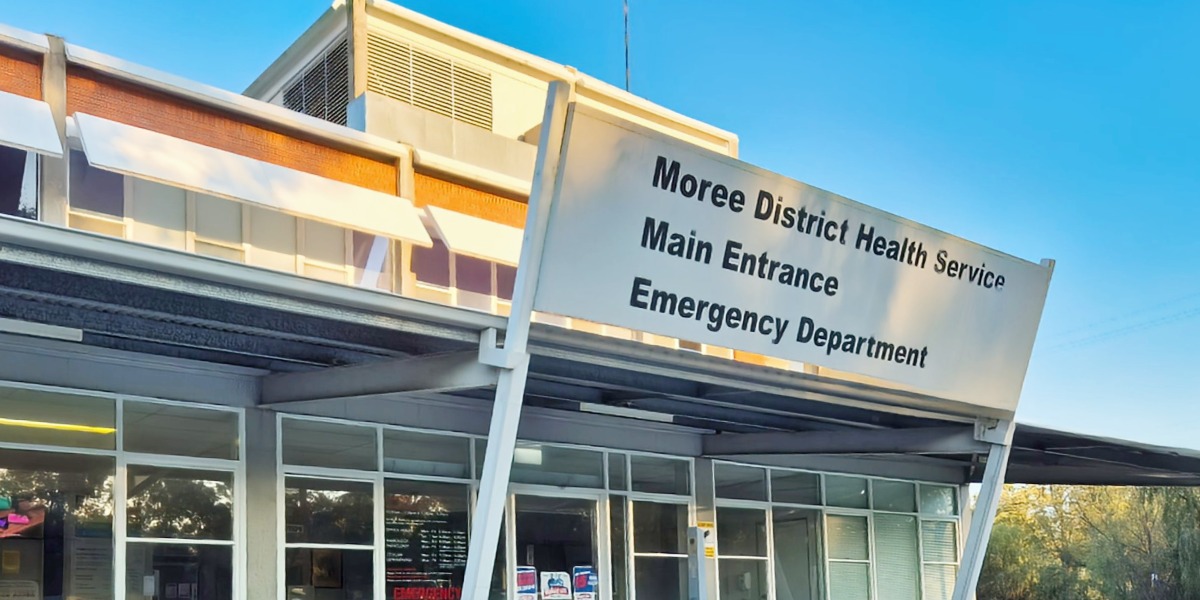
Better stroke care has been promised for Moree Hospital under a new national funding program, but long-running workforce shortages at the hospital may limit how much difference the investment can make on the ground.
Moree Hospital has been selected as one of 15 regional hospitals nationwide to receive a funding boost aimed at improving stroke treatment times and patient outcomes as part of a national trial focused on faster, evidence-based stroke care. The funding of $90,000 from the Australian Stroke Alliance will see a Stroke Coordinator based at the hospital to support local stroke patients.
A spokesperson for the Stroke Foundation said determining a patient’s stroke type and treatment options quickly is crucial and can be particularly challenging outside metropolitan areas. Rural people are 17% more likely to suffer a stroke, with Aboriginal and Torres Straight Islanders’ risk of stroke almost double that of the rest of the population.
“At Moree Hospital, patients with suspected stroke are promptly connected to specialist stroke physicians via video conference as part of the NSW Telestroke Service,” the spokesperson said.
“By using technology, specialists are able to work from another location to provide care in rural and regional hospitals. The team at the local hospital collaborates with the specialist to assess the patient, review the patient’s brain scan, provide time-critical treatment, and make decisions about ongoing care.”
The spokesperson said the new funding would further strengthen collaboration across the region, with a focus on improving staff capability and consistency of care.
“This new funding will further strengthen collaboration and stroke service quality across the region by delivering targeted stroke education including orientation to locums and new staff, as well as tailored education packages and training programs,” the spokesperson said.
“The focus of the education is to provide faster treatment providing better patients outcomes.”
The funding boost is part of the National 30/60/90 Stroke Targets, a united effort from stroke leaders across the country to ensure Australians receive faster, world-class stroke care when every minute matters. The National Stroke Targets are to have all stroke patients receiving a brain scan and treatment in less than 90 minutes from presenting at hospital, with well-established science that disability from a stroke can be significantly minimised if treatment is quick.
Time is even more critical when considering it can take people in the Moree Plains district some time to get to Moree.
Stroke Foundation Chief Executive Officer Dr Lisa Murphy says the role will go a long way to further improve patient outcomes.
“This is an exciting and crucial addition to the Moree District Hospital stroke team, enhancing its capacity to deliver time-critical stroke treatments like clot retrieval procedures and the administration of clot-busting drugs. There is no doubt this will save lives and reduce stroke-related disability.”
However, all of the hoped for improvements in stroke care will come to nothing if the patient has to be transferred to another hospital hours away just to get the brain scan that is essential for diagnosis before treatment can begin.
Unlike many New England hospitals, Moree District Hospital does have a CT scanner, allowing suspected stroke patients to receive a brain scan locally rather than being transferred elsewhere for diagnosis. However, the hospital’s ongoing lack of staff, including limited availability of doctors in the emergency department to administer treatment, and limited radiographers to operate the CT machine, has raised concerns.
Tamworth, Armidale, Inverell, and Narrabri, the only other hospitals in the region with a CT scanner on site, face similar staffing issues amongst a global shortage of radiology staff and a well-documented shortage of doctors in the region.
Member for Northern Tablelands Brendan Moylan welcomed the funding but warned that money alone would not fix the underlying problems, noting that it would be hard to ignore the reality facing patients who arrive at emergency departments without a doctor physically on site.
“This funding boost for Moree District Hospital is welcome news and will hopefully help improve stroke care and outcomes for local patients. Any investment that saves lives and reduces long-term disability is positive,” Mr Moylan said.
“However, funding alone does not address ongoing workforce challenges in regional health. The Federal Government must do far more to train, recruit, and hold on to doctors, while the NSW Government needs to ensure there are physically present doctors in emergency departments at country hospitals like Moree.”
NSW Health sought to quell concerns, claiming the stroke team was fully staffed.
“We assure the community that anyone experiencing stroke symptoms can present to any of our emergency departments,” a spokesperson for Hunter New England Health said.
“Moree Hospital’s stroke team is fully staffed and provides high-quality clinical care for people with suspected stroke from Moree and surrounding communities.
“Moree Hospital is directly linked to the John Hunter Hospital Comprehensive Stroke Centre and Tamworth Hospital’s Acute Stroke Unit, providing faster escalation pathways to transfer or coordinate the right care at the right time.”
The National Stroke Targets also have a goal of over 90% of diagnosed stroke patients being cared for in a certified stroke unit. Currently, Armidale and Tamworth are the only centres in the New England listed by Stroke Australia as having stroke units.
Got something you want to say about this story? Have your say on our opinion and comment hub, New England Times Engage